

Startup founders can’t compromise on hiring great talent. With such a small and growing team, you need the best of the best people to move your company forward. It may be tempting to rely on your gut instinct when assessing candidates aka the “I’ll know the right person when I see them,” approach, but it’s better to have a structured evaluation process in place. Gut-feel hiring can lead to inconsistent hiring practices, unconscious bias and potentially bad hires. That’s where a hiring rubric comes in. A hiring rubric provides a clear and consistent framework for picking great candidates. In this guide, we’ll help you build the ideal hiring rubric for startups, so you can focus on creating a top-tier team. Let’s get started.
TLDR:
-
Gut-feel hiring leads to inconsistent decisions; a rubric replaces it with scored criteria set before interviews begin.
-
Build your rubric around 5-7 competencies, each with three defined performance levels: exceeds, meets, and needs improvement.
-
Structured interviews are among the strongest predictors of job performance across selection methods.
-
A rubric speeds up go/no-go decisions and gives every interviewer a shared definition of what a qualified candidate looks like.
-
Some tools pair a free ATS with on-demand recruiting support at rates starting around $75/hour, giving your rubric a larger pool to work through.
What Is a Hiring Rubric?
A hiring rubric is a structured evaluation tool that defines the key competencies, expectations and characteristics required for a role. It can outline skills, behaviors and values that make a great candidate. In short, it provides a clear roadmap and criteria for everyone involved in the hiring process to use. This helps reduce subjectivity, guesswork and inconsistencies when hiring candidates.
Why Do Founders Need One?
For startup founders, time is a resource you can’t afford to waste. Without a structured hiring process and hiring criteria in place, you can spend needless hours, days, or even weeks deliberating on hiring decisions. Even worse, you might make the wrong hire and have to go through the entire process again. A hiring rubric speeds up the hiring process, improves the quality of hires, and keeps everyone on the same page. If your pipeline itself is thin, see this guide on building a startup hiring pipeline before applying a rubric.
Beyond speed, rubrics also make a fairer process for potential candidates. Top talent prefers a fair and expedient hiring process. With a rubric in place, you can garner a reputation for having a good hiring process, which can help you attract better applicants. It’s a win-win for everyone.
The data from 2026 backs this up. Time-to-hire trends in 2026 show that 60% of organizations saw time-to-hire increase in 2025, and only 1 in 9 companies succeeded in reducing it.
What Are the Benefits?
A well-designed hiring rubric has several benefits that can improve your hiring process. Here are the top five:
| Benefit | What it does | Why it matters for startups |
|---|---|---|
| Defines “good” upfront | Forces you to spell out the skills and attributes a strong candidate needs before the first interview | Prevents gut-feel decisions from creeping in after you have already spent time on a candidate |
| Reduces bias | Sets objective criteria in advance so decisions rest on competencies, not appearance or background | Keeps qualified candidates in the running who might not make a strong first impression |
| Improves team alignment | Gives every interviewer the same scoring framework so feedback is comparable | Cuts the post-interview debate that stalls small teams with no dedicated recruiting function |
| Speeds up decision-making | Produces a clear pass/fail signal against predetermined criteria instead of open-ended discussion | Faster go/no-go calls mean less time in deliberation and more time moving top candidates forward |
| Provides actionable feedback | Turns evaluation scores into specific, written observations a candidate can act on | Builds your employer reputation as a fair, transparent company, a real advantage in competitive talent markets |
1. Defines “Good” Upfront
Before you post a job or conduct an interview, a hiring rubric forces you to define what success looks like for the role. What skills and attributes does the job require? This creates a clear line between qualified and unqualified candidates. When your entire team understands what a “good” candidate is, you can avoid being swayed by superficial traits or unconscious biases.
2. Reduces Bias
Hiring rubrics are a powerful tool for mitigating unconscious bias. Setting criteria in advance helps you avoid making decisions based on irrelevant factors or solely choosing someone based on “cultural fit.” Things like appearance, background or personal preferences can sometimes influence your decision. A hiring rubric keeps this from happening. You’re also less likely to pass on highly qualified candidates who may not immediately stand out but possess the core competencies necessary to excel in the role. Research backs this up: structured interviews rank as the strongest predictor of job performance across selection methods, outperforming gut-feel conversations by a considerable margin. The U.S. Office of Personnel Management also notes that higher degrees of interview structure show higher validity, rater reliability, and less adverse impact. See their structured interview validity research for detail.
3. Improves Team Alignment
When multiple people are involved in the interview process, it’s easy for everyone to have different opinions on a candidate. A hiring rubric keeps everyone involved in the interview process using the same evaluation criteria. This helps create more consistent and comparable feedback.
4. Speeds Up Decision-Making
Everyone who has been part of a early-stage startup hiring practices team knows the pain of spending hours in lengthy circular debates after interviews are over. No one can agree on who the best candidate is or who should move forward. A rubric can help eliminate this particular bottleneck. You can quickly determine if a candidate meets, exceeds, or falls short of expectations according to your predetermined framework. This leads to go/no-go decisions faster and less frustration trying to come to a consensus.
5. Provides Feedback
Building a strong employer brand is important for growing startups. One way to make candidates happy, even if they don’t get the role, is by providing constructive feedback. A hiring rubric allows you to look at your evaluation and provide specific, actionable feedback on areas where they performed well and areas they need improvement. This helps them in future job searches and reflects well on your company as a fair employer. See the candidate experience best practices guide for more on building that reputation.
How to Build Your Startup’s Hiring Rubric
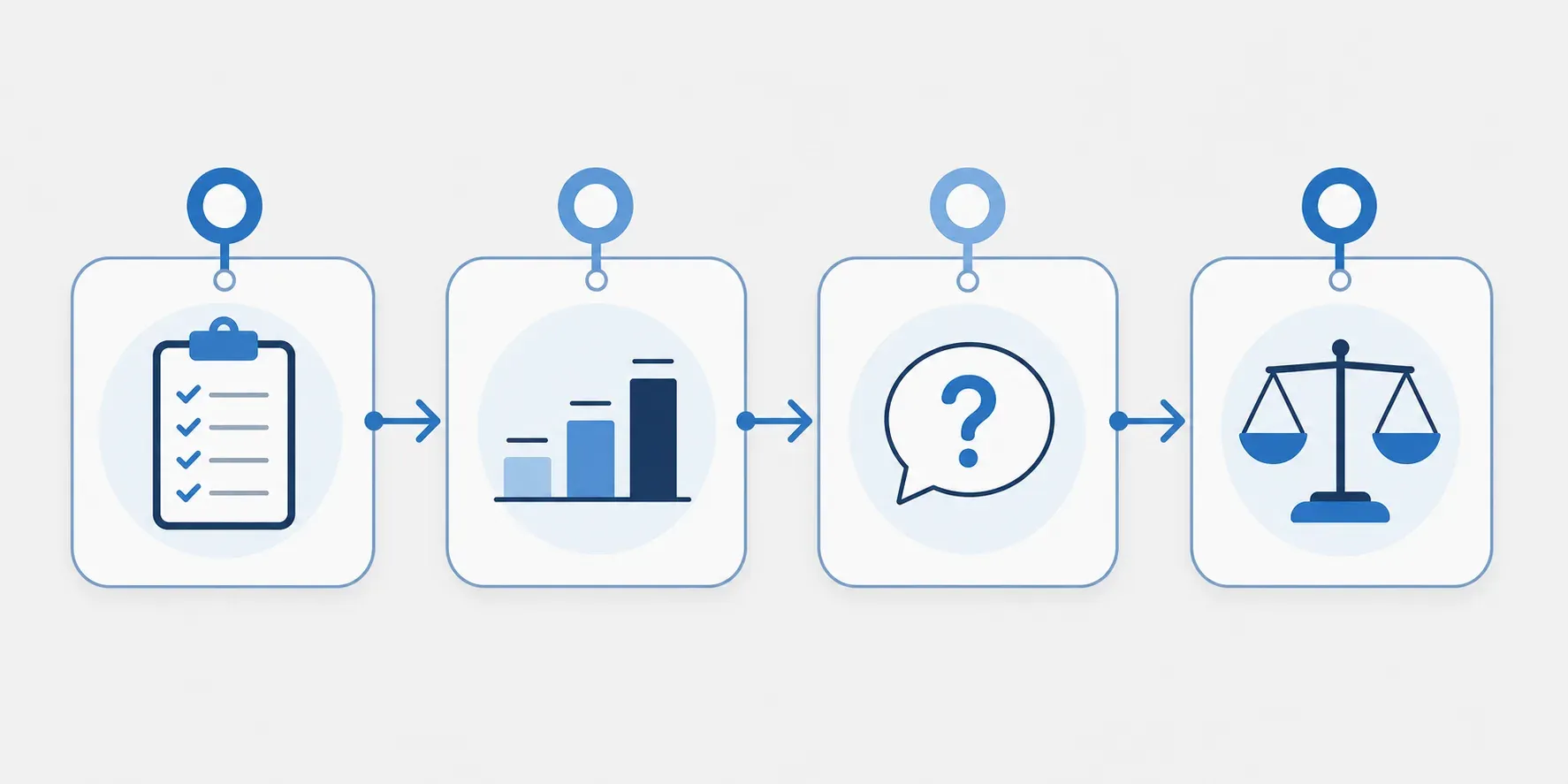
Hiring rubrics are straightforward to build. Here’s how to put one together:
-
List 5-7 Key Competencies for the Role
- Identify the core skills and attributes a candidate needs to succeed: technical skills, soft skills, problem-solving, culture alignment, leadership, and so on. Keeping it to 5-7 prevents the rubric from becoming unwieldy while still giving interviewers a clear picture of what qualified looks like.
-
Define Success Levels for Each Competency
-
For each competency, define three levels:
-
Exceeds expectations: What does top-tier performance look like, and what would a candidate need to elevate the role?
-
Meets expectations: What is the minimum level of competency to move someone forward?
-
Needs improvement: What signals under-qualification, and can this gap be closed on the job?
-
-
-
Create Interview Questions That Assess Each Competency
- Use your rubric to write questions that test each competency directly. This helps you structure your interview process around observable behavior rather than impression.
-
Weight the Competencies Based on Importance
- Not all criteria carry equal weight. For a senior engineering hire, programming fluency matters more than leadership experience. Assign weights so scores reflect what the role actually requires.
Don’t treat the rubric as fixed. Adjust it as you learn what separates strong hires from weak ones.
Key Takeaways
A hiring rubric brings structure, fairness, and consistency to recruiting, helping you assess candidates objectively and reduce the bias that comes from gut-feel decisions. Build your company values into the rubric from the start, because a candidate’s ability to get behind the mission matters as much as their technical skills.
A rubric doesn’t solve sourcing on its own. If your pipeline is thin, a free ATS for startups centralizes inbound applicants and posts jobs across 100+ boards from one place, giving your rubric more candidates to work through. For senior or specialized roles, fractional recruiting agencies can source and screen against the criteria your rubric already defines. The strongest agencies run on a shared ATS layer with vetted recruiter reviews so you can assess fit before anyone starts work.
Put Your Rubric to Work with Dover
A hiring rubric defines what a qualified candidate looks like, but it can only do so much when the pipeline behind it is thin. Dover’s free ATS centralizes inbound applicants, posts roles across 100+ job boards from one place, and gives every interviewer a shared view of candidates and evaluation history. The result: your rubric has more candidates to score, and everyone on the hiring team is working from the same data.
For senior or specialized roles where inbound volume falls short, fractional recruiting agencies built on Dover can source and screen against the criteria your rubric already defines. Dover is the infrastructure layer those agencies run on, which means the rubric, the pipeline, and recruiter activity all stay in one place. Dover also publishes vetted reviews of individual recruiters, so you can assess fit before anyone starts work. Most engagements start around $75 per hour, scaling with role seniority and search complexity, with no long-term contract required.
FAQs
How do you build a hiring rubric for a startup?
Start by listing 5-7 competencies the role genuinely requires, then define three performance levels for each: exceeds expectations, meets expectations, and needs improvement. From there, write interview questions that directly test each competency and assign weight based on how central each skill is to the role. Keeping the rubric to 5-7 criteria prevents it from becoming unwieldy while still giving every interviewer a shared, scoreable definition of a qualified candidate.
What’s the best way to reduce unconscious bias in startup hiring without a dedicated HR team?
A structured rubric with criteria defined before interviews begin is one of the most practical options available to small teams. Research on structured interviews identifies them as among the strongest predictors of job performance, outperforming unstructured gut-feel conversations by a considerable margin. Setting criteria in advance means decisions rest on proven competencies instead of first impressions or superficial fit judgments.
Should I use a hiring rubric alongside a free ATS, or is one enough without the other?
A rubric and an ATS solve different problems, so each has limits without the other. A rubric defines what a qualified candidate looks like; an ATS centralizes inbound applicants, distributes postings across 100+ job boards, and keeps the pipeline organized so the rubric has enough candidates to apply to. For most early-stage teams, both together produce faster decisions and more consistent screening than either does alone.
Final Thoughts on Hiring Rubrics for Startups
A hiring rubric defines what a qualified candidate looks like, but that definition only produces better hires when the right infrastructure and the right people sit behind it. Dover’s free ATS keeps the pipeline organized, posts roles across 100+ job boards from one place, and gives every interviewer a shared view of candidates and evaluation history. For senior or specialized searches where inbound volume alone falls short, fractional recruiting agencies that run on Dover bring active sourcing and screening directly against the criteria the rubric already defines, so the bar you set before interviews begin is the same bar the recruiter works to. The rubric, the pipeline, and recruiter activity staying in one place is the structural advantage worth looking for when the search gets harder.