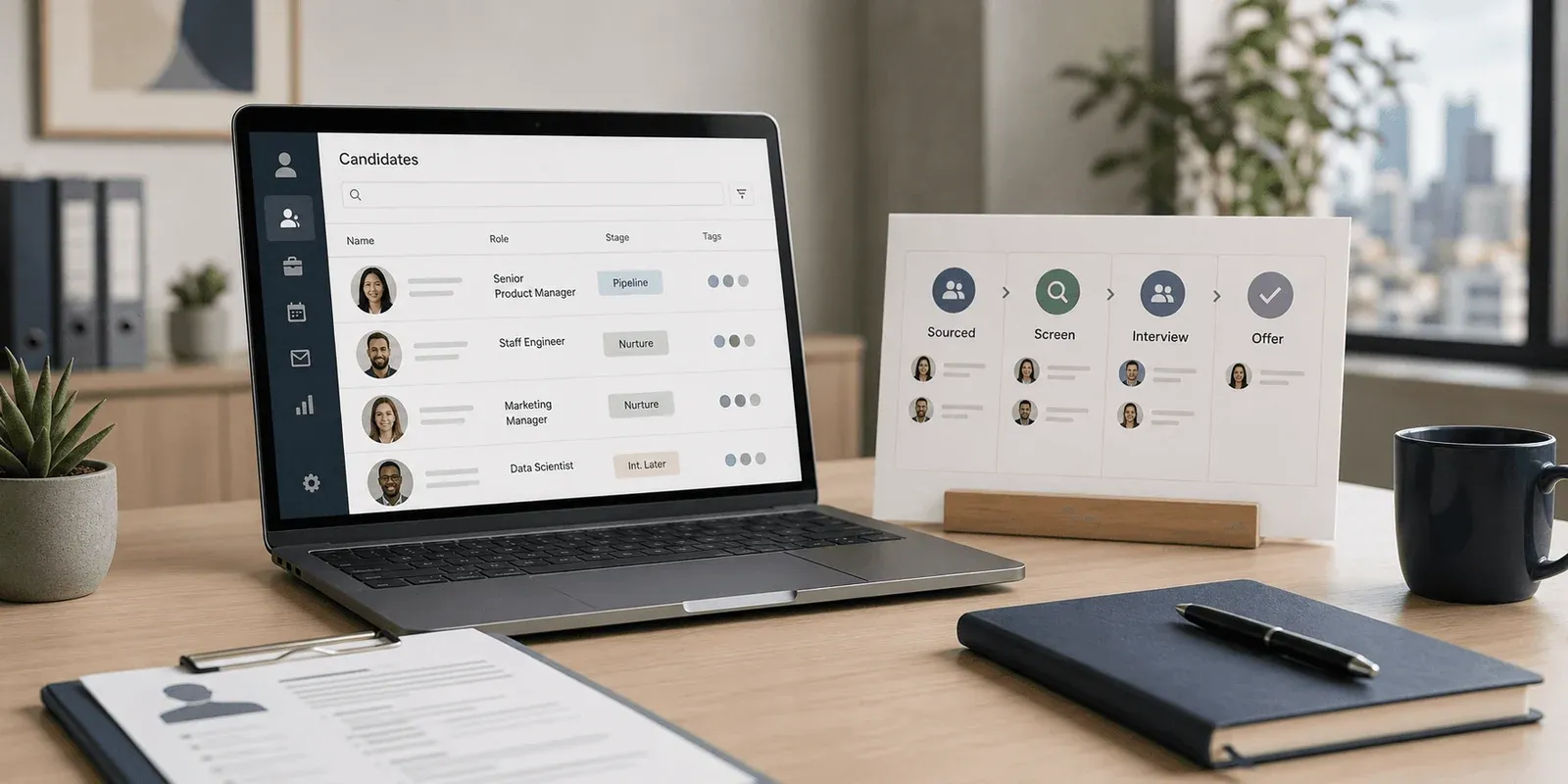

How to build your startup hiring pipeline from scratch is a question every founder faces sooner or later. Tech startups can fail at hiring because they wait until it’s too late. You need a senior engineer now, but your search starts from zero. Months pass. The role stays empty. The fix? Build your hiring pipeline before you need it. A startup hiring pipeline lets you attract and assess talent continuously, so when roles open, you’re ready to move fast. Here’s how to build yours:
TLDR:
-
Executive hires take an average of 6 months to fill, making proactive pipeline building critical.
-
Start with workforce planning 6-12 months ahead and set up a proper recruiting foundation.
-
Use multiple sourcing channels, including referrals, job boards, and professional networks.
-
Put in place structured evaluation processes and nurture long-term candidate relationships.
-
Consider fractional recruiters and a free applicant tracking system when scaling beyond your internal capacity.
Understanding the Current Startup Hiring Scene
Hiring for startups in 2026 is no joke; the competition is high. Executive hires take six months to fill on average, with early-stage companies facing challenges around:
-
Compensation expectations and budget constraints
-
Talent shortage vs the competition for skilled candidates
-
Remote work expanded the talent pool, but also increased competition

The traditional approach of posting a job when you need someone doesn’t work anymore. By the time you realize you need a new hire, write the job description, and start interviewing, you’re already months behind. A proactive pipeline fixes that by keeping qualified candidates warm before a role even opens.
What a Startup Hiring Pipeline Is and Why You Need One
A hiring pipeline is an organized approach to identify, attract, and nurture potential candidates before you have open positions. Think of it as building relationships with talent you might want to hire in the future, rather than scrambling to find people when you desperately need them.
A strong hiring pipeline framework can reduce your time-to-hire. Instead of starting from zero when a position opens, you already have qualified candidates who know your company, understand your mission, and are interested in joining your team.
Here’s the reality that most startups face: average time-to-fill statistics put the typical hiring cycle at around 44 days, with many companies taking well over a month to close an urgent opening.
Dover’s free ATS, designed for startups, serves as the foundational tool for pipeline management. It centralizes all your candidate data, tracks interactions over time, and helps you keep relationships with potential hires even when you don’t have immediate openings.
Now, let’s help you build a hiring pipeline to suit your startup needs.
Step 1: Define Your Hiring Strategy and Future Needs
Building a successful hiring pipeline starts with understanding what roles you’ll need 6-12 months from now, based on your growth path and goals.
Start by mapping out your expected growth phases:
-
If you’re planning to raise a Series A in 3 months, what roles will you need to fill with that funding?
-
If you’re launching a new product, what skills will your team need that you don’t currently have?
-
What kind of recruiting approach fulfills your hiring needs?
Consider both technical and non-technical roles in your planning. Many startups focus on engineering hires, but forget about the sales, marketing, and operations roles that become just as important as you scale. A balanced approach to pipeline building makes sure you’re prepared for all types of hiring needs.
Create a simple roadmap that outlines:
-
Roles you’ll definitely need in the next 6 months
-
Roles you’ll likely need in the next 6-12 months
-
Skills that will become important as you scale
-
Leadership positions you’ll need to fill as you grow
Dover’s platform helps startups organize and plan their strategy with clear pipeline stages. Creating hiring rubrics for each anticipated role gives you consistency in your process and helps you find the right candidates.
Step 2: Set Up Your Recruiting Infrastructure
Your recruiting foundation makes pipeline management possible. A strong applicant tracking system centralizes candidate data, automates communication, and tracks key metrics across every open role. A free ATS built for startups gives you that foundation without the setup overhead of enterprise tools.
| Infrastructure Component | Why It Matters | Dover Solution |
|---|---|---|
| Centralized candidate database | Track interactions over time | Free ATS with unlimited storage (no hidden costs or feature limitations) |
| Automated communication | Maintain regular touchpoints | Built-in email templates and scheduling |
| Pipeline stage tracking | Monitor candidate progression | Customizable pipeline stages |
| Team collaboration | Keep everyone aligned | Shared candidate profiles and notes |
| Integrated sourcing tools | Reach more candidates faster | Free sourcing tool (post on 100+ job boards, capture emails, and ATS sync) |
Best practices suggest keeping your pipeline to 12 stages or less. Consistent processes will help keep your hiring team on track. Dover’s platform follows this structure while remaining flexible.
As hiring volume grows, the ATS also becomes the foundation that fractional recruiting agencies operate on. Sourcing notes, candidate history, and outreach activity accumulate in the same shared system, so any recruiting support you bring in builds on existing pipeline intelligence instead of starting from zero.
Step 3: Build Your Candidate Sourcing Strategy
Successful candidate sourcing for startups calls for a multi-channel approach. You can’t rely on job postings alone; the best candidates are often passive and need to be actively recruited.
Employee referral research shows that most startup hires come from friends, friends of friends, or ex-colleagues. This makes sense, good people know good people. Personal recommendations carry major weight in hiring choices.
Here’s a complete sourcing strategy that works for startups:
-
Employee referrals: Your current team’s network
-
Professional networking: Industry events, conferences, and meetups
-
Social media: LinkedIn, Twitter, and industry-specific platforms
-
Job board posting: Cast a wide net with strategic job postings
-
Direct outreach: Identifying and reaching out to passive candidates
-
University partnerships: Building relationships with relevant academic programs
A good sourcing toolkit ties these channels together. The free Chrome extension for LinkedIn finds candidate emails and sends personalized outreach in seconds, one-click job board distribution reaches 100+ boards at once, and a built-in referral system lets you request and track referrals from your team or investors with no setup required.
Step 4: Create Compelling Job Descriptions and Employer Branding
Your employer brand is what attracts candidates to your pipeline in the first place, yet only 28% of HR professionals have a comprehensive employer branding strategy. Job descriptions are often the first candidate touchpoint, so they need to be compelling, clear, and authentic.
Startup job descriptions should include:
-
Clear role expectations and growth opportunities
-
Specific technical requirements and nice-to-haves
-
Company mission and values alignment
-
Compensation range and equity information
Dover’s job posting features help startups create professional, convincing job descriptions that reach the right candidates. We have templates and best practices designed for startup hiring needs. Read more about writing clear and compelling job descriptions to attract passive candidates.
Step 5: Implement a Candidate Screening and Evaluation Process
Use consistent criteria across every interview so you’re making fair comparisons, whether you’re assessing technical skills, cultural fit, or the same role months apart. Assess both technical skills and cultural fit, and use consistent criteria across every interview so you’re making fair comparisons, especially when interviewing for the same role months apart.
Your evaluation process should include multiple touchpoints:
-
Initial resume screening (automated where possible)
-
Phone or video screening call
-
Technical assessment or work sample
-
Team interviews with multiple stakeholders
-
Final interview with decision makers
-
Reference checks for final candidates
Dover’s AI-powered candidate scoring ranks applicants based on custom criteria you define, saving time in the early screening phase.
Step 6: Nurture Long-term Candidate Relationships
Many great candidates aren’t available when you first meet them, but situations change. The candidate who wasn’t interested six months ago might be ready now, which is why staying in touch keeps you top-of-mind when they are.
Dover’s platform lets you manage candidate relationships through automated communication, interaction tracking, and organized notes on each person’s interests and availability.
Dover can improve your candidate experience through smooth communication, clear process expectations, and professional follow-up. The candidates you don’t hire can become valuable referral sources or future applicants if they have a positive experience with your process. People appreciate transparency and responsiveness, even when the answer is no.
When to Scale: Using Fractional Recruiters for Pipeline Growth
An ATS handles the structural work well: tracking candidates, organizing pipeline stages, sending communications, and keeping your team aligned. What it can’t do is source candidates, build relationships in specialized talent communities, or free up founder hours spent on calls. When hiring volume picks up, roles get senior or specialized, or your team can’t run full-cycle searches, a fractional recruiter fills that gap as a capacity layer on top of your existing infrastructure.
Dover is the infrastructure layer fractional recruiting agencies are built on, connecting startups with recruiting professionals who carry vetted reviews so you can assess fit before engaging. Fractional recruiters can help with:
-
Pipeline development and candidate sourcing
-
Initial screening and qualification calls
-
Specialized recruiting for hard-to-fill roles
-
Recruiting process optimization and training
-
Temporary capacity during high-volume hiring periods
The flexibility to scale recruiting capacity up or down means no long-term commitments that don’t match your hiring reality.
How Dover Helps You Build and Scale Your Hiring Pipeline
Dover is built for exactly the scenario this post describes: a startup that needs to hire without a full-time recruiting team. The free ATS gives you the foundational infrastructure from day one. You get a branded careers page, one-click distribution to 100+ job boards, a native referral tracking system, and a shared candidate database that every search builds on. Setup takes under five minutes, and there are no seat limits or hidden costs on the free tier.
When hiring volume picks up or roles get senior and specialized, Dover’s recruiter network functions as the infrastructure layer fractional recruiting runs on, connecting you with independent recruiters who work directly inside your existing ATS rather than a separate agency system. Every recruiter in the network carries vetted reviews, so you can compare track records and make an informed choice before engaging anyone. Recruiters work at rates starting around $75 per hour, averaging $2,000 to $7,000 per hire, with no long-term contracts. Actual cost varies with the recruiter’s hourly rate and the type of role. The pipeline stays visible to everyone, sourcing notes accumulate over time, and each new search starts from a stronger foundation than the last.
FAQs
Do I need a recruiter if I’m already using an ATS?
Not always. An ATS handles pipeline organization, candidate tracking, and job board distribution, which is enough for straightforward hires when your team has capacity. Where it falls short is proactive sourcing and the hours spent on outreach and screening calls. A fractional recruiter fills that gap, sourcing candidates your team wouldn’t otherwise reach and taking coordination off your founders and hiring managers. The two work best together when roles are senior or specialized, hiring picks up after a funding round, or your team simply can’t run full searches on top of their day jobs.
What’s the ideal size for a startup hiring pipeline?
Try to keep 3-5 qualified candidates per role you’re planning to fill in your pipeline. For example, if you’re a startup looking to hire 10 people over the next year, you’ll want to stay connected with about 30-50 potential candidates across all the different roles and experience levels you’re targeting.
How often should I communicate with pipeline candidates?
Touch base with your top pipeline candidates every 4-6 weeks with relevant content or updates. This keeps relationships warm without being overwhelming. Less promising candidates can be contacted quarterly or when relevant opportunities come up.
Final Thoughts on How to Build Your Startup Hiring Pipeline from Scratch
How to build your startup hiring pipeline from scratch is more than a checklist; it is a mindset shift. Getting hiring right comes down to building the infrastructure before you need it: defining future roles early, keeping candidate data organized, sourcing across multiple channels, and staying in touch with promising people. The right setup depends on your hiring volume, team capacity, and role complexity. Some startups go far with a free ATS and a disciplined process; others find certain roles or growth phases call for a fractional recruiter alongside the team. Dover is one place to start: a free ATS that serves as the infrastructure layer fractional recruiting agencies are built on, with vetted recruiter reviews so each new search builds on what came before.