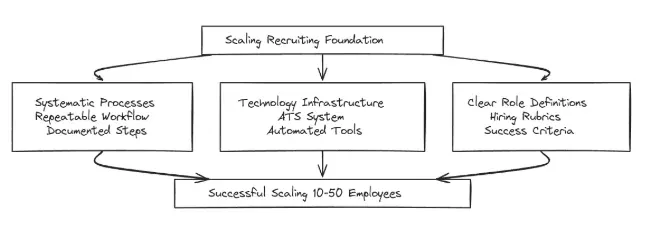

Building a recruiting tech stack for startups is one of those decisions that feels optional until it isn’t. Most early-stage teams rely on Gmail and spreadsheets until missed candidates, slow screening, and a costly mishire make the cost of inaction obvious. Once you’re scaling, the right stack stops being overhead and starts being the infrastructure that determines whether you hire ahead of growth or scramble to catch up. This guide covers the core components, how to layer them in order, and when adding fractional recruiting support makes more sense than going further solo.
TLDR:
-
Modern recruiting tech stacks can reduce time-to-hire and cut costs, which matters for fast-moving startups.
-
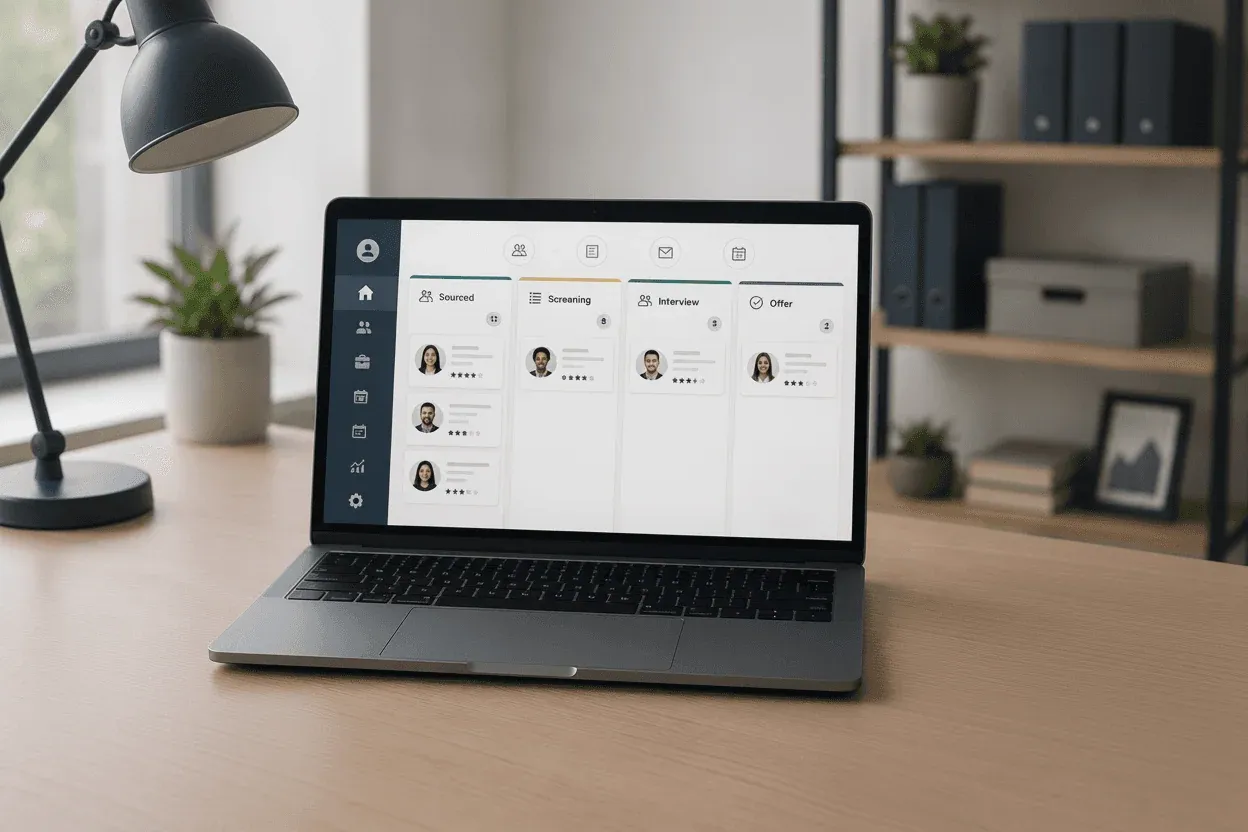
A solid Applicant Tracking System centralizes candidate data, automates workflows, and scales with your team.
-
Combine LinkedIn outreach, referrals, and automation to reach passive candidates.
-
Use AI-powered tools to handle resume filtering, interview scheduling, and follow-ups, saving hours weekly.
-
Some tools pair a free ATS with on-demand fractional recruiting support, averaging $2,000 to $7,000 per hire with no retainer required, giving startups a middle path between DIY software and traditional agency fees.
Why Your Startup Needs a Recruiting Tech Stack
Most startups still rely on the old methods: post a job, hope for the best, and manually sort through resumes. This approach falls apart as you scale, and the cost of getting it wrong compounds fast. Some estimates put the cost of a bad hire at roughly 30% of that person’s annual salary.
Companies using recruitment automation tools have seen meaningful reductions in time-to-hire and recruitment costs. Modern recruiting tech stacks can be affordable when you start with free tools that scale with your growth. You just need to know which components matter most.
Core Components Every Startup Needs
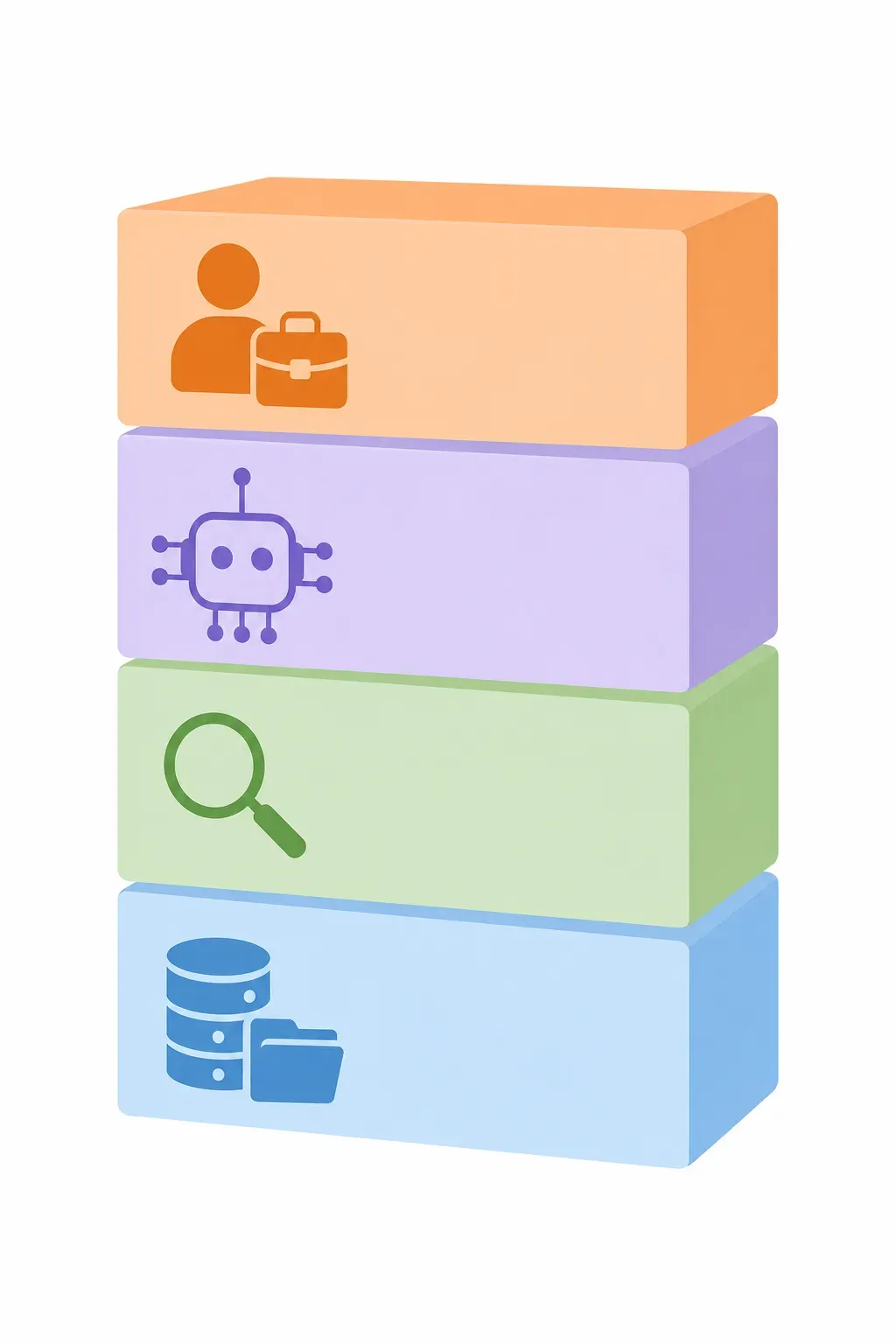
Your recruiting tech stack should solve four problems: tracking candidates, finding talent, screening at speed, and maintaining consistent communication. A startup ATS is the foundation, serving as the central hub where all candidate data lives from initial application through final offer. Layer in sourcing tools to reach passive candidates, screening tools to automate resume review and interview scheduling, and communication tools to keep candidates engaged. Focus on tools that integrate well so data flows from sourcing through hiring without manual entry or duplicate systems.
| Tool Category | What It Does | When You Need It | Cost Range |
|---|---|---|---|
| ATS | Tracks candidates, distributes job posts, automates workflows | Day 1: before your first hire | Free to $200+/month |
| Sourcing Tools | Finds passive candidates, manages LinkedIn outreach | When job boards alone aren’t filling roles | Free extensions to $500+/month |
| AI Screening | Scores and ranks applicants against your criteria | When inbound volume exceeds 30+ applications per role | Included in some ATS tiers |
| Fractional Recruiting | Full-cycle recruiting support for senior or specialized searches | When sourcing requires more than templates and outreach | from $75/hr; avg. $2K to $7K per hire |
Building Your ATS Foundation
An Application Tracking System (ATS) automates job posting, resume screening, candidate communications, and interview scheduling. 94% of HR professionals said their ATS positively impacted their hiring process, and 86% said it reduced their time-to-hire. Most ATS platforms charge per user or per job posting, which gets expensive fast. Dover’s free ATS offers unlimited users and unlimited job postings at no cost, with candidate tracking, automated job board posting, team collaboration tools, and analytics built in. Setup takes under five minutes, and the system scales as you grow with no per-seat fees.
It’s worth noting that Dover’s ATS is the same system fractional recruiting agencies use to run searches on behalf of their clients. That shared architecture means bringing in outside recruiting support doesn’t require switching tools or handing over pipeline control. All candidate data, outreach history, and sourcing notes stay in your account, not the agency’s.
“It is incredibly easy to get started, it took me 15 minutes to get onboarded, and at the end of it, I was already calibrating whether or not a set of candidates were a good fit based on what I wanted in a hire.” Eric Martin, Head of Sales, Vanta
Expanding Your Reach with Sourcing Tools
Job posts only reach active candidates, but the best talent is often passive. Dover’s free Chrome extension integrates directly with LinkedIn so you can find candidate email contacts and send personalized outreach in two clicks, with prospects tracked automatically in your ATS. Employee referrals consistently produce strong hires, and Dover makes it easy to solicit them from your team, investors, or advisors with zero setup. Whichever channel candidates come from, they should all flow into the same pipeline for a consistent experience.
Using Automation and AI for Screening
Manual resume review breaks down fast once a role gets traction. When a posting draws 50 or more applicants, reading every resume by hand costs hours your team doesn’t have, and the ones buried at the bottom rarely get a fair look. AI-powered screening tools parse resumes and score candidates against your criteria, cutting the time spent on initial review from hours to minutes. The scoring is based on requirements you define, not generic matching, so the ranked list reflects your actual bar for the role.
Beyond resume scoring, automation handles the coordination work that slows every stage down. Interview scheduling removes the back-and-forth of finding mutual availability, and automated messaging keeps candidates informed at each stage without manual drafting. Dover’s AI candidate scoring runs on its premium ATS plan, ranking applicants against custom criteria you set with no API key required. Scheduling, screening, and outreach all run through the same pipeline instead of across disconnected tools.
When to Add Fractional Recruiting Support
Fractional recruiters make sense once your ATS is running smoothly but a role is senior, specialized, or hard to source through job boards alone. The cost case is clear: a full-time in-house recruiter runs $85,000 to $170,000 per year fully loaded, agency fees typically land at 15 to 25% of first-year salary, and fractional support starts around $75 per hour and averages $2,000 to $7,000 per hire with no retainer required. Actual cost varies with the recruiter’s hourly rate and the type of role.
Three signals that fractional support is worth considering: your last two open roles stayed open longer than six weeks, inbound volume is low and job boards alone are not producing qualified candidates, or the role requires domain expertise your team cannot accurately screen for. Any one of these is enough to shift the calculus. All three together usually mean the cost of waiting exceeds the cost of bringing in outside help.
The practical advantage of Dover’s fractional model over a traditional agency is control and transparency. With a contingency agency, you pay a placement fee only on hire, which creates pressure to close quickly and deprioritizes roles that are harder to fill. You also have no way to assess the recruiter’s track record beyond what the agency tells you. Dover’s fractional recruiters carry verified reviews from past clients visible in the marketplace, so you can read real feedback and assess fit before the search begins. Once engaged, the recruiter works on an hourly basis inside your pipeline, so you see the activity, own the candidate data, and can pause or redirect the search without losing what was built. For startups hiring five to fifty roles per year, that combination of verified recruiter quality and pipeline visibility tends to fit better than either a fully outsourced search or going it alone with no recruiting support behind it.
Integration and Data Flow Management
Treating each recruiting tool as a separate system is the most common mistake startups make. Candidate data scatters, data entry gets duplicated, and the candidate experience suffers. Dover combines ATS, sourcing tools, candidate communication, and recruiter marketplace access in one place, so information moves from first contact to final offer without manual hand-offs.
This shared-system architecture matters especially when fractional recruiting support is involved. Fractional recruiters on Dover work inside the same pipeline as your hiring team, so both sides see the same candidates in real time with no duplicate outreach. Sourcing activity, candidate notes, and outreach history stay in your account when the engagement ends, unlike traditional agency relationships where that intelligence belongs to the agency and leaves with them.
What’s Changed in Startup Recruiting in 2026
If you built your hiring process a few years ago, it’s worth revisiting your stack. AI has moved from a nice-to-have to a standard part of how fast-growing teams hire. According to Ashby’s 2026 State of Startup Hiring report, over 60% of startup talent teams now use AI across multiple hiring workflows, reaching 77% at startups with 100-300 employees, and teams that bring in recruiters earlier cut time-to-hire by nearly a third.
A few practical shifts worth acting on now:
-
AI-powered screening is table stakes. If you’re still reading every resume manually, you’re losing hours that compound across every open role.
-
Speed wins offers. Data from 2026 shows that founder-led processes closing within six weeks win twice as often as those that drag past twelve weeks.
-
Passive sourcing matters more than ever. With 79% of job seekers now using AI tools in their own applications, standing out requires personalized outreach, not merely job board posts.
How Dover Helps You Measure Recruiting Success
Knowing which parts of your hiring process are working starts with having the right data in one place. Dover’s built-in analytics dashboard tracks the metrics that matter most: time-to-hire, cost-per-hire, source effectiveness, and offer acceptance rates. Because Dover’s ATS for startups centralizes every candidate interaction, those numbers reflect your full pipeline rather than a partial snapshot pulled from disconnected tools.
Speed and cost are the easiest wins to spot. Most startups running Dover see time-to-hire drop within the first few searches because automated screening, interview scheduling, and candidate communication remove the manual delays that slow every stage down. Cost-per-hire also comes into focus once you can see exactly which sourcing channels are converting. Dover surfaces that breakdown by channel, so budget decisions are based on actual conversion data rather than guesswork. For teams comparing options, the best ATS options for startups shows how Dover’s free tier stacks up against paid alternatives on both features and output.
Quality of hire takes longer to measure, but Dover gives you a head start by keeping sourcing intelligence, recruiter activity, and candidate history inside one shared system. When a fractional recruiting engagement ends, that data stays in your account rather than walking out the door with a third-party vendor. Over time, tracking performance reviews and retention by source becomes straightforward because the hiring record is already there.
FAQs
Should we hire a full-time recruiter or use fractional support?
Fractional recruiting makes sense until you’re consistently hiring 8-10 people per month. It gives you expertise without fixed costs and lets you test different recruiters before making a full-time commitment.
What recruiting platforms do YC startups typically use?
YC startups tend to favor lightweight, founder-friendly tools that keep overhead low. Dover is common in the YC community because it offers a free ATS with unlimited users and job postings, plus a sourcing Chrome extension and direct access to fractional recruiters.
Do I need a recruiter if I’m already using an ATS?
An ATS handles tracking, job distribution, screening, and interview scheduling, but it does not source passive candidates or close competitive offers. The trigger for adding a fractional recruiter is usually role complexity, limited internal bandwidth, or sourcing yield that job boards alone cannot meet.
Final Thoughts on Building a Recruiting Tech Stack for Startups
A recruiting tech stack for startups works best when each layer is added with intention: an ATS for pipeline and job distribution, sourcing tools to reach passive candidates, AI screening to cut manual review time, and fractional recruiting support for senior or specialized searches. Dover brings all of those layers together in one place, offering a free ATS, AI-powered screening, and on-demand fractional recruiters who work inside the same pipeline your team already uses, at an average cost of $2,000 to $7,000 per hire with no retainer required. If your current setup is slowing down hiring, it is worth seeing how a purpose-built stack changes that.