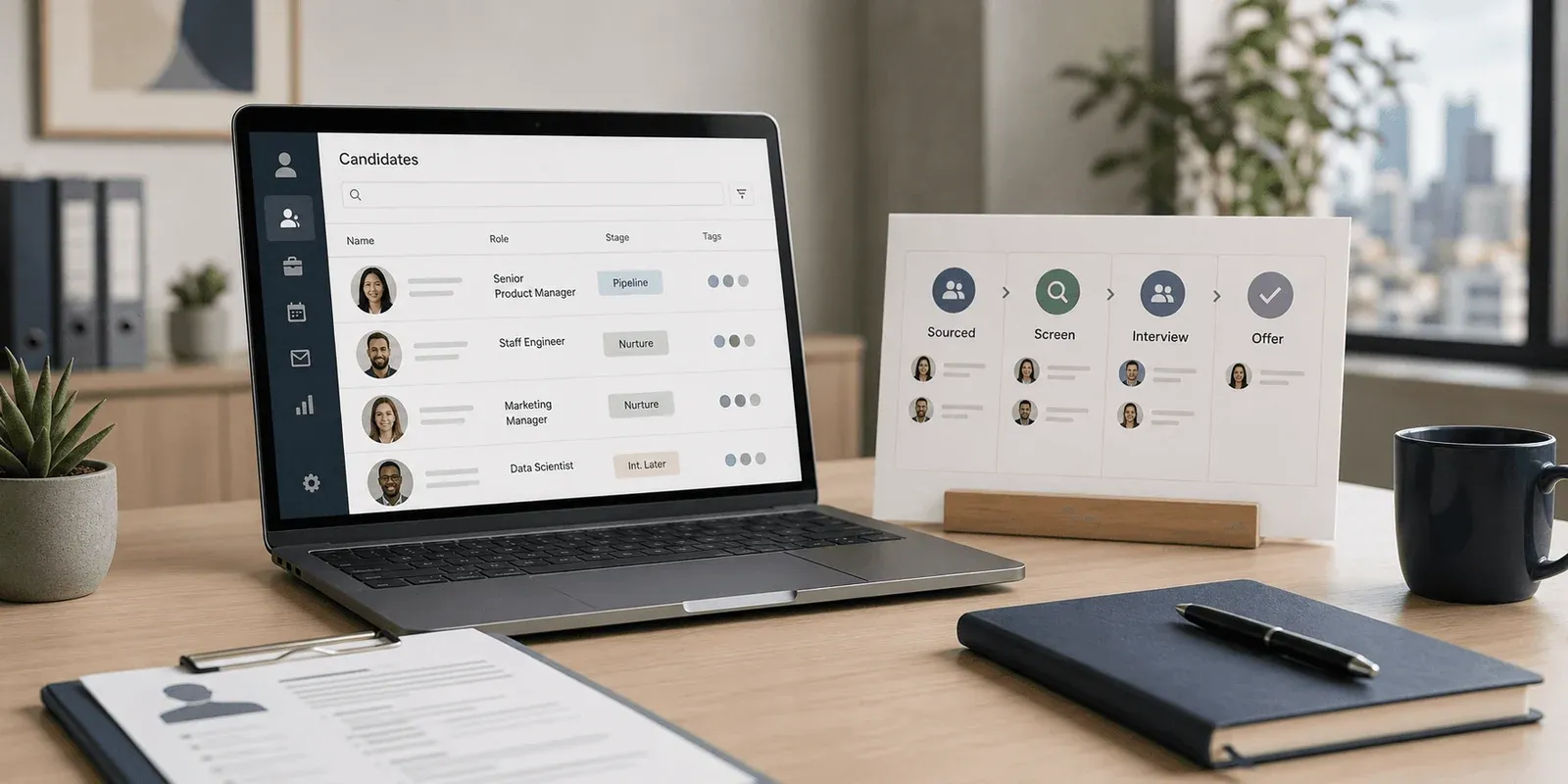

You’re looking at AI recruiting tools because your current process involves too much manual work and not enough qualified candidates reaching your hiring managers. The challenge is that most platforms automate parts of recruiting without connecting sourcing, outreach, and scheduling into one workflow. We tested ten solutions to identify which tools reduce time to hire across the entire funnel and which ones just move bottlenecks around.
TLDR:
-
AI recruiting tools automate sourcing, screening, and scheduling to reduce manual work.
-
Most tools focus on one recruiting slice; none replace experienced recruiter judgment.
-
One solution combines AI sourcing with fractional recruiter support in one workflow.
-
Enterprise tools like Phenom and Beamery require $50,000+ contracts and months to implement.
-
That same solution offers transparent pricing, no contracts, and setup under 10 minutes with a free ATS.
What Are AI Recruiting Tools?
AI recruiting tools are software solutions that use AI to automate stages of the hiring process. Sourcing candidates, screening resumes, scheduling interviews, ranking applicants based on fit: these are the kinds of tasks these tools take off recruiters’ plates. The goal is to cut manual work, speed up time to hire, and surface better candidates through data-driven matching. According to AI recruiting statistics, 64% of organizations using AI in HR apply it especially to recruiting and hiring.
Most tools focus on one slice of recruiting. Some handle sourcing, others screen resumes, and a few specialize in outreach or interview scheduling. No single piece of software replaces the judgment, relationships, and intuition that experienced recruiters bring.
| Tool | Best For | Pricing | Setup Speed | Key Strengths |
|---|---|---|---|---|
| Dover | Startups and growth-stage teams | Transparent; free ATS, hourly recruiter rates | Under 10 minutes | Full-funnel AI plus fractional recruiter support |
| Sapia.ai | High-volume hourly hiring (500+ roles/year) | Not publicly listed | Moderate | Structured chat and voice screening at scale |
| Phenom People | Large enterprise talent management | Starts at $50,000+/year | Months | Career sites, CRM, internal mobility, AI personalization |
| Beamery | Enterprise workforce planning | Not publicly listed | Months | Skills inference, internal mobility, HRIS integration |
| SeekOut | Technical sourcing specialists | Annual contract; prices increase yearly | Moderate | 800M+ profiles, diversity filters, conversational search |
| hireEZ | Mid-size to enterprise sourcing teams | Not publicly listed | Moderate | 800M+ profiles across 45+ platforms, outreach automation |
| Juicebox AI | Sourcers focusing on speed | Not publicly listed | Fast | Plain-language search across LinkedIn, GitHub, and more |
| Paradox (Olivia) | High-volume retail, hospitality, healthcare | Not publicly listed | Moderate | Conversational screening and scheduling at scale |
| CloudTalk | AI voice screening and outbound candidate calls | AI Receptionist from $99/month (200 minutes included); AI Specialist $349/month; telephony seats $25-$49/user/month; 50-minute free trial | Fast | Autonomous AI voice agents, 60+ languages, CRM sync |
| Workable | Small to mid-size teams wanting an all-in-one | From $189/month; 15-day free trial | Fast | 400M+ candidate matches, multi-board posting, mobile apps |
Best Overall AI Recruiting Tools: Dover
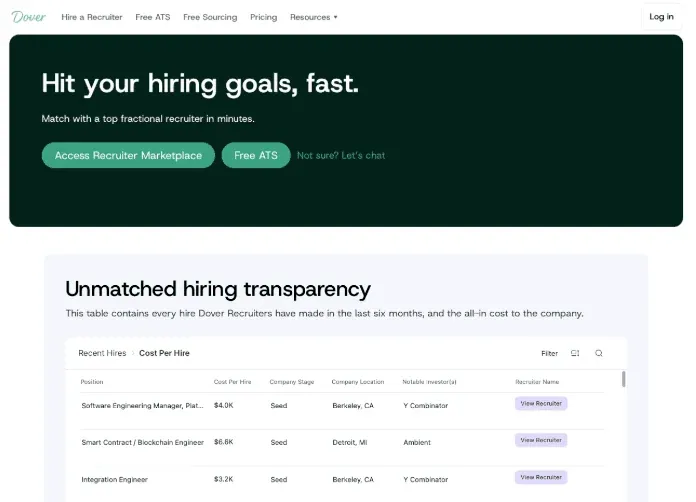
Dover is a full-service AI recruiting solution built for companies that want to move faster without sacrificing quality. It combines AI sourcing, automated outreach, and recruiter support into one workflow, so hiring teams spend less time on manual tasks and more time talking to good candidates.
Dover works across the full recruiting funnel. Sourcing, screening, scheduling, and coordination are handled in one place instead of spread across disconnected tools.
A few things set Dover apart from point solutions that only solve one piece of the recruiting puzzle:
-
AI sourcing pulls from a wide candidate database and surfaces profiles that match your criteria, reducing the time spent manually searching LinkedIn or other job boards.
-
Automated outreach sends personalized messages to candidates and follows up based on engagement, keeping pipelines active without recruiter intervention at every step.
-
Integrated scheduling removes the back-and-forth of booking interviews, syncing directly with calendars so candidates move through the process faster.
-
Fractional recruiter support gives teams access to experienced recruiters when they need human judgment on a role, without committing to a full-time hire.
Dover is a good fit for startups and growing teams that want the output of a full recruiting function at a fraction of the cost of building one in-house.
Sapia.ai
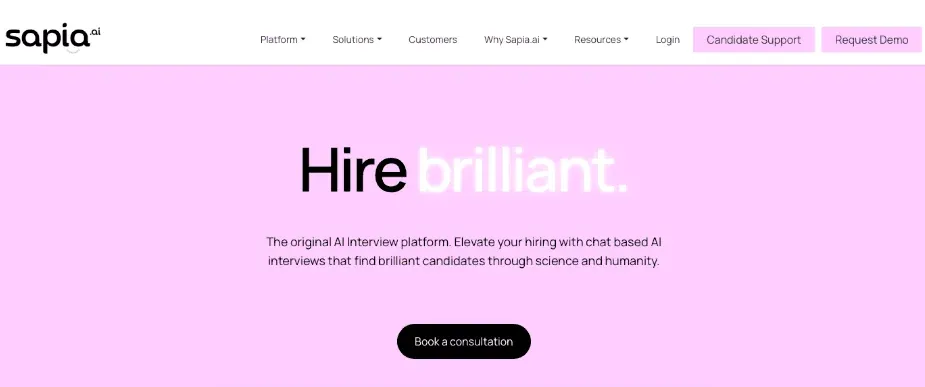
Sapia.ai focuses on structured chat and voice interviews at scale, using its SAIGE scoring engine to assess candidates against validated competency models. It screens in multiple languages and removes CV-based bias from early-stage screening.
Good for companies hiring 500+ people per year, particularly in retail, hospitality, and customer service where standardized screening across thousands of applicants is the bottleneck.
The gaps show up in reporting. Connecting interview scores to actual hires inside your ATS stays a largely manual process, and integration depth is a common complaint. More broadly, Sapia.ai covers one slice of recruiting, with no sourcing, no outreach, and no hands-on recruiter support.
Phenom
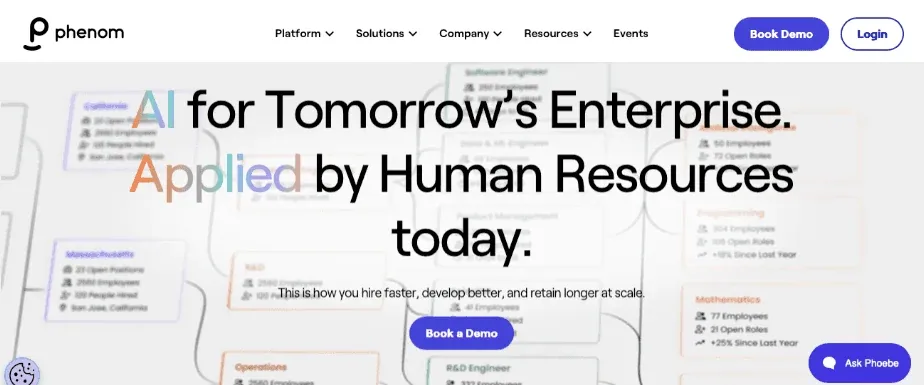
Phenom is built for enterprise talent management at scale and is used by many large organizations. Its suite covers career sites, chatbots, CRM, interview scheduling, and internal mobility, connecting candidates, employees, and recruiters through AI personalization across the full talent journey.
The trade-off is complexity. Contracts often start at $50,000+ per year, and implementation typically runs months before delivering value. For large organizations with dedicated HR teams, that investment can make sense. Early-stage companies that need to hire this week will find Dover a more practical starting point.
Beamery
Beamery sits at the enterprise end of talent intelligence. Their AI maps skills across internal workforces and external talent pools, integrating with Workday and SAP to give HR leaders a real-time picture of where skills gaps exist and how to close them. Their agentic advisor, Ray, adds scenario simulation and AI-guided workforce recommendations on top.
Their core capabilities include:
-
Skills inference with up to 90% accuracy
-
AI scoring of inbound applicants against hiring manager criteria
-
Internal mobility and workforce planning tools
-
Integration with major HRIS systems for real-time skills data
Pricing is not publicly listed, setup takes time, and the focus on building a skills taxonomy means you are not sourcing candidates this week. For large enterprises with dedicated HR infrastructure, Beamery’s depth is genuinely useful. For a growing company with open roles now, it is a lot of architecture before you get a hire.
SeekOut
SeekOut gives technical recruiters access to a large database of public candidate profiles. Conversational search replaces complex Boolean queries, and integrations with ATS and HRIS systems pull internal data alongside external candidates.
Good for mid-size to enterprise teams with dedicated sourcing specialists hunting for specialized engineering talent.
The frustrations are real, though. Prices increase yearly, and there is no visibility into whether another recruiter has already contacted the same candidate, which leads to duplicated outreach. SeekOut covers sourcing only, with no outreach execution, no relationship management, and no human support to actually close roles.
hireEZ
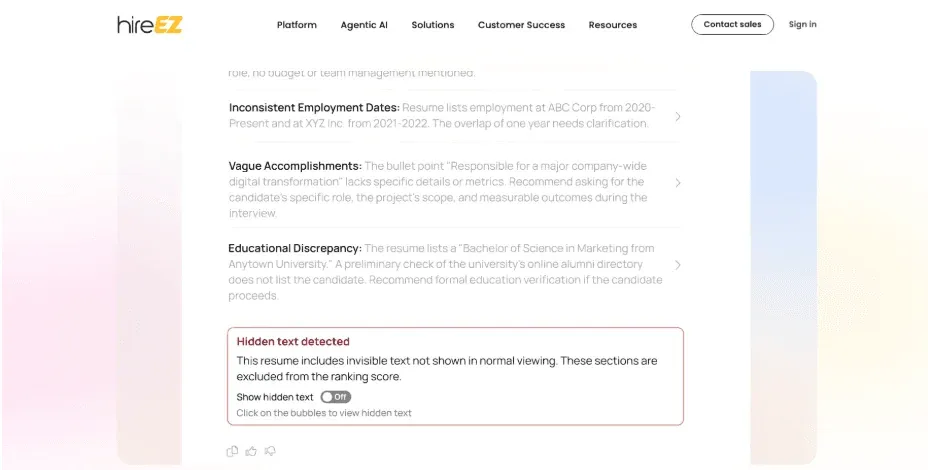
HireEZ is an outbound recruiting tool built around AI-powered candidate sourcing across multiple public talent platforms. It targets talent acquisition teams that want to automate outreach sequences and surface passive candidates at scale.
The tool is best suited for mid-size to enterprise recruiting teams and staffing agencies with structured sourcing workflows and dedicated recruiters.
Juicebox AI
Juicebox AI is an AI-powered candidate sourcing tool that searches across LinkedIn, GitHub, and other public data sources to surface relevant profiles. It lets recruiters describe their ideal candidate in plain language and returns ranked results with contact information.
The tool is designed for sourcers who want speed over manual Boolean searching, making it useful for high-volume pipelines where time-to-shortlist matters.
Paradox (Olivia)
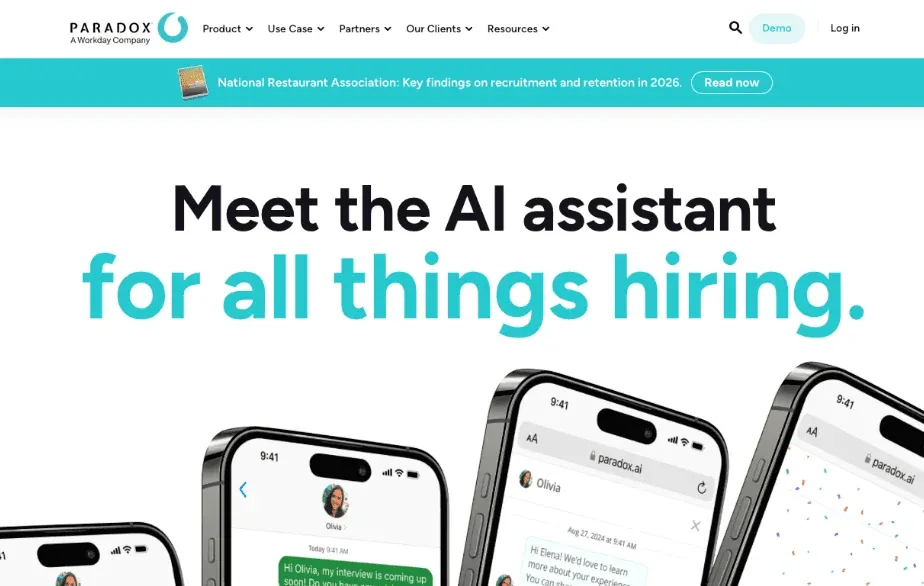
Paradox’s AI assistant, Olivia, automates conversational screening, scheduling, and hiring event coordination so recruiters spend more time with candidates instead of software. Companies like Compass Group hire 120,000 workers annually with a team of just 20 recruiters because Olivia handles repetitive logistics at scale.
That model works well for high-volume hourly roles in retail, hospitality, and healthcare. For startup hires across engineering, product, and sales, standardized chat flows can’t replace careful candidate evaluation.
CloudTalk
CloudTalk brings conversational voice AI directly into talent acquisition workflows. While most recruiting software focuses on email sequences or text chatbots, CloudTalk uses autonomous AI voice agents to handle high-volume outbound phone outreach, early-stage candidate screening, and automated interview scheduling.
Recruiters can deploy CloudTalk to call applicant pipelines, conduct structured phone interviews across 60+ languages, qualify candidates against job criteria, and sync live calendar availability to book next-round meetings without manual phone tag. Every call transcript, AI sentiment score, and candidate summary is logged back into connected CRMs and hiring platforms like Salesforce, HubSpot, and Zendesk.
Key features include:
-
Autonomous outbound AI voice agents that call passive candidates or applicants to run pre-screening phone interviews.
-
Conversational natural language IVR that engages candidates in human-like dialogue across 60+ languages and accents.
-
Automated calendar booking and CRM sync for instant interview scheduling and post-call logging into Salesforce, HubSpot, or Zendesk.
-
Conversation intelligence with AI transcripts, sentiment analysis, and talk-to-listen ratios to evaluate candidate engagement during phone screens.
The upside is speed. CloudTalk removes phone tag and hours of manual screening, which matters most for high-volume hiring in retail, hospitality, customer service, and sales, where 24/7 qualification and scheduling can decide who gets to the candidate first.
The limits are worth noting. CloudTalk is voice-first, so it does not cover candidate sourcing on LinkedIn or GitHub, and it requires running call management on CloudTalk’s own VoIP telephony infrastructure.
Workable
Workable bundles AI sourcing, resume screening, scheduling, and onboarding into one system with access to a large candidate database and one-click multi-board posting. Published pricing starts around $189/month, a 15-day free trial is available, and mobile apps cover iOS and Android.
The trade-offs add up quickly. Texting and video interviews are paid add-ons, pricing scales with headcount, and there is no recruiter support for sourcing or closing candidates.
Why Dover Is the Best AI Recruiting Tool
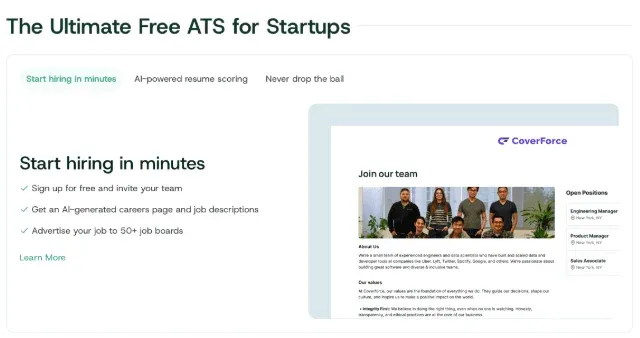
Dover takes a different approach to AI recruiting than most tools on this list. Instead of giving recruiters another software subscription to manage, Dover acts as an embedded recruiting partner, combining AI-powered sourcing with experienced human recruiters who work inside your existing workflows. Sourcing, outreach, scheduling, and coordination are handled together, so hiring managers spend their time on interviews instead of logistics.
Dover’s AI sourcing reaches across LinkedIn, GitHub, and dozens of other databases to surface candidates who match your role, instead of only your keywords. Recruiters review and refine those results before anything goes to a hiring manager, adding judgment that pure software tools skip.
Dover works best for startups and growth-stage companies that need recruiting capacity without the overhead of a full in-house team. The recruiters on the platform have deep startup hiring backgrounds, so they understand urgency and lean processes. If your hiring volume fluctuates or your recruiting team is stretched thin, Dover’s embedded model fills that gap without requiring a long-term headcount commitment.
Frequently Asked Questions
How do I choose the right AI recruiting tool for my company?
Start by identifying your biggest recruiting bottleneck: whether that’s sourcing passive candidates, screening high application volumes, or coordinating interviews across teams. Tools like Dover cover the full funnel with both software and recruiter support, while options like SeekOut or hireEZ focus on sourcing only, and Sapia.ai handles structured screening at scale.
Which AI recruiting tools work best for startups versus enterprise companies?
Startups hiring 5-50 roles per year typically benefit from tools with fast setup, transparent pricing, and minimal contracts: Dover and Workable fit this profile. Enterprise teams with dedicated HR functions and complex compliance needs may find value in Phenom or Beamery, though these require longer implementation timelines and come with higher price tags.
Can AI recruiting tools actually replace human recruiters?
No AI recruiting tool fully replaces the judgment, relationship-building, and detailed candidate evaluation that experienced recruiters bring. Most tools automate specific tasks like resume screening, outreach sequences, or interview scheduling, but still require human oversight to assess cultural fit, close candidates, and handle complex hiring decisions.
Final Thoughts on AI Recruiting Software
AI recruiting tools automate parts of hiring, but most still leave you managing sourcing, outreach, and coordination across disconnected systems. Dover works differently by pairing AI candidate matching with recruiters who close roles, so you get capacity without adding headcount. If your team is stretched thin or hiring in bursts, schedule a call to see how embedded recruiting compares to buying another software subscription. The right choice depends on whether you need another tool to manage or another recruiter who works inside your existing workflows.