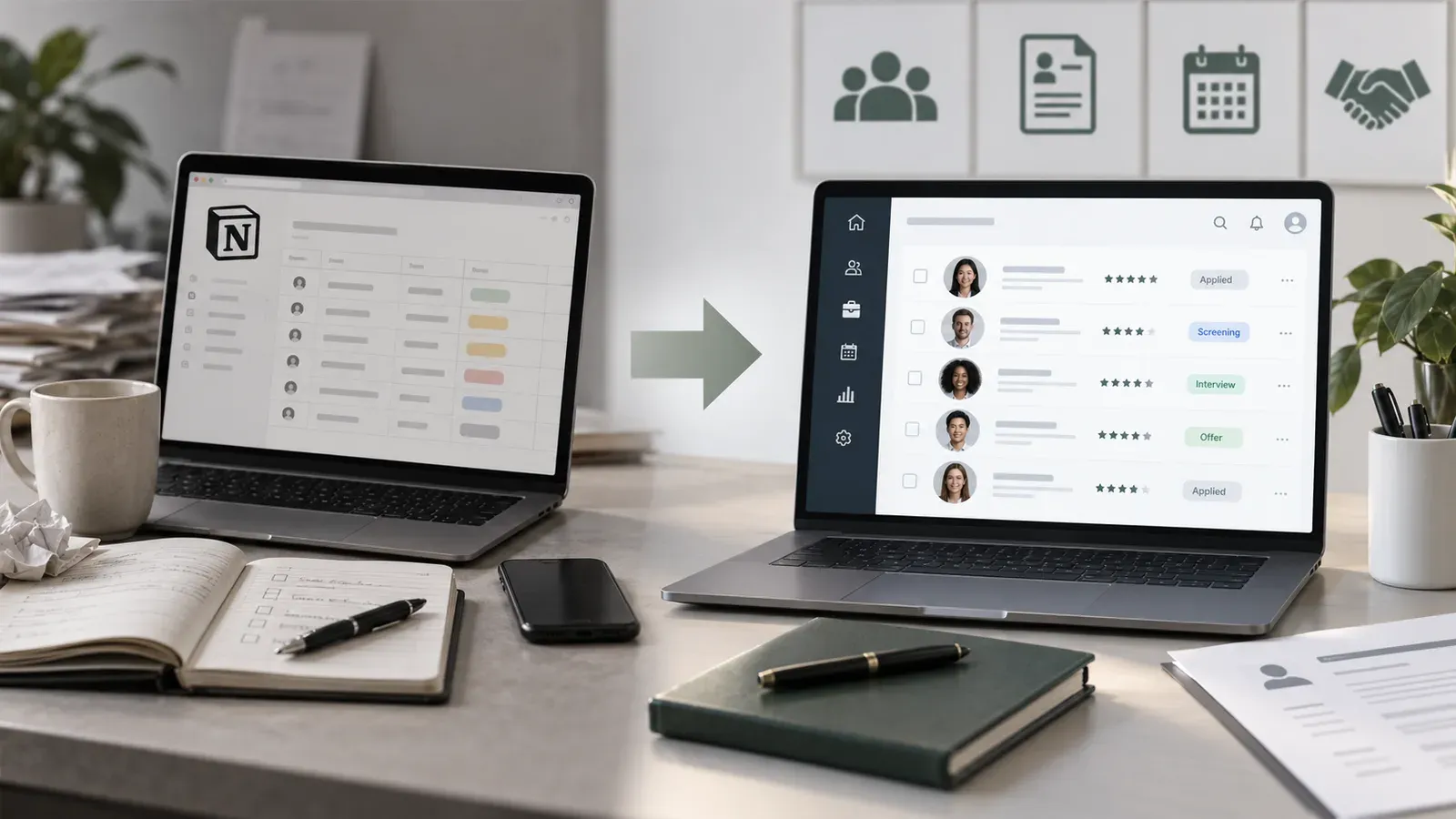

Most early-stage founders know within the first few bad hires that gut instinct alone won’t hold a team together. The problem is deciding which numbers to track, where to get them, and what they’re actually telling you about whether your hiring process is working. This guide walks through the metrics that matter, how to collect them, and how to use that data to measure quality of hire so you can build a stronger team from the start.
TLDR:
-
Quality of hire can’t be tracked with one metric; combine performance, retention, ramp-up time, and cultural fit.
-
High turnover among top performers often signals compensation gaps, and not merely hiring process failures.
-
An ATS creates the data layer that makes quality-of-hire measurement possible in the first place.
-
Start tracking 2-3 metrics tied to your biggest hiring pain point before you need the data at scale.
-
Some tools pair a free ATS with on-demand recruiting support, with costs averaging $2,000 to $7,000 per hire.
What Is Quality of Hire and Why Does It Matter for Startups?
Quality of hire measures the value a new hire brings to the company. For startups, it matters more than most metrics because:
-
Limited resources mean every hire needs to contribute quickly.
-
The wrong hire slows progress and costs time and money to replace.
-
A strong hire does more than perform well. They reinforce culture and team cohesion.
By understanding and measuring the quality of hire, startups can make data-driven decisions to improve their recruitment strategies and build a more effective team. quality of hire metrics breakdown describes it as an aggregated index of metrics designed to show whether hiring decisions are driving business results.
The stakes for getting this right have never been higher. According to LinkedIn’s Future of Recruiting 2025 report, 89% of senior recruiting professionals say measuring quality of hire is becoming more important, yet only 25% feel confident they can do it well. For early-stage teams without a dedicated HR function, building even a basic measurement framework early creates a real advantage over competitors who are still guessing.
Four Key Metrics for Measuring Quality of Hire

Quality of hire can’t be defined by one metric. Combining a variety of indicators gives you a more reliable picture than any single number can. Some key metrics for measuring quality of hire include:
| Metric | What it measures | Key signals to watch |
|---|---|---|
| Performance | How well a new hire delivers in the role | KPIs vs. expectations, goal completion, peer feedback |
| Retention rate | How long employees stay | Turnover rate, top-performer attrition, satisfaction scores |
| Ramp-up time | How quickly a hire reaches full productivity | Time-to-full-output vs. industry average, onboarding milestone completion |
| Cultural fit | How well a hire integrates with team and values | Engagement scores, manager feedback, collaboration patterns |
1. Performance Metrics
Performance metrics are the first and most obvious place to look. How well are new hires performing in their role and are they bringing value to the table efficiently? Some performance metrics you might look at include:
-
Key performance indicators (KPIs) - Simple and easy-to-measure metrics are a good place to start. You can see how close new hires are to meeting the expectations you have for others in the role. These KPIs depend on the role, but some examples would be the number of tasks they complete, sales quotas, etc. For a deeper look at structuring these assessments, see the SHRM quality of hire guide.
-
Feedback - Feedback from other team members, managers or people who work under them if they’re in a management position can help provide a well-rounded view of a new hire’s performance.
-
Achievements- Assess whether new hires are meeting or exceeding goals or objectives that were set out for them when they were brought on board.
2. Retention Rates
Retention rates are an important quality of hire metric. Retention rates measure how long employees stay with the company. You might be making great hires, but that’s not helpful if they leave the company quickly. Some key metrics you can look at include:
-
Turnover rate - This is the percentage of employees who leave the company within a period of time. High turnover means you may have issues in the hiring process or there might be issues with the workplace culture that’s causing people to leave. AIHR retention benchmarks offer useful context for comparing your rates against industry norms.
-
Top talent retention- It can also be helpful to monitor the retention rates of high performers compared to other team members. If you find top talent leaves at a higher rate than other employees, it could indicate you’re not offering competitive compensation or benefits compared to others in your industry.
-
Employee satisfaction - Conducting regular surveys to monitor employee satisfaction can help you understand if employees are enjoying the workplace or if there’s work to be done.
3. Ramp-Up Time
Ramp-up time is how long it takes a new hire to reach full productivity. Benchmarking yours against industry averages can reveal whether your onboarding process is working. AIHR’s breakdown of pre-hire and post-hire quality metrics offers a useful framework for deciding which ramp-up indicators to track at each stage. If your ramp-up time is slow, it typically signals that training or the onboarding process needs work.
4. Cultural Fit
Cultural fit looks at how new hires align with your company values and how they get along with others in the work environment. According to Jobylon’s guide to quality of hire KPIs, engagement scores and retention patterns are among the most telling signals of cultural fit over time. Some key metrics you can look at include:
-
**Employee satisfaction -**Measure employee satisfaction regularly to confirm employees are happy and satisfied in their roles.
-
**Employee engagement -**Engaged employees are more productive and satisfied in their roles. They also contribute to a more positive work environment. Looking at employee engagement metrics can help you understand how many team members are championing your company and how many are likely wanting to leave.
-
**Feedback -**Feedback from other team members and managers can help you understand how well new hires are integrating into their new workplace culture. If you find many new hires are having trouble, you can readjust your onboarding or hiring to account for this.
How to Track Hiring Data
Now that we know what metrics to look for when measuring quality of hire, the next step is implementing the right tools and strategies to track this data. If you’re still choosing a system, see how the best ATS options for startups compare. Here are some great ways to track the data you need to measure quality of hire:
1. Use a Free ATS to Build Your Quality-of-Hire Foundation
An ATS does more than organize candidates. It creates the data layer that makes quality-of-hire measurement possible in the first place. Without a central system, ramp-up time, offer acceptance rates, and source performance exist only in someone’s memory. With one, they become trackable trends you can act on.
Dover’s free ATS is built for this. Core capabilities include:
-
**Job board distribution -**Post to over 100 boards in minutes, giving you broader sourcing data to compare against quality-of-hire outcomes.
-
**AI-assisted job descriptions -**Generate tailored job descriptions to attract candidates who match your criteria, reducing mismatches that inflate ramp-up time.
-
**Resume scoring -**Rank candidates against your defined parameters so you spend interview time on the most promising prospects.
-
**Full pipeline visibility -**Every candidate’s status is visible in one place, keeping the process consistent and the data clean.
-
**Scheduling and communications automation -**Automated scheduling and messaging keep top candidates engaged throughout the process.
For most early-stage hiring, the ATS handles the infrastructure layer: pipeline management, sourcing data, scheduling, and candidate tracking. That foundation is often enough for straightforward roles with strong inbound. For a deeper look at setting up your pipeline, see our startup ATS guide.
When a search gets harder, a fractional recruiter can layer on top of that same system. Because both the internal team and the recruiter work within a shared ATS, sourcing activity, candidate notes, and pipeline status stay visible to everyone in real time. No handoff friction, no duplicate outreach, and no data loss when the engagement ends.
Dover also serves as the infrastructure layer that fractional recruiting agencies are built on. Agencies using Dover operate within the same shared pipeline, so client teams retain full visibility into sourcing activity and candidate history. Dover’s marketplace surfaces vetted profiles with real reviews from prior clients, grounding the selection decision in verified track records rather than introductory calls alone.
2. Use Performance Tools, Reviews, and Peer Feedback
Performance management software and HR tools give you analytics on retention, engagement, and output that go beyond what an ATS captures. Regular performance reviews and surveys let you track whether those metrics are improving over time. Getting input from managers and peers adds a ground-level view that spreadsheets and dashboards can miss, and it often surfaces issues a founder working alone wouldn’t catch.
Tips for Improving Quality of Hire in Startups
-
**Refine your hiring process -**Make sure you’re continually reviewing your recruitment process guide and sourcing, recruiting, and hiring practices to attract the best talent.
-
**Optimize onboarding -**Give new hires the resources they need to succeed.
-
**Improve the candidate experience -**Keep top candidates engaged throughout the process.
-
**Use data and analytics to iterate -**Track metrics so you can improve your process over time.
How Dover Fits Into Your Quality-of-Hire Infrastructure
Dover is built around this exact infrastructure problem. The free ATS gives founders a central place to track every candidate, capture sourcing data, and monitor pipeline metrics from day one, without paying for software before you’ve even validated your process. When a search gets harder (a specialized technical role, a senior hire, or a stretch of high hiring volume), the Dover recruiter marketplace lets you bring in a fractional recruiter who works inside that same system, so sourcing activity and candidate data stay visible to everyone instead of living in a vendor’s inbox. For more on when and how to bring in outside recruiting help, see our fractional recruiting guide. Dover also serves as the software that fractional recruiting agencies are built on. Agencies operating through Dover work within the client’s own ATS, so pipeline data and sourcing history accumulate on the client side regardless of which agency or recruiter handles the search.
On the cost side, most companies working with Dover’s marketplace spend an average of $2,000 to $7,000 per hire, compared to 15 to 25% of first-year salary with a traditional agency. Fractional recruiters bill at $75 to $125/hour on average, there are no long-term contracts, and the $800 deposit to get started is fully refundable. Every recruiter in Dover’s marketplace carries a verified review history from prior clients, so founders can select based on documented performance instead of relying on an agency’s self-reported success rates.
FAQs
What is the best free ATS for a team just starting to hire?
For a team making its first few hires, the best free ATS is one that takes under five minutes to set up, imposes no limits on jobs or users, and handles job board distribution automatically. Platforms like Dover offer a free tier with unlimited jobs and users, one-click posting to 100+ job boards, and built-in candidate tracking, which covers the full pipeline without software costs. More complex platforms tend to require recruiting-ops expertise to configure, which slows things down before any value is delivered. Starting with a lightweight, free tool and layering in additional capability when hiring volume grows tends to work better than over-investing in enterprise software at the seed stage.
What hiring tools do most YC-backed startups actually use?
YC startups don’t settle on a single stack, but a few patterns hold. At the earliest stage (pre-product-market fit, first five to ten hires) most teams default to a lightweight or free ATS combined with LinkedIn sourcing and referral networks. Dover is used by 100+ Y Combinator startups and is itself a YC-backed company (Summer 2019 batch), making it a natural fit for the ecosystem: the free ATS handles pipeline management without seat fees, and the recruiter marketplace can layer in fractional recruiting capacity when a role is urgent or outside the founding team’s network. Ashby is common among scaling YC companies and tends to be a stronger fit once a team has a dedicated recruiting function and predictable hiring volume. Greenhouse and Lever appear more frequently at Series B and beyond, where structured recruiting operations make the investment worthwhile. For job distribution, most teams use a combination of LinkedIn, Indeed, and startup-specific boards like Wellfound. Tool choice at the early stage matters less than having a consistent process: an ATS that’s free, fast to set up, and doesn’t require an ops specialist tends to get used, while more complex platforms often get abandoned before they deliver value.
What metrics should startup founders track to measure quality of hire?
No single metric captures quality of hire on its own. Combine performance against role KPIs, retention rate, ramp-up time, and cultural fit scores to get a reliable picture. Start with two or three that map directly to your biggest hiring pain point (early attrition, slow productivity, or team friction) before building out a fuller tracking system.
Do I need an ATS to measure quality of hire, or can I track this in a spreadsheet?
A spreadsheet can hold data, but it can’t connect sourcing activity to downstream outcomes like ramp-up time or retention the way a purpose-built ATS can. Without a central system, quality-of-hire data tends to live in someone’s memory instead of becoming a trend you can act on, which is why setting up an ATS before you feel like you need one is worth doing early.
How do I know when to bring in a fractional recruiter versus handling hiring with my ATS alone?
For straightforward roles with strong inbound applications, a free ATS typically handles the full pipeline without outside support. A fractional recruiter makes sense when a search gets harder, such as a specialized technical role, a senior position where strong candidates aren’t applying, or a period of high hiring volume that stretches your bandwidth beyond what self-serve tools can absorb.
When to Use Your ATS Alone vs. Bring In a Fractional Recruiter
| Situation | ATS Alone | Fractional Recruiter |
|---|---|---|
| Role difficulty | Straightforward, well-defined role with clear requirements | Specialized or technical role where qualified candidates are hard to find |
| Inbound volume | Strong inbound applications from job board distribution | Weak inbound; sourcing outreach is required to fill the pipeline |
| Hiring urgency | Flexible timeline allows for a self-managed search | Role needs to be filled quickly and pipeline speed matters |
| Team bandwidth | Founder or hiring manager has capacity to review and manage candidates | High hiring volume or competing priorities stretch internal capacity |
| Role seniority | Junior or mid-level hire where candidates are widely available | Senior or executive hire where strong candidates are unlikely to apply cold |
Final Thoughts on How to Measure Quality of Hire as a Startup Founder
Founders who start tracking quality-of-hire metrics early build a data layer that makes every subsequent hire cheaper and faster to evaluate. Dover’s model fits that framework directly: a free ATS captures pipeline data from day one, and fractional recruiters from the marketplace work inside the same system when a search gets harder, so sourcing activity and candidate history stay intact. The data you collect over your first 10 or 20 hires tells a clearer story than any industry benchmark.