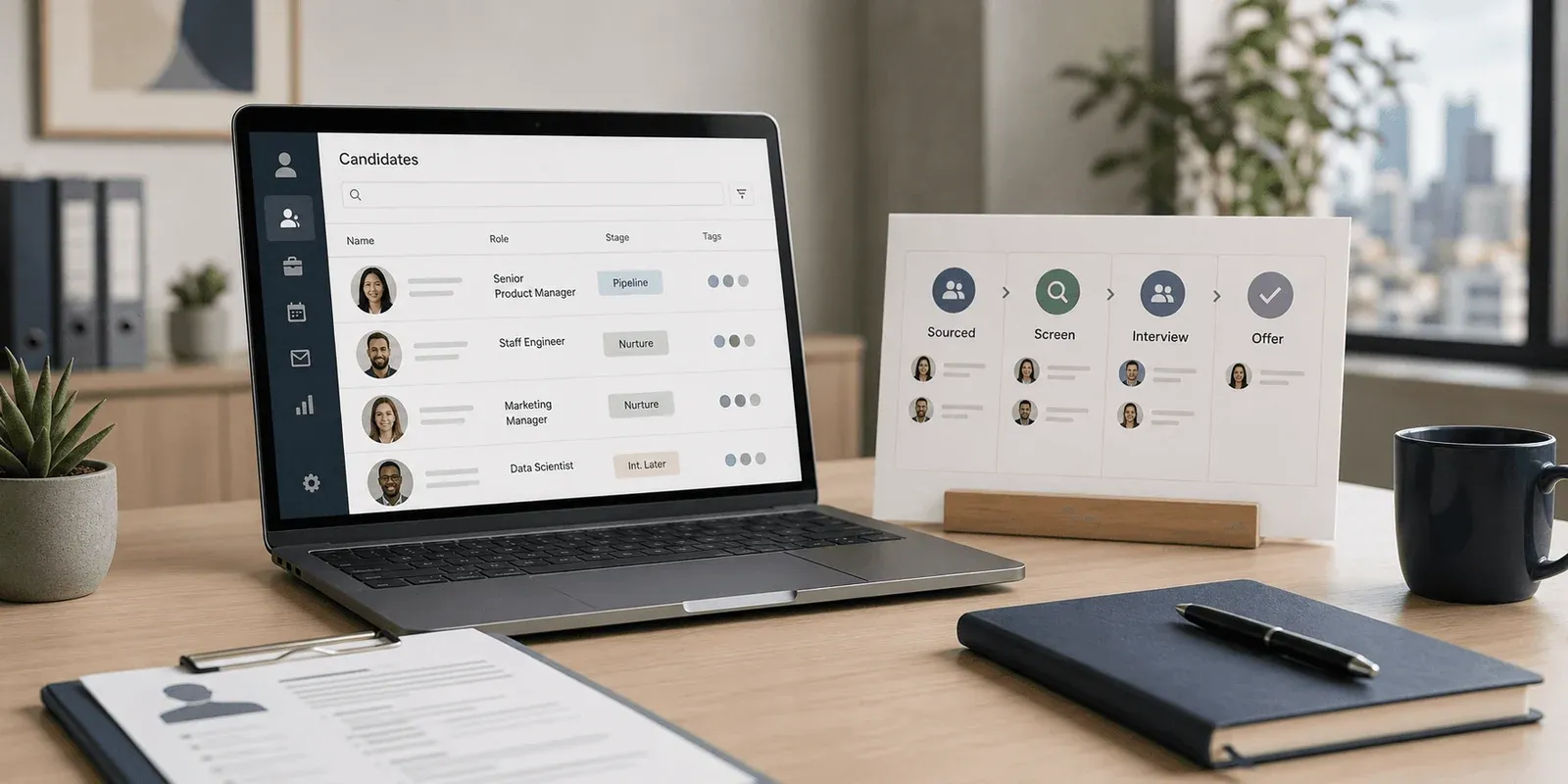

Your sales team is the engine of your startup, and the first salesperson you bring on sets the pace for everything that follows. Get it right and you build a consistent revenue stream fast; get it wrong and you’ll burn time and money you can’t spare. This guide covers the who, what, where, when, and why of making that hire, from role sequencing to the signals that tell you it’s time. For broader context on sequencing your early team, see the first five hires for seed startups and early-stage hiring practices worth knowing before you start.
TLDR:
-
Your first sales hire sets the pace for the entire team, so timing and role fit matter more than speed.
-
Hire an AE before an SDR at early stage; SDRs make sense only once you’re actively scaling.
-
Avoid bringing in a VP of Sales too early. They accelerate existing sales, not build it from scratch.
-
You’re likely ready to hire when your pipeline outpaces your bandwidth or you’re spending 2+ hours daily on prospects.
-
Having at least 5-10 paying customers and product-market fit gives your first sales hire a real foundation to work from.
Types of Sales Roles and Typical Career Ladders
| Role | Typical stage to hire | Primary focus | Held to quota? |
|---|---|---|---|
| SDR / BDR | Scaling (post-PMF) | Prospecting and qualifying leads | Activity targets |
| Account Executive | First sales hire | Demos, proposals, closing deals | Yes, a revenue quota |
| Senior AE / Sales Manager | After 2-3 AEs | Team management, quota oversight | Team quota |
| Director of Sales | Series A+ | Strategy, forecasting, hiring | Department goals |
| VP of Sales | After proven sales motion | Scaling and structuring an existing process | Revenue targets |
The journey from Junior Marketer to Director to VP is typically the same across all departments:
-
Sales Development Rep (BDR)
-
Account Executive
-
Senior Account Executive
-
Director of Sales
-
VP of Sales
At startups, the early marketing team will probably wear a wide variety of hats.
You’ll also be hiring more senior folks who will build out your junior team once you have a foundation in place. As your company grows, your senior folks will take on fewer projects and focus primarily on people management.
Here, we’ll describe the functions of each department in more detail:
Sales/Business Development Representatives
SDRs (also commonly called business development reps, or BDRs) are responsible for researching, prospecting, and qualifying leads.
If you’re an early-stage company, you probably won’t hire SDRs until you’re scaling your sales arm. They’re typically managed by an account executive, and their day-to-day involves:
-
identifying and reaching out to potential good fits,
-
answering requests for more information,
-
following up with prospects who downloaded content,
-
prospecting on LinkedIn and other social networks, and more.
Once an SDR has determined the lead is qualified, they pass the opportunity to a sales rep, who is responsible for presenting or demoing the product, resolving the buyer’s objections, and creating a proposal.
Account Executives
Most SDRs move into an AE position after about 6 to 18 months. As an AE, they’ve got a lot more autonomy and responsibility including:
-
running demos or giving presentations,
-
identifying, surfacing, and working through potential buying obstacles,
-
crafting personalized pitches for different buyer personas,
-
getting the commitment to purchase,
-
and negotiating contract terms
AEs are typically held to quotas, more on that later.
Senior Account Executives or Sales Managers
If you’re building a sales arm at a startup, your Account Executives will naturally move into senior or managerial positions as you hire more folks. Senior AEs lead teams of SDRs, and AEs. They’ll also:
-
set individual quotas and team goals,
-
analyze revenue data and make sure targets are met,
-
coordinate sales trainings and call reviews,
-
and manage sales territories (whether by location, industry or company size).
Director of Sales
A director of sales works with sales managers to determine sales objectives, forecast and develop sales quotas, maintain sales volume, and stay deeply involved in the hiring process.
They’ll maintain a more strategic role than that of a sales manager, and will likely report to the VP of Sales when you’re ready to hire one.
They’ll be held responsible for the performance of the department, and their bonus will be awarded when the sales organization meets or exceeds goals.
VP of Sales
A VP of Sales acts as part team leader, part thought partner. They are typically some of the most highly compensated folks in an organization since they are in charge of driving revenue targets.
Many startups bring in a VP of Sales too early. A true VP of Sales is NOT someone you hire to get sales going at your startup. They’re someone you hire to accelerate pre-existing sales into the upper tier of success. They should help bring structure and efficient processes to the table whereas the day-to-day sales grind is better left to your AEs and SDRs. They shouldn’t have to jump in and do IC work, or your sales will actually stall instead of getting better.
Core responsibilities include:
-
Working with Marketing to understand the best GTM (go to market) strategy
-
Understanding the post-sales buyer journey to understand which types of buyers are at the highest risk for churn
-
Understanding why revenue targets are missed and devising a plan to fix them
-
Creating a repeatable, measurable, scalable process to engage the buyer where they are versus where you want to force them to be
-
Recruiting and hiring the best salespeople
-
Helping the team scout, engage, and close better deals
-
Reinforcing, and strengthening your culture
Four Signs You’re Ready to Make Your First Sales Hire

The first salesperson you hire plays a defining role in setting the course of the sales team as you scale. They’ll be in charge of hiring, creating workflows, and pitching your company without the support of a larger team. In 2026, with many early-stage teams operating on tighter runways and longer fundraising timelines, getting this sequencing right matters more than it did in prior years - a misaligned first hire in sales is one of the costlier mistakes at the seed stage. Here are four signs you’re ready to make the leap:
1: You Aren’t Able to Meet Your Revenue Number, But the Pipeline or Opportunities Are Plentiful.
Most entrepreneurs start out as the first and only salespeople for their companies, but eventually, your pipeline will outpace your bandwidth. If you’re an entrepreneur who’s spending more than two hours a day on interacting with prospects – or generating new business – it’s probably time to hire a salesperson who can take over for you. SaaStr recommends closing 10-20 customers yourself before handing off the process.
2. You Know Where Your Target Customers Hang Out.
This ties in a bit with question one, as your channel might also be the best path for distribution because it’s where your target customers typically network or go to learn more about their job (like LinkedIn, for example). However, the answer might not be so cut and dry, or a channel might work for some time and then suddenly stop driving results. Part of your first sales hire’s job will be to experiment and research new channels for growth.
One way to decide which department they should live in is to consider how your target customers are currently finding competitive products or services. For example, if you know from competitive research that clients are finding out about data migration solutions through recommendations from friends, you may want to hire a brand marketer who can work on driving top-of-funnel awareness. If they’re finding out about them through Instagram ads, you’ll want to hire a growth marketer to build campaigns.
3. You Have Lots of Competitors in Your Category.
Beyond that, ask yourself this: are your competitors dominant players with strong brands? Do they have endless marketing budgets? Are CACs in this space huge because everyone is outbidding each other?
If so, you might want to put money into building an exceptional brand or product/customer experience. That means solidifying your pitch and figuring out how to position yourselves against your competitors.
4. You Have Product-Market Fit.
Even an excellent salesperson won’t be able to make an impact if you haven’t proven product-market fit is already a reality.
In practice, you’ll likely have at least 5-10 customers. With a core group of adopters, you’ll be able to start to identify trends in the sales cycle that will help you understand how to build a process around sales. If you’re still refining your pitch and ICP, it’s worth reading about hiring your first sales rep at a startup before kicking off the search.
If two or more of these statements resonate, you’re likely ready and in a good financial position to make your first sales hire.
How Dover Helps with Your First Sales Hire
Dover is built for exactly the situation most early-stage founders face when making a first sales hire: you know the role exists, you know it matters, and you don’t have a recruiting team to run the search. Dover’s free ATS gives you a clean system to post to 100+ job boards, manage inbound, and track every candidate from first touch to offer, with no setup fees and no seat limits. If the search needs more firepower, Dover’s recruiter marketplace connects you with experienced, startup-savvy fractional recruiters who work inside your ATS, not alongside it, so nothing gets lost in handoffs.
Wondering about the cost? Fractional recruiter pricing is typically far below a traditional staffing agency retainer, and Dover’s model means you only pay for the hours you actually need.
Dover’s fractional recruiters typically work at $75 to $125/hour, with most standard roles filling within 20 to 30 hours of dedicated recruiting work. There’s no retainer required and no long-term contract, so you can ramp up for the search and step back once the role is filled.
FAQs
Should I hire an AE or an SDR as my first sales hire?
Hire an Account Executive first. SDRs are built to support a sales motion that already exists. They prospect and qualify leads that an AE then closes. At early stage, you need someone who can run the full cycle, and that’s an AE role. SDRs make sense once you have enough pipeline volume to warrant a dedicated top-of-funnel function.
When is it too early to hire a VP of Sales?
If you haven’t proven a repeatable sales motion yet, a VP of Sales will stall your growth instead of accelerating it. A VP of Sales is designed to scale an existing process, building structure around deals that are already closing, and not to do the foundational IC work of getting your first customers. Most early-stage founders should have an AE closing deals before a VP enters the picture.
How do I know if I’m ready to make my first sales hire?
Two signals are the most reliable: your pipeline is outpacing your bandwidth, or you’re spending more than two hours a day on prospects. Having at least 5-10 paying customers and a clear sense of where your buyers come from gives your first hire a foundation to build on instead of starting from zero.
Is there a free tool to manage the search once I decide to hire?
A few free ATS options exist. The core jobs they do are the same: post to job boards, collect inbound applications, and track candidates through stages. What varies is how much setup they require and whether they give you any recruiting support once the search is live. Some tools pair free software with access to on-demand fractional recruiters who work inside the same system, so you’re not managing a recruiter in one place and your pipeline in another. That shared-system setup tends to matter most when your first sales hire search is moving fast and you can’t afford candidates falling through the cracks.
Final Thoughts on Making Your First Sales Hire Count
Getting your first sales hire right comes down to timing, role clarity, and a process that matches how sales candidates actually move. Hire before you have pipeline clarity and you’ll burn the seat; wait too long and you’ll lose deals you could have closed. Dover is built for exactly the window most early-stage founders are in when they reach this decision: a free ATS to keep the search organized and a marketplace of startup-savvy fractional recruiters who can run the sourcing when self-serve isn’t enough, all in one shared system, no retainer required.