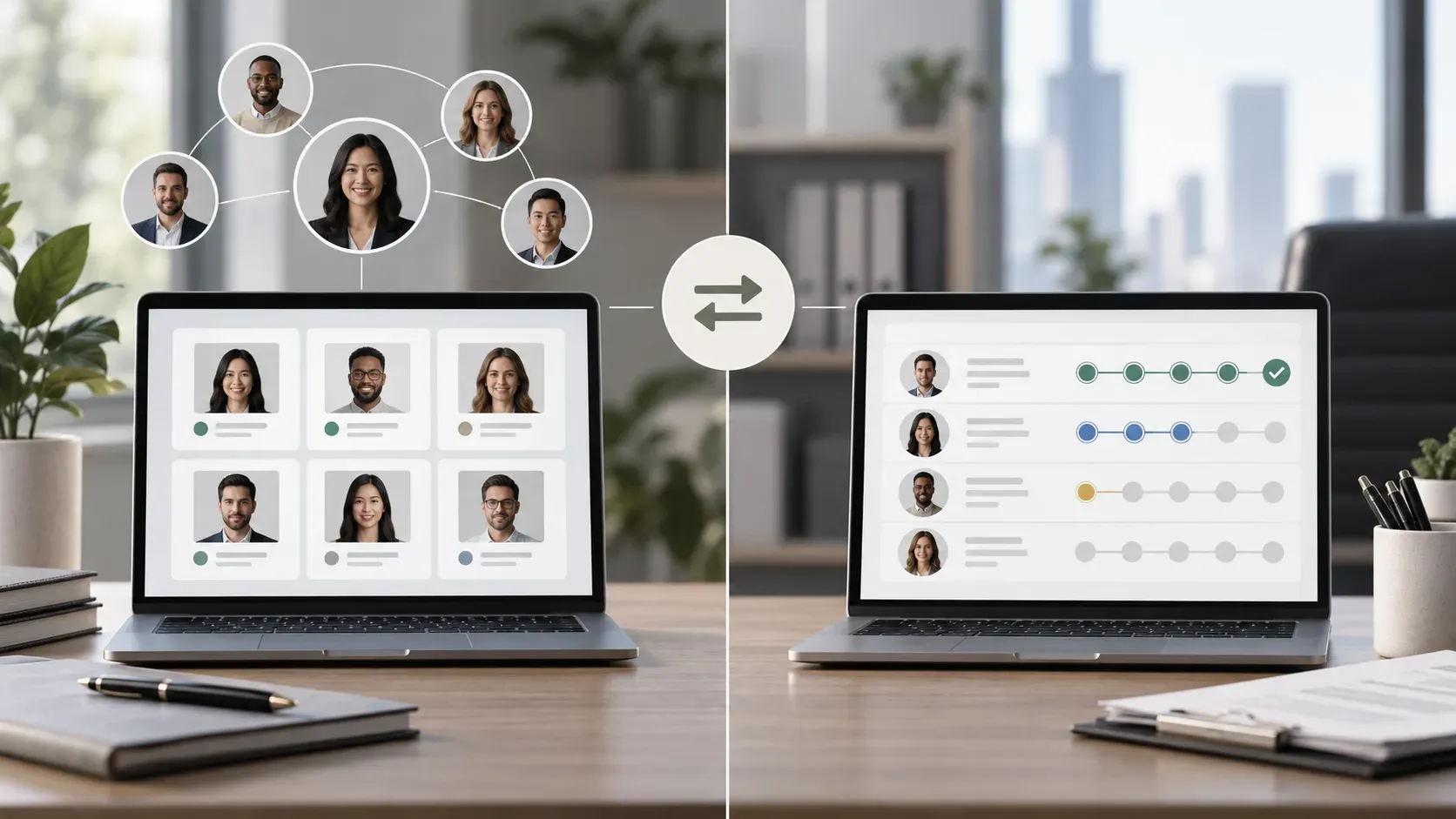
Tracking ten candidates across two open roles sounds manageable until a hiring manager misses a follow-up, a candidate follows up on status you can’t quickly answer, and the spreadsheet hasn’t been touched in a week. Understanding what an ATS is in recruiting, and whether one fits how your team hires, is where most founders land. An ATS (applicant tracking system) is software that keeps that coordination from breaking down, and this guide covers the full picture in plain terms.
TLDR:
-
An ATS replaces the inbox by collecting applications, parsing resumes, and moving candidates through defined stages in one shared place.
-
AI in ATS software can score and rank applicants, but human review still determines who advances; no mainstream ATS is known to reliably detect or reject AI-written resumes.
-
ATS pricing runs from free to $100,000+ annually; free tiers can carry early-stage teams through their first several dozen hires without losing core pipeline features.
-
An ATS manages pre-hire candidate pipelines, an HRIS handles post-hire employee records, and a recruitment CRM tracks passive candidates; most startups only need the first.
-
Some tools pair free ATS software with on-demand recruiting support instead of fixed retainers, and publish the all-in cost of every hire so you can check current numbers before committing.
What an ATS Is in Recruiting
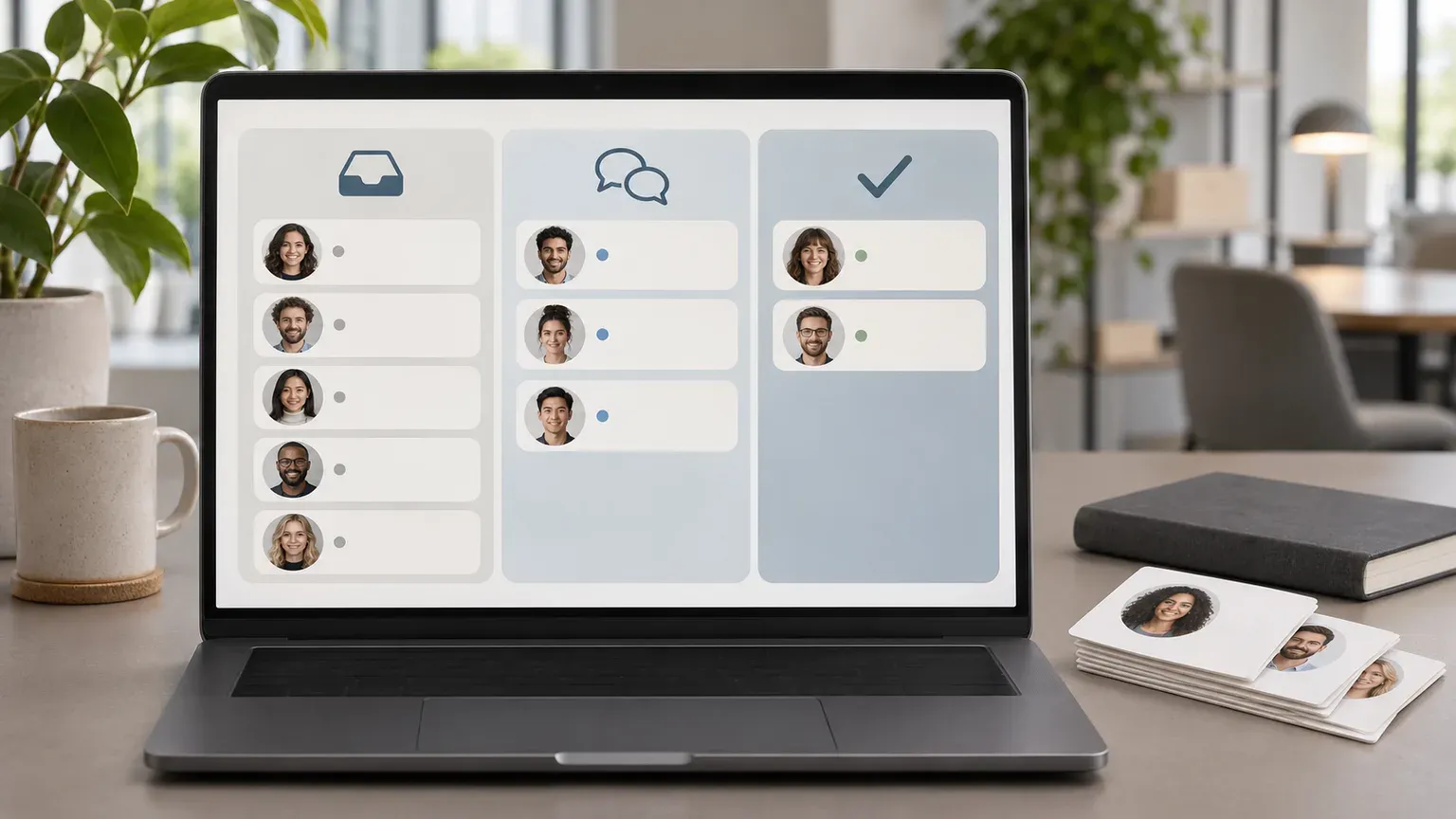
An applicant tracking system (ATS) is software that manages job applications from the moment a candidate submits their resume to the moment you make a hire. It collects applications, parses resume data into structured fields, and gives your team a shared place to move candidates through defined stages like phone screen, technical interview, and offer.
The core job of an ATS is replacing the inbox. Without one, applications pile up across email threads, shared spreadsheets, and calendar invites that no single person fully owns. An ATS gives every application a home and every candidate a status.
How an ATS Works: The Hiring Workflow End to End
Job Creation and Distribution
You write a job description inside the ATS, set the required fields, and publish. The system distributes the listing to job boards automatically, anywhere from a handful to 100 or more depending on the tool. Every application that comes back gets routed into a single pipeline, regardless of which board it came from.
Application Review and Screening
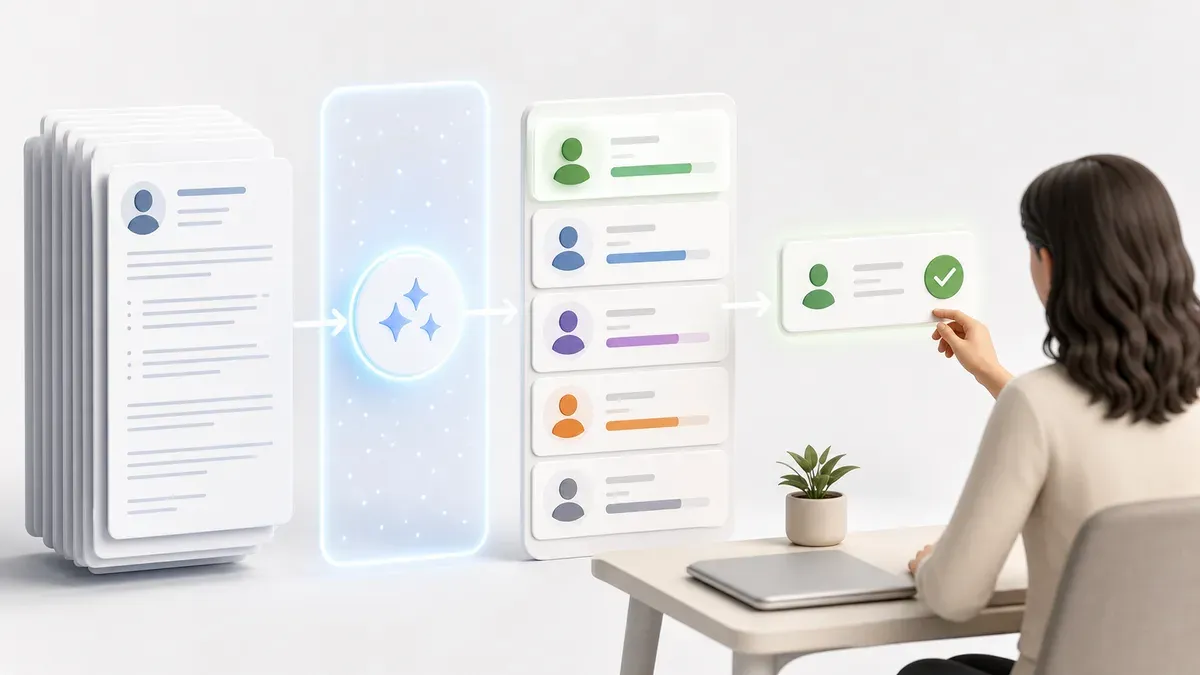
As applications arrive, the ATS parses each resume, pulling out structured data like job titles, employers, dates, and skills. Many systems then score or rank candidates against criteria you defined upfront, whether that is years of experience, specific keywords, or required credentials.
Who Uses an ATS and When to Implement One
Hiring managers at growth-stage companies use an ATS to keep multiple open roles organized without letting any candidate fall through. Founders and small teams use free tiers to get a basic pipeline in place before they have dedicated recruiting headcount.
When to Bring One In
The timing question matters more than most founders expect. A few signals suggest an ATS has become worth setting up:
-
You are tracking more than a handful of candidates across more than one open role, and a spreadsheet requires constant manual upkeep just to stay current.
-
Candidates are following up about their status and you have no quick way to check where they are in the process.
-
You are coordinating interviews across multiple interviewers and losing time to scheduling back-and-forth with no central record of feedback.
-
You are posting the same job to multiple boards manually each time a role opens.
Once a second or third role opens concurrently, the coordination cost of not having a system tends to compound faster than the setup cost of getting one in place.
The Real Benefits of Using an ATS
Founders who have spent time sorting through inbound applications in a spreadsheet know what happens after a few dozen candidates pile up: columns drift, follow-up dates get missed, and it becomes hard to tell who got a rejection email and who is still waiting. An ATS removes that friction at the source.

-
Automated status updates and email triggers keep candidates informed without requiring a hiring manager to write individual follow-up messages after every stage moves.
-
Structured interview workflows give everyone on the hiring team the same scorecard and question set, so feedback is comparable across candidates instead of impressionistic.
-
Compliance recordkeeping captures the data trail required for equal employment opportunity reporting and audit readiness, which matters more once headcount grows past a handful of people.
The less obvious benefit is speed. An ATS does not make interviews faster, but it can compress the dead time between them. For a startup competing against larger employers, cutting a week out of the process can be the difference between closing a candidate and losing them to a faster-moving offer. Some users also report that enterprise ATS tools add more overhead than they remove.
ATS and AI: What Is Actually Automated
AI has become a genuine part of how many ATS products work, though the gap between what vendors advertise and what actually runs under the hood is worth understanding before you buy.
-
Resume parsing uses pattern recognition to pull structured data from unstructured documents, reading job titles, dates, and skills out of uploaded files so candidates land in the right fields without manual data entry.
-
Candidate scoring ranks applicants against criteria you define, such as years of experience or specific skills, and surfaces higher-matching profiles toward the top of your queue.
-
Automated communication sends acknowledgment emails, status updates, and interview scheduling links based on triggers you configure, reducing the back-and-forth that slows pipelines down.
What AI in an ATS does not do is make hiring decisions autonomously. The screening layer flags and ranks; a human still reviews and advances candidates.
ATS vs. HRIS vs. Recruitment CRM: What Is the Difference
These three categories operate at different stages of the employee lifecycle, and mixing them up leads to buying software you don’t yet need. A breakdown of HRIS vs. ATS differences makes the distinction clear: one manages the recruiting phase, the other tracks employees over time.
| Tool | What It Manages | When You Need It |
|---|---|---|
| ATS | Pre-hire candidate pipeline | Open roles, inbound applications, interview coordination |
| HRIS | Post-hire employee records, payroll, benefits | Once you have employees to administer |
| Recruitment CRM | Passive candidate relationships, talent nurturing | When proactive sourcing is a core part of your strategy |
A recruitment CRM sits on the opposite end. Where an ATS manages active candidates who have already applied, a CRM helps you build relationships with passive candidates who haven’t applied yet.
How Much Does an ATS Cost
The price range is wide: you can run a meaningful hiring process for free, while enterprise recruiting software can reach $100,000 or more per year depending on company size and contract scope. What drives costs up is usually per-seat licensing, job volume limits, ATS integrations with payroll or HRIS tools, and implementation help. Free tiers often get dismissed as stripped-down, but that is not accurate. Some tools, including a few free ATS options built for startups, offer unlimited jobs and users with no expiration, covering everything a startup needs through its first several dozen hires.
How to Choose an ATS for Your Startup
Choosing an ATS involves matching the tool’s actual capabilities to where your team is right now, not where you hope to be in two years.
Consulting a guide to the best applicant tracking systems for 2026 can help narrow the field; for early-stage teams making their first few hires, free ATS options and entry-level plans often cover the basics: job postings, candidate tracking, and interview scheduling. The tradeoff is that free tiers typically cap users, limit integrations, or restrict reporting.
A few variables worth assessing before committing:
-
How many roles you plan to open in the next six months, since some tools charge per job posting instead of per user
-
Whether you need multi-channel sourcing built in or just a place to organize inbound applicants
-
How much of your interview process relies on structured feedback, since scoring and rubric features vary widely across tools
-
Whether your team has someone who can configure and maintain the system, or needs something that works out of the box in minutes
Why Dover Works for Early-Stage Startups
Dover is built for the recruiting reality most early-stage startups face: managing inbound applicants, coordinating interviews, and posting to multiple boards without a dedicated recruiting team or an expensive software contract. The free ATS covers that foundation from the first hire forward, with no limits on jobs or users and setup that takes just minutes.
The ATS includes job posting to 50+ job boards from a single interface, interview scheduling links, candidate pipeline tracking, and a built-in CRM for searching and emailing candidates across every role, with AI-assisted applicant scoring available on the paid Premium plan. There is no cost tied to the number of roles you open or the number of people on the hiring team, which means the free plan stays free as headcount and hiring volume grow, while the paid Premium and Enterprise plans add features as the business scales.
For roles where inbound alone isn’t enough, Dover’s fractional recruiter marketplace lets you bring in an experienced recruiter with no long-term contract required. Recruiters set their own rates, and the all-in cost of every hire is published in a public cost-per-hire table on the marketplace. Visit the marketplace to see current, up-to-date numbers instead of relying on a static figure in this post. Recruiters can work directly inside the same ATS or in your existing tools, so the hiring team can keep real-time pipeline visibility without managing a separate coordination layer.
FAQs
Can an ATS score resumes with AI, and how accurate is it?
Many ATS products can score resumes against criteria you define, but a score is a screening aid, not a verdict. Accuracy depends on how specific your criteria are and how closely a resume’s wording matches them. Keyword-style scoring can miss strong candidates who describe their experience in different terms, and scoring can reflect bias present in the criteria or the underlying model. Employers generally remain responsible for adverse impact under anti-discrimination law, and some jurisdictions have rules that cover automated screening tools, so software alone does not make a process compliant. A practical safeguard is to have a person review borderline scores and spot-check a sample of low-scored applicants on a regular basis. In Dover, AI resume review is a Premium feature that scores applicants against a custom prompt, with the option to bring your own API key from OpenAI, Anthropic, or Gemini.
How do you stop good candidates from slipping through the cracks when hiring is spread across email, LinkedIn, and a spreadsheet?
Candidates slip when no one owns the next step: a reply sits unread in an inbox, a LinkedIn conversation never reaches the sheet, or a row has no follow-up date. The fix is structural. Every candidate needs one record with a stage, an owner, and a visible history, and every source (job boards, careers page, LinkedIn outreach, referrals) needs to feed that same pipeline. For a founder running hiring on top of other work, the simplest version is a free ATS: import the existing spreadsheet by CSV, route new applications into one queue, use stage-based email templates so no one waits without a reply, and snooze candidates with a follow-up date so they resurface on schedule. Dover’s free ATS includes bulk candidate upload, notes with @mentions, candidate snooze, and a Chrome extension for sending outreach from LinkedIn.
Which type of recruiting help works best when your hiring plan is unpredictable?
The fee structure matters more than the label. Retainers charge for capacity whether or not roles are open, a full-time recruiter typically starts to pay off around 15 to 20 hires a year, and contingency agencies charge a percentage of first-year salary and can deprioritize harder or slower searches. For bursty or uncertain hiring volume, an hourly fractional recruiter tends to fit better because cost follows the work: you scale up when roles open and pause when they close. Dover’s marketplace uses hourly billing as its primary model, with weekly or monthly budgets, free intro calls, a refundable deposit, and no long-term contracts. Retainer and pay-per-hire options are also available, and each recruiter sets their own rate.
Final Thoughts on Choosing the Right ATS and Recruiting Tools for Your Startup
Understanding what an ATS is in recruiting is a starting point; the right fit depends on where your team is right now, not where you hope to be in two years. Teams that hire in bursts tend to value flexibility over feature depth, so a tool that costs nothing while roles are closed and scales when they open often matters more than a long feature list or a polished sales demo. Free tools can carry early-stage teams further than most founders expect, and Dover is one concrete place to start: a free ATS with no user or job limits, setup in minutes, and access to fractional recruiters when a role needs more than software alone.