
You’re looking at applicant tracking systems because hiring through email and shared spreadsheets stopped scaling months ago, but most of the options you’ve demoed feel like they’re built for someone else’s company. Either the pricing is hidden behind a sales call, the setup takes weeks, or the feature set is so bloated you’ll never use half of it. We’ve compared six of the most common ATS tools across cost, implementation time, and core functionality so you can see which one fits where you’re hiring right now instead of where some vendor thinks you should be.
TLDR:
-
An ATS manages your full hiring pipeline from job posting through final offer in one system.
-
Free options exist, while enterprise tools can run $100K+ annually plus implementation.
-
Some tools can combine a free ATS with optional fractional recruiters at roughly $4,800 per hire on average.
-
Many platforms charge per seat or user, creating cost barriers as your team grows.
-
Some modern solutions give startups recruiting software and on-demand recruiting help without contracts.
What Is an Applicant Tracking System?
An applicant tracking system is recruiting software that manages the full hiring process. It takes candidates from job posting through application collection, interview stages, and final decision, all in one place instead of scattered across email threads and spreadsheets.
At its core, an ATS tracks where each candidate stands and gives your team a shared view of the pipeline. More advanced systems add AI-powered candidate matching, automated scheduling, and recruiting analytics. ATS software is now widely used to screen applications, and many recruiters report better process effectiveness and hire quality after adopting one.
How an Applicant Tracking System Works
Most ATS tools map onto a similar recruitment process, even if the interface and feature depth vary widely.
-
Job Requisition Creation: Define role skills, salary range, and approval chain.
-
Job Distribution: Post the role to boards and the career page.
-
Application Collection: Resumes land in one central, source-tagged database.
-
Resume Parsing and Screening: System extracts data and scores candidates for review.
-
Interview Coordination: Candidates move through stages with scheduling and feedback.
-
Offer and Onboarding Handoff: Approved candidates get offers and move to onboarding tools.
How We Ranked Applicant Tracking Systems
Our rankings draw from publicly available information across five key factors:
-
Ease of use and setup time, especially for teams without dedicated IT support
-
Core functionality: resume parsing, candidate communication, interview scheduling, and reporting
-
Pricing transparency and value relative to features offered
-
Integration depth with job boards and existing HR tools
-
Fit across company stages, from early-stage startups to enterprise organizations
No single system wins on every dimension. A tool that works well for a 10-person startup may be completely wrong for a 2,000-person company. Keep that in mind as you read through each option below.
| ATS | Best For | Starting Price | Free Tier | Key Limitation |
|---|---|---|---|---|
| Dover | Seed to Series C startups hiring 5-50 roles/year | Free ATS; optional recruiters average roughly $4,800/hire | Yes, with unlimited jobs and seats | Less suited for large enterprise or high-volume hiring ops |
| Workday | Enterprises already running Workday HCM across payroll and HR | Third-party estimates of $100K-$500K+/year; implementation adds $300K-$800K in year one | No | Some users report native sourcing feels limited; AI features may be separately licensed add-ons |
| iCIMS | Large, multi-location organizations with layered hiring needs | Quote-based; third-party estimates start around $1,700/month for smaller orgs | No | Feature depth and setup overhead may be more than small teams need |
| Workable | Mid-market teams with international or multilingual hiring needs | Starts at $299/month (Standard); roughly $556/month with add-ons | No (trial only) | Some users report reporting feels rigid; add-ons raise real cost |
| Greenhouse | Companies with 100-10,000+ employees and dedicated recruiting teams | Quote-based; Core estimated at $6K-$10K/year; implementation $1K-$15K extra | No | Advanced analytics and sourcing tools excluded from base tier |
| Lever | Mid-sized teams focused on passive candidate nurturing and DEI | ~$6-$8/employee/month (third-party estimate); quote-based | No | Some users report Boolean search and reporting feel limited |
How to Choose the Right ATS for Your Business
Before comparing tools, align on the factors that determine fit for your situation.
-
Company stage and hiring volume: a 15-person startup needs something different from a 500-person company.
-
Internal recruiting capacity: with no in-house recruiter, pair software with on-demand human support.
-
Integration requirements: check native connections to your HRIS, background checks, and calendar tools.
-
Total cost of ownership: factor in implementation fees, per-seat pricing, and add-ons beyond the base subscription.
Picking an ATS usually raises a second question: who does the recruiting work? An ATS handles posting, tracking, and scheduling, but it can’t source passive candidates or run outreach for a senior engineering search. If you’re filling a few roles a year and a founder or hiring manager has time to screen, the ATS alone is often enough. When volume climbs, roles get specialized, or nobody on the team has recruiting bandwidth, a fractional recruiter can plug in on top of the same ATS at an hourly rate, typically without the percentage fee a traditional agency charges.
Best Overall Applicant Tracking System: Dover
Dover’s ATS is completely free, with no seat limits or caps on active jobs, and setup takes minutes in a spreadsheet-like interface. The free tier covers unlimited jobs and candidates, one-click posting to 50+ job boards including Indeed, no-code career pages, referral tracking, a built-in CRM, and a Chrome sourcing extension for sending email outreach campaigns directly from LinkedIn, a full hiring stack before you’ve spent a dollar.
When software alone isn’t enough, Dover’s optional recruiter marketplace connects you with a vetted fractional recruiter who bills hourly, with no long-term contracts. Across all roles, companies spend roughly $4,800 per hire on average this way, compared to the $22,500-$37,500 a traditional agency might charge on a $150,000 role. Fractional recruiters and internal teams work from the same ATS, so sourcing activity, candidate flow, and pipeline metrics stay visible to everyone in real time.
Pros
-
Completely free ATS with no seat limits or job caps
-
Optional hourly recruiters avoid traditional agency percentage fees
Cons
-
Less suited for large enterprise or high-volume hiring operations
-
AI applicant scoring requires the $199/month premium plan
Dover suits seed to Series C startups hiring 5-50 roles per year that need more than software but aren’t ready for a full-time recruiter.
Workday
Workday offers an ATS inside its Human Capital Management suite, built for large enterprises that want recruiting, payroll, benefits, and workforce planning in one system. AI tools like HiredScore can flag high-priority candidates before they go cold.
Good for enterprises with 1,000+ employees already running Workday infrastructure across payroll and HR.
Third-party estimates put Workday Recruiting at roughly $100K-$500K+ per year as part of Workday HCM, with implementation adding another $300K-$800K in year one. AI features may be licensed as add-ons, and some users report native sourcing feels limited.
Pros
-
Deep integration with payroll, benefits, and workforce planning in one suite
-
AI-assisted candidate prioritization through HiredScore flags high-priority applicants
-
Mass communication and hiring campaigns support high-volume enterprise roles
Cons
-
Typically $100K-$500K+ per year plus $300K-$800K implementation
-
AI features like HiredScore may be licensed as separate add-ons
-
Some users report native candidate sourcing features feel limited
Workday makes the most sense if you already run its HCM suite. For companies assessing software for recruiting alone, that price point is hard to support without the broader Workday investment already in place.
iCIMS
iCIMS bundles ATS, CRM, career sites, onboarding, text recruiting, and AI into one talent cloud aimed at enterprise and high-growth organizations.
Good for large, multi-location organizations with layered hiring needs. Small businesses will likely find the feature depth and implementation overhead excessive.
Pros
-
Social distribution tool pushes jobs across social networks for wider reach
-
Full talent cloud bundles ATS, CRM, career sites, and onboarding
-
Strong fit for large, multi-location organizations with layered hiring
Cons
-
Setup overhead can feel excessive for small teams and startups
-
Pricing is custom and quote-based, which makes budgeting harder
-
Implementation fees add to an already large total cost
Pricing is custom and quote-based. Third-party estimates put entry pricing around $1,700/month for smaller organizations, and many contracts are priced per employee per month, plus implementation fees on top.
Workable
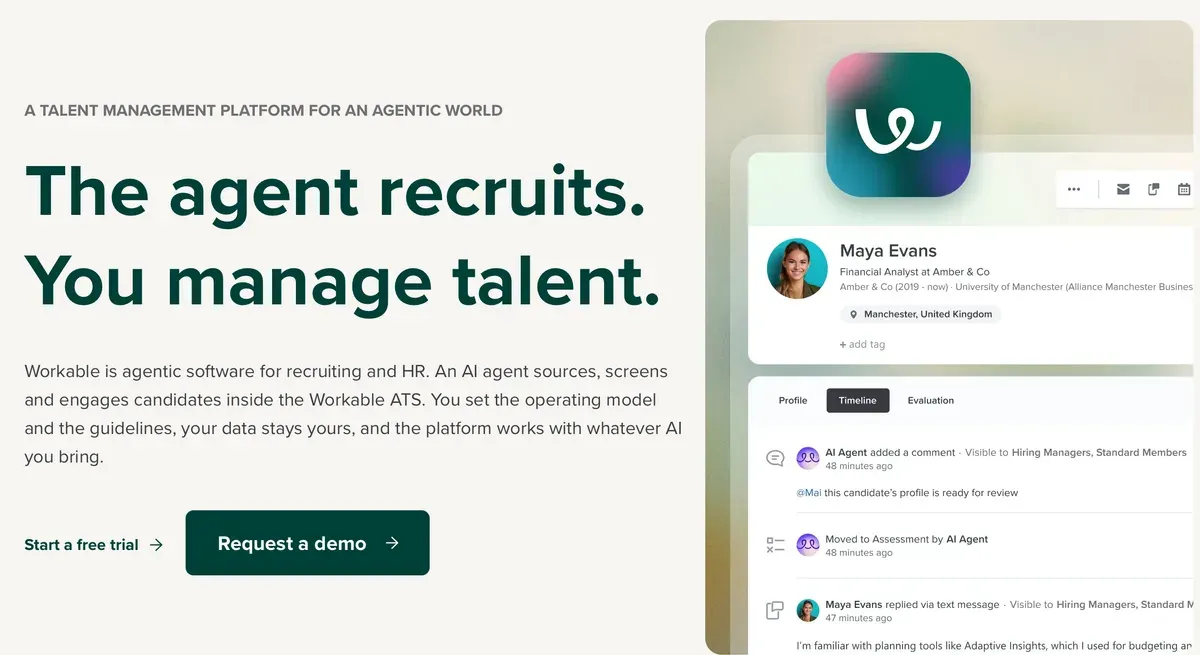
Workable serves over 35,000 companies per its customer page and is known for sourcing reach, including one-click posting to 200+ job boards. It targets small to mid-sized businesses that want AI-powered matching and multilingual support for international hiring.
Good for mid-market teams with international hiring needs and a budget for add-ons.
Pros
-
One-click posting to 200+ job boards from a single screen
-
Large built-in candidate database supports proactive sourcing
-
Multilingual support and localization help with international hiring
Cons
-
Texting, video interviews, and assessments cost extra, pushing Standard to about $556/month
-
Some users report reporting customization feels limited
For companies with 1-20 employees billed annually, the Standard plan starts at $299/month, but adding texting, video interviews, and assessments brings real spend to about $556/month. The Premier plan bundles those features at $599/month. Some users report that reporting feels rigid.
Greenhouse
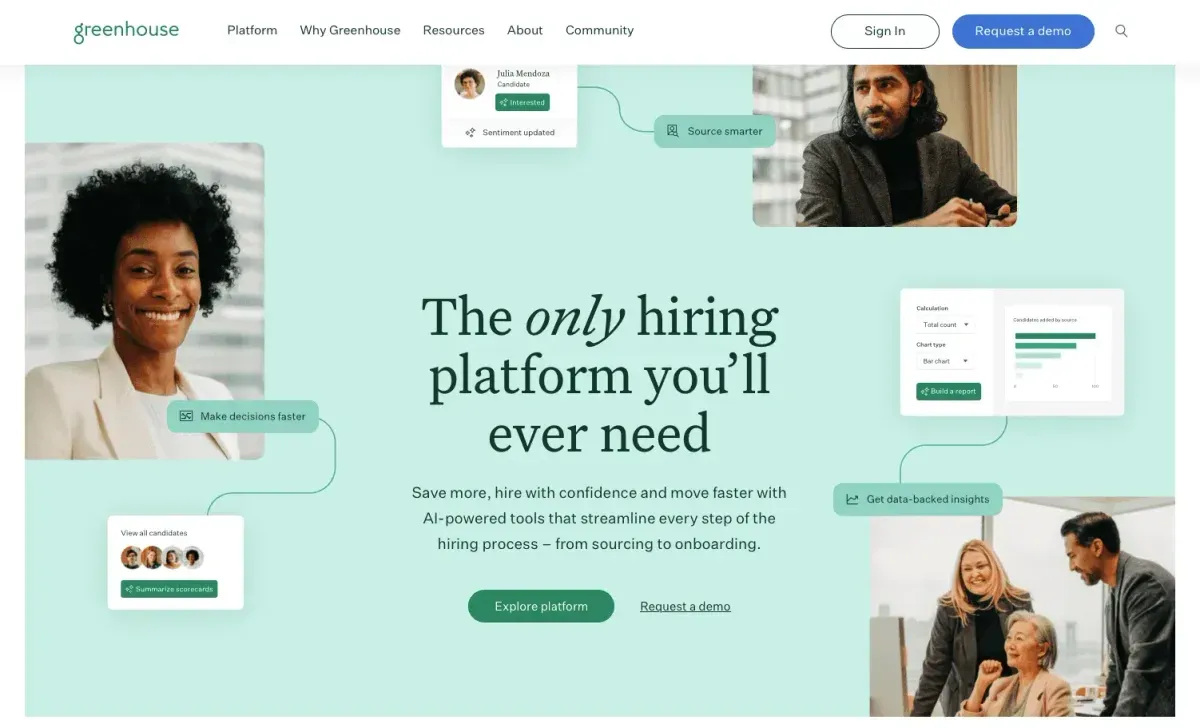
Greenhouse serves mid-size to enterprise companies that want every hiring decision to be structured and evidence-based. Each role gets a customized plan with defined stages, interview kits, and scorecards.
Good for companies with 100 to 10,000+ employees hiring regularly with dedicated recruiting teams and compliance needs.
Pros
-
Structured scorecards, interview kits, and DEI analytics come built in
-
400+ pre-built integrations across HRIS, assessments, and onboarding tools
-
Strong fit for evidence-based hiring with defined stages per role
Cons
-
Advanced analytics and sourcing tools are excluded from the Core tier
-
Implementation can add $1,000 to $15,000 on top of subscription
-
Structured setup may feel heavy for teams without dedicated recruiters
Greenhouse pricing is quote-based, and third-party data puts the Core tier at $6,000-$10,000/year for companies under 50 employees. Core excludes advanced analytics, onboarding, and sourcing tools most teams need within a year. Implementation runs $1,000 to $15,000, and buyers often see 8 to 15% annual increases at renewal.
Lever
Lever combines ATS functionality with candidate relationship management through its LeverTRM product, making it a fit for mid-sized teams that nurture passive candidates over time.
Good for companies with dedicated recruiting teams focused on DEI initiatives and long-term candidate relationships.
Pricing is quote-based, with third-party estimates around $6 to $8 per employee monthly. Some users report that Boolean search and reporting feel limited.
Pros
-
Unified ATS and CRM tracks applicants and sourced prospects together
-
Strong tools for nurturing passive candidates over longer timelines
-
AI Interview Companion and AI Screening Companion support interviews and screening
Cons
-
Some users report Boolean search and reporting tools feel limited
-
Costs can climb quickly as headcount or add-ons grow
-
CRM features go underused if passive nurturing isn’t a focus
Lever works well if passive candidate nurturing is a core part of your hiring strategy. If it isn’t, you’re paying for CRM features you may rarely use.
Why Dover Is the Best Applicant Tracking System
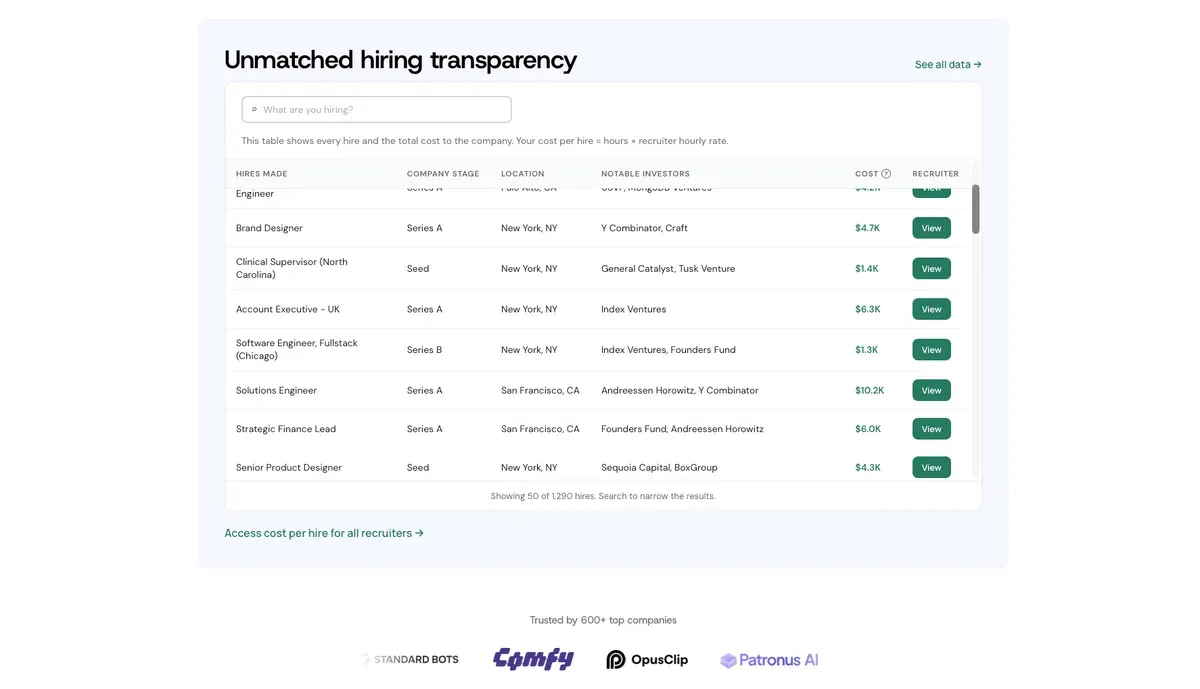
The ATS is free, unlimited, and ready in minutes, with no seat limits or caps on active jobs. A small team can post to 50+ job boards, build a career page, and track every candidate without paying for software. Setup typically takes minutes in a spreadsheet-like interface, which suits founders who need to start hiring this week instead of after a long implementation. Many of the other tools in this comparison add per-seat pricing, implementation fees, or add-ons as your team grows, and that cost structure can work against early-stage companies with uneven hiring volume.
When you need more than software, Dover’s optional recruiter marketplace offers hourly access to fractional recruiters, with no long-term contracts. Across all roles, companies spend roughly $4,800 per hire on average this way, and you can scale support up or down as roles open and close. Recruiters and your internal team work from the same ATS, so sourcing activity, candidate flow, and pipeline metrics stay visible to everyone in real time, and pipeline visibility doesn’t break down when an engagement ends.
FAQs
How do I choose the right applicant tracking system for my company size?
Early-stage startups hiring 5-50 roles annually typically need simplicity and low costs, so a free or low-cost system with fast setup works well. Mid-sized companies with dedicated recruiting teams can support tools like Greenhouse or Lever for structured workflows and DEI analytics. Enterprises often need systems like Workday or iCIMS for broader HR integration, though these add implementation overhead.
How does an ATS parse and rank resumes?
ATS software scans resumes for keywords and qualifications matching the job description, and can score candidates on skill and experience fit, filtering out unqualified applicants so a human reviewer starts with a shorter list. Dover’s AI resume review, part of its $199/month premium plan, scores applicants against role-specific criteria, with the hiring team making the final call.
Do I need a recruiter if I’m already using an ATS?
Not always, since an ATS doesn’t source passive candidates, run outreach, or conduct screening calls on its own. When those tasks pile up, a fractional recruiter can work inside the same ATS on an hourly basis instead of a full-time hire. With Dover, recruiters bill hourly, cost roughly $4,800 per hire on average across all roles, and share the same pipeline as your team.
Final Thoughts on Picking an Applicant Tracking System
The right applicant tracking system depends on your hiring volume and whether you have dedicated recruiting support. Dover gives you a free ATS with no seat or job limits, so you can start immediately and add recruiter help only when you need it. Most early-stage teams find that mix works better than paying for enterprise software they won’t use. The best fit usually comes down to matching software cost and recruiting support to the stage you are in today, instead of the stage a vendor expects you to grow into.