

Tracking your hiring metrics the wrong way costs you the best candidates in a competitive market. Time-to-hire vs time-to-fill is where that confusion most often starts, and treating them as the same metric means missing the diagnostic insights that could cut recruiting timelines by weeks. These are two separate metrics pointing to different breakdown points. Let’s break down both so you can make smarter hiring decisions in 2026.
TLDR:
- Time-to-hire tracks a candidate’s pipeline entry to offer acceptance; time-to-fill starts at requisition approval instead.
- Hourly fractional recruiters can cut average cost-per-hire compared with fixed percentage-based agency placement fees.
- AI-assisted screening and scheduling can reduce admin work while people still make final hiring decisions.
- Pairing an ATS with automated metrics tracking and fractional recruiters can improve both speed and cost.
- Hiring delays often start before candidates apply, in internal approvals and sourcing gaps, though waiting between interview rounds also adds time.
What Is Time-to-Hire?
Time-to-hire measures the duration from when a candidate first applies or enters your recruitment pipeline until they accept your job offer. It zeroes in on individual candidate progression, making it a key indicator of how well your process works. The best engineers and product managers get snapped up quickly, and a slow time-to-hire often means losing them to faster competitors.
What Is Time-to-Fill?
Time-to-fill typically measures the recruitment cycle from job requisition approval until a candidate accepts the offer. It captures the major stages of the recruiting process, including internal approvals, budget sign-offs, writing job descriptions, posting roles, sourcing candidates, interviewing, and final negotiations.
Time-to-Hire vs Time-to-Fill Key Differences
The biggest mistake startups make is treating these metrics as interchangeable. Each measures a different aspect of your hiring process, pointing to different breakdown points. Three core differences:
- Starting Points: Time-to-hire starts at application; time-to-fill starts at requisition approval.
- Scope: Time-to-hire covers the candidate’s journey; time-to-fill covers the full requisition-to-offer cycle.
- Purpose: Time-to-hire reveals candidate experience; time-to-fill reveals organizational readiness.
| Time-to-Hire | Time-to-Fill | |
|---|---|---|
| Measures | Candidate journey from application to offer acceptance | Full hiring cycle from job requisition approval to offer acceptance |
| Starts when | Candidate applies or enters pipeline | Job requisition is approved |
| Ends when | Candidate accepts the offer | Candidate accepts the offer |
| Reveals | Interview process quality and candidate experience gaps | Internal planning delays and organizational readiness |
| Best used for | Optimizing how candidates move through your process | Improving resource allocation and headcount planning |
Although these metrics differ, both matter: one sharpens candidate experience, the other sharpens organizational planning. Use time-to-hire to tune your interview process and candidate experience. Use time-to-fill to improve organizational planning and resource allocation.
How to Calculate Time-to-Hire and Time-to-Fill
The formulas are straightforward; what matters is recording the right dates consistently. Time-to-fill needs the requisition approval date, which many systems don’t capture on their own, so log it when the role is approved.
Time-to-Hire Formula: Time-to-Hire = Offer Acceptance Date - Application Date
Time-to-Fill Formula: Time-to-Fill = Offer Acceptance Date - Job Requisition Approval Date
Consider the following example:
- Sarah applies for your product manager role on January 5th
- She accepts the offer on January 28th
- Her time-to-hire was 23 days
The job requisition was approved on December 15. Because Sarah accepted the offer on January 28, the role’s time-to-fill was 44 days.

An Applicant Tracking System (ATS) can calculate both metrics automatically, with averages by role, department, or hiring manager, alongside the other recruiting metrics startup founders track.
Industry Benchmarks for Time-to-Hire in 2026
Employer hiring timelines and candidate job-search durations measure different things. Recent labor market survey data puts the average candidate job search at roughly 6.6 months, while employer time-to-hire is generally measured in days from a candidate’s entry into the pipeline to offer acceptance.
Industry averages vary by source and by where each source starts the clock. Gem’s 2024 customer data and SmartRecruiters’ 2023 to 2024 medians, compiled in MSH’s 2026 time-to-fill benchmarks, show:
- Financial Services: 63 days on average (Gem)
- Technology and IT Services: 48 days (Gem average and SmartRecruiters median)
- Healthcare: 41 days median (SmartRecruiters)
- Hospitality: 39 days median (SmartRecruiters)
- Manufacturing: 36 days on average (Gem) to a 55 day median (SmartRecruiters)
- Retail: 25 days median (SmartRecruiters)
A Closer Look: Technology Startup Time-to-Hire
Tech roles often take longer to hire because teams screen closely for both technical depth and team fit. In Gem’s 2024 data, compiled in the MSH benchmarks above, IT and information security roles averaged 58 days to hire and engineering and design roles 53 days. Smaller teams often have fewer approvers, but they still compete with larger employers for the same engineers, so a slow loop can cost candidates. Structured interview plans and clear pre-screening criteria can shorten tech hiring timelines, though results vary by role and seniority.
Don’t Just Optimize for Speed, Optimize for Cost Too
Speed is only half the story. A fast time-to-hire can still be expensive if it relied on search firms charging a percentage of first-year salary.
Cost-per-hire measures the total expense of filling a position, including both internal and external recruiting costs. The standard formula is:
Cost-per-hire = (Internal Recruiting Costs + External Recruiting Costs) / Total Number of Hires
Internal costs include recruiter salaries, hiring manager time, and tools. External costs cover job board postings, agency fees, and background checks. Recruiter salary becomes a fixed cost once you decide when to hire a full-time recruiter.
Average Cost-Per-Hire by Industry 2026
According to SHRM’s 2026 recruiting benchmarking data, the median cost per hire was $1,300 for nonexecutive positions and $15,000 for executive positions.
Widely cited cost-per-hire estimates by industry (figures vary by source and by which costs are counted):
- Retail / Hospitality: $2,700
- Technology: $6,200-$8,000
- Healthcare: $9,000-$12,000
- Skilled Trades: $12,000+
- Legal / Professional Services: $16,000-$20,000
These industry figures come from varied, unlinked sources and count different cost components than SHRM’s median, so treat them as rough directional ranges rather than a direct comparison with the SHRM figures above. Cost-per-hire continues to rise as sourcing becomes more competitive and companies spend more on recruiting software, job advertising, recruiter salaries, and agency fees. Some benchmark data suggests technical and compliance-heavy industries tend to see higher hiring costs due to talent shortages and longer hiring cycles.
What the Latest Hiring Data Shows for Late 2026
SHRM’s 2026 recruiting benchmarking puts median time-to-fill at 39 calendar days for nonexecutive roles, with executive time-to-fill holding steady year over year. SHRM’s measure runs requisition to accepted offer, matching time-to-fill, so compare your own numbers against benchmarks using the same start and end dates.
How to Speed Up Your Time-to-Hire
A few process changes can shorten time-to-hire without expensive tools, though results vary by role and team:
- Respond Quickly: Replying within 24-48 hours helps retain candidate interest.
- Simplify Your Interview Process: Two thorough panel interviews can replace five separate rounds.
- Use Pre-Screening Assessments: An AI resume scoring tool can rank candidates before manual review begins.
- Improve Candidate Communication: Clear timeline expectations help candidates move faster through your process.
- Bring in Fractional Recruiting Support: A fractional recruiting partner can deliver interview-ready candidates, cutting days off your timeline.
According to Gem’s 2025 recruiting benchmark data, hiring teams ran more interviews per hire in 2024 than in 2021 (20 versus 14), and average time to hire rose from 33 to 41 days over the same period.
Two Ways to Shorten Your Interview Timeline
A large share of calendar time in a hiring process can go to waiting between interviews instead of interviewing itself. A four-round loop with three days of scheduling per round can add two weeks without adding a single hour of evaluation. Two changes attack that waiting directly.
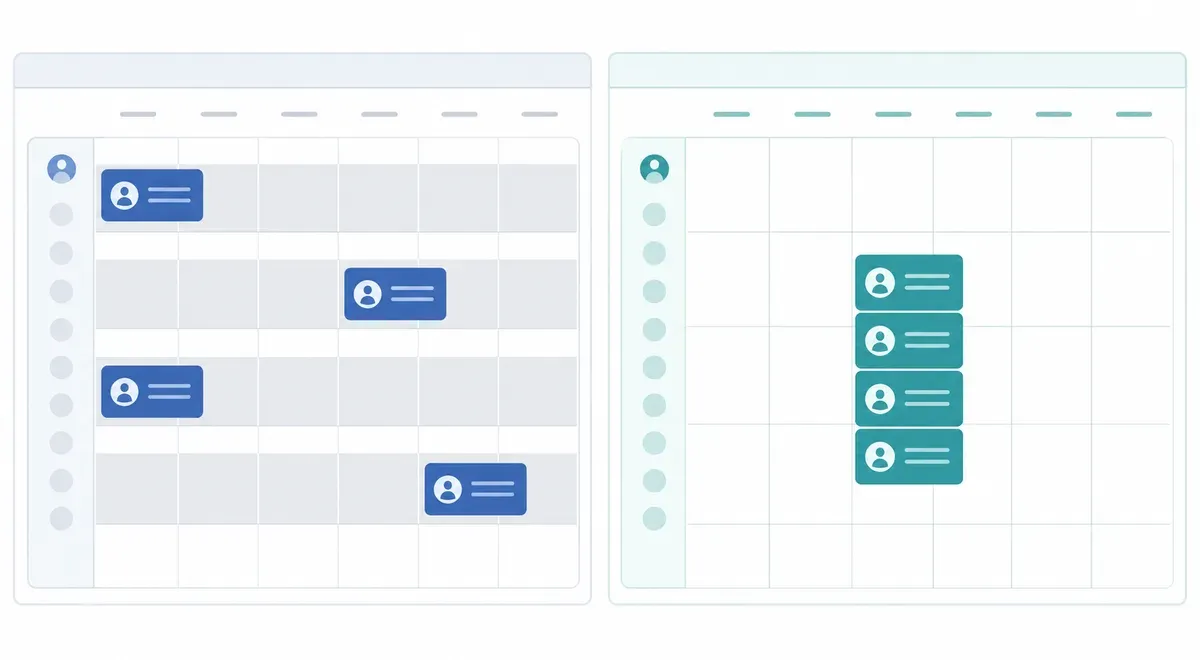
Batch your rounds into a single day
Instead of scheduling rounds one at a time, block one day with every interviewer on the panel. Candidates get a clear picture of the team in one sitting, and you collect all your signal at once.
The scheduling coordination becomes a one-time cost per candidate instead of a recurring one per round. Teams that make this switch commonly pull a week or more out of their loop. Our guide to improving your interview process covers how to structure the panel.
Take first-round screens off your calendar
The first-round phone screen is the highest-volume, lowest-leverage step, and it usually gates everything behind it. When a founder owns every screen, throughput is capped by that one calendar.
Delegating screens to a recruiter, whether internal or fractional, removes that ceiling. See more on the tradeoffs in why startups should delegate initial phone screens, and our first-round phone screen tips.
One caution: compressing the calendar is not the same as lowering the bar. Keep the same scorecards and evaluators.
Hiring Technology That Cuts Your Timeline
With the right automation, manual steps that used to take days can happen in minutes:
- AI-Powered Resume Screening: AI can rank applicants before resumes reach your desk.
- Automated Interview Scheduling: Candidates book directly into open slots on your calendar.
- Broad Job Board Distribution: One posting reaches dozens of job sites at once.
- Integrated Communication: Automated sequences keep candidates informed between each step.
Startups that adopt recruiting automation typically see the biggest gains in screening and scheduling, with people still making the hiring decisions.
How Dover Helps You Improve Time-to-Hire and Time-to-Fill
Getting accurate readings on both metrics starts with consistent data capture, and that’s where most startups lose ground. Application dates, offer timestamps, and requisition approvals tend to scatter across spreadsheets and email threads instead of living in one system.
Dover’s free ATS records application and offer activity in one place, with reporting dashboards covering pipeline, sources, and hires, so you can see roughly where candidates stall. Requisition approval dates aren’t tied to an approval workflow since Dover has no layered job-creation approval step, so a team generally needs to log that date on its own when a role gets approved in order to calculate time-to-fill.
On the cost side, Dover’s fractional recruiters bill for hours worked, with each recruiter setting their own rate, tying hourly cost to work done instead of a candidate’s salary. Every hire’s all-in cost gets published in a public cost-per-hire table. Because they work inside the same ATS as your team, metrics stay visible in one place.
FAQs
How do I calculate time-to-hire vs time-to-fill for my startup?
Time-to-hire = Offer Acceptance Date - Application Date, while time-to-fill = Offer Acceptance Date - Job Requisition Approval Date. You can use a free ATS to automatically track both metrics instead of managing data manually across spreadsheets and emails.
What’s the main difference between time-to-hire and time-to-fill?
Time-to-hire measures the candidate’s journey from application to offer acceptance, while time-to-fill tracks the broader organizational process from job requisition approval to offer acceptance. Time-to-hire focuses on candidate experience, while time-to-fill reveals internal inefficiencies and total business impact.
When should I be concerned about my startup’s hiring speed?
If you are consistently losing quality candidates, it’s time to dig into the data. If your time-to-hire exceeds industry benchmarks, you are probably losing a large portion of qualified candidates to faster competitors.
What tools can post jobs to multiple boards at once without paying per listing?
Many applicant tracking systems include multiposting that sends each role to free organic listings on boards such as Indeed and Google for Jobs, while sponsored or premium placements usually still cost extra. Dover’s free ATS posts unlimited jobs to 50+ job boards, including Indeed, with no per-listing fee. Verified venture-backed startups can also list roles for free on Dover Startup Jobs, with applications flowing into the same ATS.
Final Thoughts on Optimizing Your Hiring Metrics
Getting time-to-hire vs time-to-fill right shows you where your recruiting process breaks down. Delays can build up in internal approvals, candidate sourcing, and the waiting between interview rounds, and the split varies by team. Dover’s free ATS keeps application and offer activity in one place, so you can see where time is slipping away by role or department. Pairing that data with hourly fractional recruiting support, where cost tracks work done instead of salary, may lower both time-to-fill and cost-per-hire over a year of hiring.