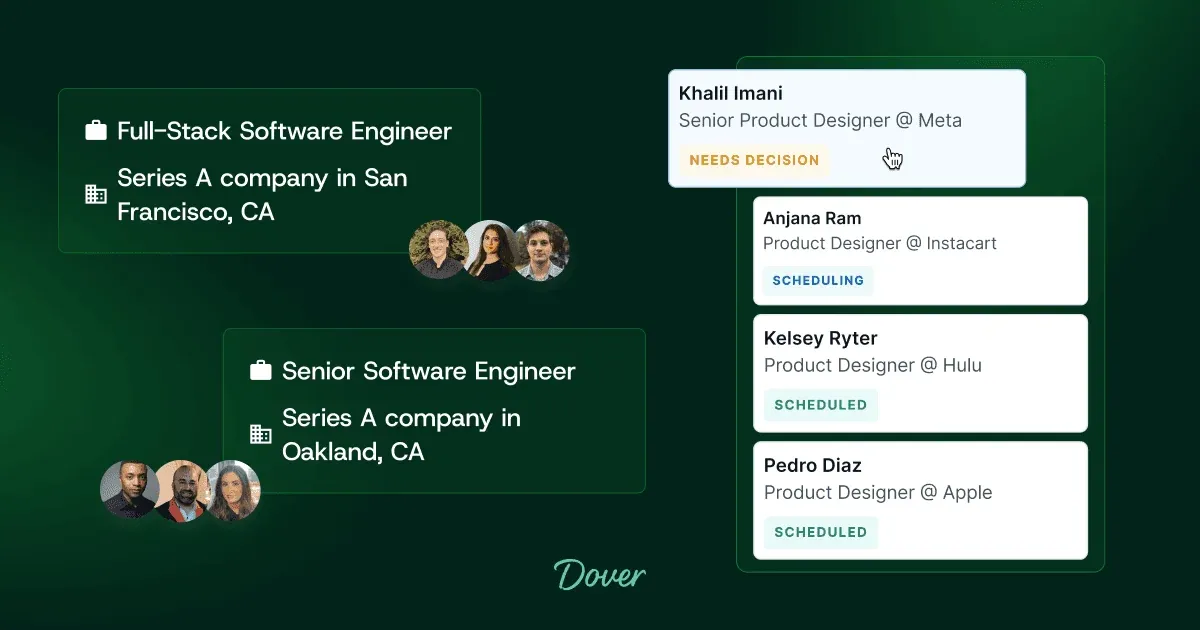

Your job postings are live, but the crickets are deafening. Meanwhile, your competitors are somehow hiring amazing people who never applied to anything. The secret isn’t luck; it’s that they’ve moved beyond traditional recruiting to advanced candidate sourcing that finds talent before they even think about job hunting. This guide covers everything from AI-powered automation to creative sourcing in Discord channels and GitHub repos, giving you the playbook to build a pipeline of candidates who actually respond and interview.
TLDR:
-
Passive candidates make up most of the workforce and deliver higher quality hires than active applicants.
-
AI-powered screening cuts time-to-hire while Boolean search filters thousands of profiles fast.
-
Employee referrals reduce hiring costs by $1,000 per hire and cut time-to-fill by 31% (about 13 days).
-
Multi-channel sourcing across LinkedIn, GitHub, niche communities, and referrals outperforms single-source strategies.
-
Some tools combine a free ATS with on-demand recruiting support, giving teams both the infrastructure and human capacity to run sourcing without adding full-time headcount.
Understanding Candidate Sourcing in 2026
Candidate sourcing is the proactive process of identifying, researching, and engaging potential candidates for open roles before they apply. Instead of waiting for applications, recruiters actively hunt for talent.
Job postings alone no longer work when most workers are passive candidates who aren’t actively job searching. These professionals might consider the right offer, but won’t see a job board listing.
There are two main approaches:
-
Active sourcing targets candidates currently job hunting and responding to postings
-
Passive sourcing focuses on working professionals who aren’t looking but could be persuaded with the right opportunity and outreach
Companies that rely solely on inbound applications miss most available talent. Proactive sourcing accesses a larger pool of qualified candidates, including people with rare skills who are already performing well in their current roles.
AI-Powered Candidate Sourcing Revolution
AI has changed how recruiters find and assess candidates. Résumé screening that once took hours now happens in seconds. Automated systems parse thousands of profiles across job boards and professional networks, identifying candidates who match specific requirements.
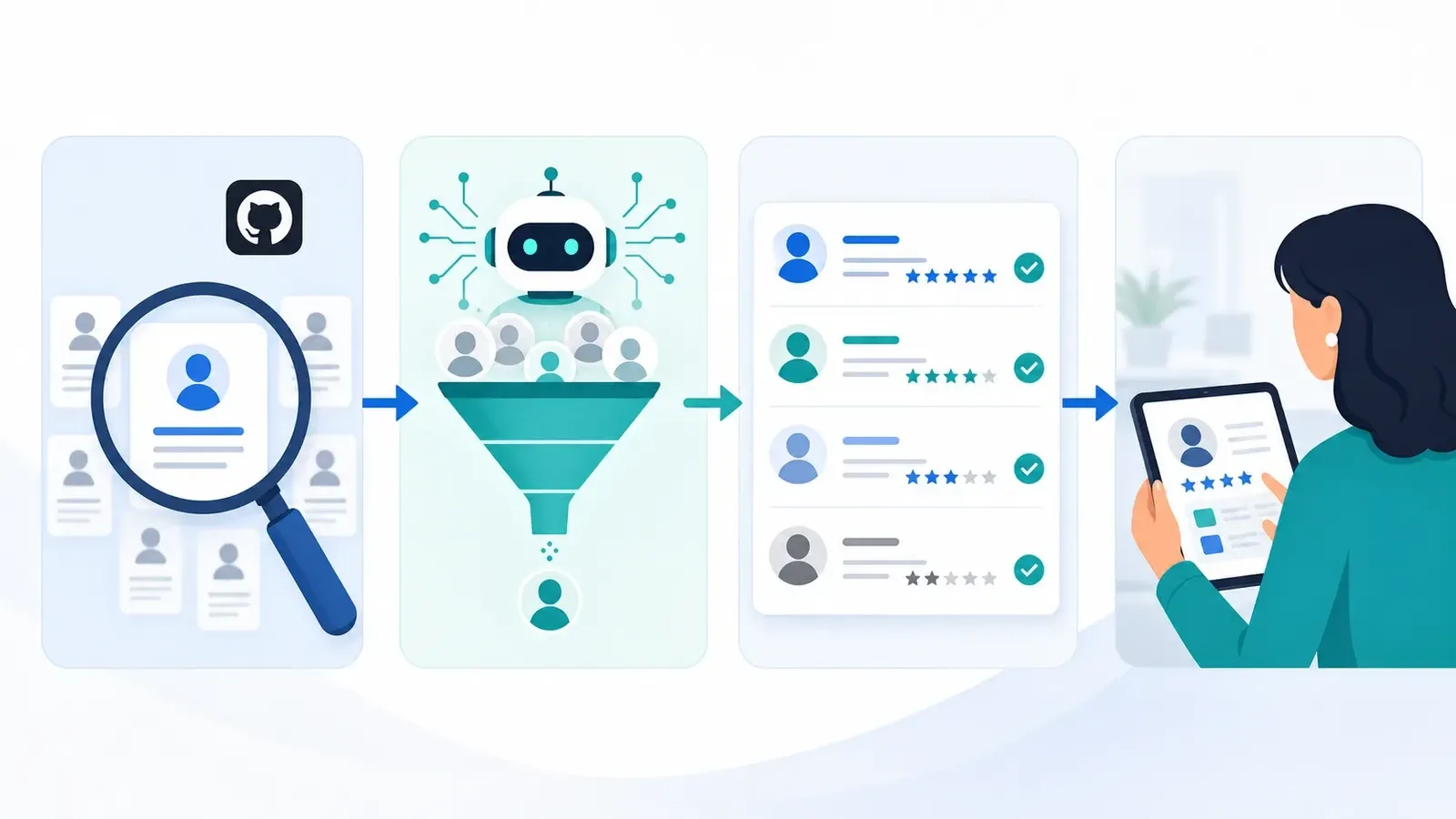
Companies using AI-powered assessments report faster hiring cycles, while AI recruiting tools inside an ATS can reduce time-to-hire. These gains come from automating repetitive tasks like résumé sorting, initial qualification checks, and first-round screening questions.
Practical AI sourcing applications include:
-
Automated LinkedIn profile discovery based on skills, experience, and career progression patterns that match your requirements
-
Email finder tools that locate contact information and generate personalized outreach messages at scale
-
Résumé scoring systems that rank applicants against job requirements to surface the strongest matches
-
Chatbots that engage candidates with qualifying questions and schedule initial conversations without recruiter involvement
The best approach combines AI for initial identification and screening with human judgment for relationship building. AI excels at data-heavy work, letting recruiters focus on actual candidate engagement and detailed conversations about career motivations or cultural fit.
Passive Candidate Sourcing Strategies
Passive candidates make up about 70% of the global workforce but rarely browse job boards. They’re working, satisfied, and not interviewing. Yet 73% of recruiters report finding higher quality hires through passive sourcing. Sourced candidates are also 5x more likely to be hired than inbound applicants, according to Gem’s 2025 Recruiting Benchmarks report.
Find passive talent using LinkedIn’s advanced search filters for specific skills, companies, and job titles. GitHub contributions reveal technical abilities for engineering roles. Industry conference speaker lists and publication authorship identify subject matter experts. Stack Overflow profiles and open source contributions surface active practitioners.
Initial outreach should acknowledge they’re not job searching. Lead with genuine interest in their work or a specific project. Ask for advice instead of pitching a role. The goal is conversation, not an immediate interview.
When presenting opportunities, focus on career growth over compensation. Passive candidates already have paychecks. What matters is learning opportunities, problem complexity, team quality, and impact potential. Focus on challenges they can’t solve in their current role and specific projects they’d own.
Boolean Search Mastery for Precision Targeting
Boolean search operators filter thousands of profiles to surface exactly who you need. According to Gem’s 2026 Recruiting Benchmarks Report, the average recruiter juggles 13.4 open roles at once, making precision search a necessity rather than a luxury.
Core operators work across LinkedIn, GitHub, and job boards:
| Operator | What It Does | Example |
|---|---|---|
| AND | Narrows results by requiring all terms to appear | software engineer AND python AND “machine learning” |
| OR | Expands your pool by matching any of the listed terms | designer OR “UX researcher” OR “product designer” |
| NOT | Excludes profiles containing the specified term | developer NOT intern NOT junior |
| “ “ (Quotes) | Finds an exact phrase instead of individual words | “growth marketing” (vs. growth marketing without quotes) |
| ( ) (Parentheses) | Groups terms to control how logic is applied | (Java OR Kotlin) AND Android |
Employee Referral Programs as Sourcing Accelerators
Employee referral programs consistently rank as the top sourcing channel, with 71.3% of employers relying on them, according to iHire’s 2025 State of Online Recruiting report. They cut hiring costs by roughly $3,000 per hire while reducing time-to-hire by about 15 days, with referral hires typically closing in around 29 days compared to 44 days for other channels.
Your employees know people who could excel at your company. They understand your culture and can pre-qualify candidates informally before making introductions.
Building a Referral Program That Actually Works
Keep submissions simple. Skip lengthy forms. A Slack channel or dedicated inbox where employees forward LinkedIn profiles works better than complex submission systems.
Drive engagement beyond cash bonuses:
-
Recognize top referrers publicly in team meetings
-
Share updates when referred candidates get hired
-
Create friendly competition with leaderboard tracking by department
Multi-Channel Sourcing Strategy Development
Relying on a single sourcing channel limits your talent pool. Successful recruiters distribute efforts across LinkedIn, niche job boards, employee networks, and direct outreach.
Map where your target candidates spend time across all recruitment sources. Engineers gather on GitHub and Stack Overflow. Sales professionals engage on LinkedIn and industry conferences. Creative roles showcase work on Dribbble or Behance.
Track source-of-hire metrics monthly for each channel. If 40% of your best hires come from referrals but you spend only 10% of sourcing time on referral activation, you’re misallocating resources.
| Channel | Best For | Typical Cost | Speed to Results |
|---|---|---|---|
| Employee Referrals | Culture-fit hires from trusted networks | Low (bonus only) | Fast (days to weeks) |
| LinkedIn Direct Outreach | Passive professionals in known roles | Low to medium | Medium (weeks) |
| Niche Communities (GitHub/Discord/Reddit) | Specialists with rare or deep skills | Free | Slow (relationship-first) |
| ATS + Fractional Recruiter | Hard-to-fill or high-volume searches | Medium (per-hire basis) | Fast with expert support |
Budget Allocation Across Channels
Free channels like employee referrals and direct LinkedIn outreach should anchor your strategy. Paid job board postings work for high-volume roles where speed matters. Specialized recruiters or sourcing tools make sense for hard-to-fill positions where time-to-hire costs exceed tool costs.
Multi-channel sourcing tools handle discovery and pipeline visibility well for most roles. Senior or highly specialized positions, though, often require a human layer on top, someone who can own candidate engagement and build relationships that automated outreach cannot replicate. A fractional recruiter working inside the same ATS covers sourcing and outreach for those harder searches, giving a team both the infrastructure and the capacity without having to choose between self-serve software and a full traditional agency. Teams that need on-demand recruiting capacity on short notice can also explore a recruiter marketplace to quickly match with vetted specialists. Whether that tradeoff is worth it depends on the role complexity and how much recruiter time your team can absorb internally.
Data-Driven Sourcing Performance Optimization
Track five core metrics to measure sourcing effectiveness: response rate (replies per 100 messages sent), conversion rate (candidates who interview per 100 contacted), time-to-respond, source-of-hire by channel, and cost-per-qualified-candidate.
A/B test outreach variables systematically. Send two subject line versions to equal audience segments, measure open rates after 48 hours, then scale the winner. Test one element at a time: message length, personalization depth, or call-to-action phrasing.
Creative Sourcing Techniques beyond Traditional Methods
Hidden talent often gathers in niche online spaces that traditional recruiters overlook. Reddit threads, Discord servers, and Slack groups host practitioners solving real problems in real time. A developer debugging React hooks or a marketer sharing growth tests in these spaces may never update their LinkedIn profile, so join these communities, contribute value, and build rapport before mentioning open roles.
Twitter offers direct access to people showing their work openly through technical threads, project announcements, and industry commentary. Engineers posting debugging walkthroughs show both skill and clarity, while creators building audiences show strong marketing instincts.
Podcast guests and newsletter authors show expertise through long-form content, which makes Apple Podcasts and Substack useful for finding people who’ve already built visible credibility.
Candidate Sourcing in September 2026
AI sourcing has moved from experimental to standard practice. According to SHRM’s 2025 Talent Trends survey of over 2,000 HR professionals, 51% of organizations now use AI specifically for recruiting, up from 26% in 2024. Agentic AI tools that handle multi-step sourcing workflows, from profile discovery through outreach sequencing, are now in production use at growing teams.
One trend worth noting: candidates are checking how companies use AI before they even apply. Job seekers increasingly want to see that AI supports the process without replacing human judgment in it. That puts a premium on outreach that reads like a real person wrote it, not a sequence tool.
For sourcers, the practical takeaway is clear: automation handles volume, but the quality of your message and the specificity of your research on each candidate drive replies. A personalized note referencing someone’s actual work will outperform a high-volume sequence every time, especially now that candidates are more aware of how recruiters use AI to reach them at scale.
Why Dover Matters for Modern Recruiting
Dover helps startups hire faster without adding extra headcount or juggling multiple tools. Its free ATS, AI-based resume scoring, automated scheduling, and simple careers page builder keep your entire pipeline in one place.
AI That Actually Reduces Work
Dover’s AI filters applicants, ranks resumes, and identifies high-match passive candidates across LinkedIn and GitHub. It cuts hours of manual triage and lets recruiters focus on conversations instead of admin.
Instant Passive Sourcing
The Chrome extension turns any profile into a sourcing lead, find email, draft outreach, and queue it into a cadence in seconds. This is how teams scale passive sourcing without adding headcount.
Post Everywhere at Once
One click distributes your job to 100+ boards. No separate accounts, no renewals, no formatting headaches.
Referrals Without Friction
Employees submit profiles through a simple link, and Dover tracks everything automatically. No portals, no forms, no drop-off.
On-Demand Recruiters When You Need Them
For hiring spikes, Dover gives you access to vetted startup recruiters on an hourly basis, typically $75 to $125/hour, far cheaper and more flexible than agencies. Because those recruiters work inside the same ATS you’re already using, there’s no handoff friction; your pipeline visibility stays intact, candidate notes stay in one place, and the search picks up without rebuilding context from scratch.
FAQs
What is the difference between active and passive candidate sourcing?
Active sourcing targets candidates currently job hunting and responding to postings, while passive sourcing focuses on employed professionals who aren’t actively looking but might consider the right opportunity.
How do I reach passive candidates who aren’t on job boards?
Find passive talent through LinkedIn advanced search, GitHub contributions, industry conference speaker lists, and niche online communities like Reddit threads or Discord servers. Initial outreach should acknowledge they’re not job searching and focus on their work or projects instead of immediately pitching a role.
Do I need a recruiter if I already use an ATS?
An ATS handles pipeline management, job distribution, and resume screening well. For standard or high-volume roles where candidates are actively applying, self-serve is often enough. The gap shows up with senior, technical, or niche roles where passive candidates are not going to find the posting on their own. In those cases, the ATS gives you the infrastructure, but it does not generate the sourcing activity or candidate conversations needed to fill the role. A fractional recruiter working inside the same ATS can own outreach and sourcing for those harder searches without requiring a separate system, a long-term agency contract, or a full-time hire.
Why do employee referrals produce better hiring outcomes?
Referrals cut hiring costs by roughly $3,000 per hire and reduce time-to-hire by about 15 days because employees pre-qualify candidates who already understand your culture. 82% of employers rate referrals as delivering the best ROI compared to other sourcing channels.
Final Thoughts on Proactive Recruiting
Advanced candidate sourcing works best when you reach talent that never shows up on job boards, using sharp Boolean search skills, strong referral channels, and creative outreach in the places where your ideal candidates actually spend their time. Start small, test what draws people in, and build on the methods that bring you candidates who follow through and join your team, especially with the help of Dover, which adds extra power to your sourcing efforts.