

Recruitment marketing has changed quickly in recent years. The ‘post and pray’ era is long gone. Startups today compete in a market where top talent expects personalized, data-driven, and authentic outreach. In 2026, effective recruitment marketing strategies depend on treating candidates like customers, using automation and AI to scale relationships without losing the human touch. The best hiring teams are using integrated, all-in-one recruiting solutions that simplify sourcing, personalize engagement, and can shorten time-to-fill.
TLDR:
-
Recruitment marketing in 2026 treats candidates like customers, using personalized, multi-channel outreach that builds long-term relationships.
-
AI and automation can save hours each week and scale personalized outreach, though human judgment still matters for quality hires.
-
Developer recruiting tends to work best when teams prove technical credibility through open-source work, engineering write-ups, and community participation.
-
Tracking cost-per-hire, time-to-fill, and source-of-hire quality shows which channels deserve more of your budget.
-
Some tools pair free ATS software with on-demand recruiting support, which can cost much less than traditional agency fees for startups.
What Makes Recruitment Marketing Different in 2026?
Recruitment marketing is the practice of applying marketing methods, such as branding, content, personalization, and multi-channel engagement, to attract, engage, and retain talent, instead of relying on transactional post-and-wait recruiting. The recruitment marketing field has shifted dramatically over the past few years. Employers no longer compete only on salary and benefits. Today’s candidates expect personalized experiences, authentic employer branding, and transparent communication throughout the hiring process.
The biggest change? Data-driven personalization at scale. Companies that succeed in 2026 use sophisticated targeting to reach passive candidates with the right message at the right time. This isn’t about blasting generic job posts across every channel. It’s about understanding candidate behavior, preferences, and career motivations.
How AI and Automation Are Changing Recruitment Marketing

LinkedIn’s Future of Recruiting research found that talent acquisition professionals using generative AI save about 20% of their work week, roughly one full workday. But the real value is its ability to personalize outreach at scale while maintaining authentic human connections.
The most effective AI applications focus on three areas: candidate screening, personalized messaging, and predictive analytics. Smart companies use recruitment automation software and AI to handle the repetitive tasks so their recruiters can focus on relationship building and strategic conversations.
However, there’s an important balance to strike. Over-automation can make your recruitment marketing feel robotic and impersonal. The best AI recruiting tools improve human skills instead of replacing them entirely.
Benefits and Risks of AI in Recruitment Marketing
Benefits:
-
Faster candidate screening when paired with human review
-
Personalized outreach that can scale across many candidates
-
Predictive insights that can inform candidate fit assessments
Risks:
-
Outreach that can feel impersonal if over-automated
-
Potential bias introduced through algorithmic screening
-
Heavy reliance on AI that can weaken human judgment
Social Media Recruitment Marketing That Converts
Social media recruiting has matured beyond posting job openings on LinkedIn. With 98% of hiring teams now using social media, according to recruiting statistics from SelectSoftware Reviews, the companies that win are those with sophisticated, channel-specific strategies.
-
LinkedIn remains the powerhouse for professional recruiting, but the approach has evolved. Instead of generic InMails, successful recruiters create value-first content that attracts candidates organically. This includes industry insights, career advice, and behind-the-scenes company content.
-
X (formerly Twitter) has become surprisingly effective for tech recruiting, especially for developer and designer roles. The key is participating in relevant conversations and building genuine relationships before making any recruiting pitches.
-
Instagram and TikTok are gaining traction for employer branding, particularly when targeting younger talent. Companies that showcase their culture authentically on these channels see much higher application rates.
Recruitment Marketing Strategies Built for Developers
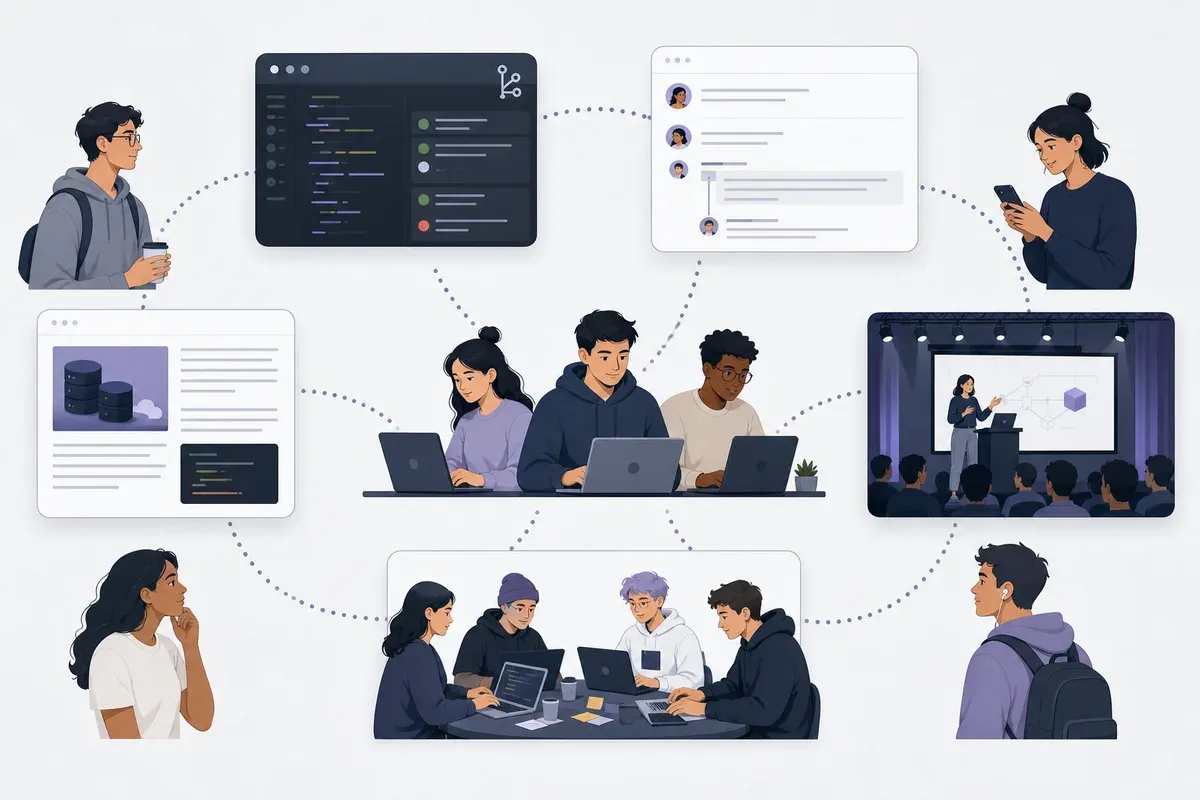
Developer recruiting works differently from most other hiring. Engineers tend to judge companies on technical credibility, not polished employer branding, and they often ignore templated outreach that reads like it was sent to a thousand other people. Winning developer attention typically means showing up in the places they already spend time and proving competence instead of just claiming it.
-
Contributing to open-source projects can show engineers that your team writes real code and invests in the broader community beyond internal tools.
-
Taking part in developer communities like GitHub, Stack Overflow, and Hacker News helps your team build a reputation before any job is ever posted.
-
Publishing engineering blog content and technical write-ups, such as a migration or scaling postmortem, gives candidates a genuine look at how your team solves hard problems.
-
Sponsoring or speaking at developer conferences and hackathons can put your team in front of engaged, technically minded candidates in a low-pressure setting.
-
Using developer-focused job boards and communities often surfaces candidates who are already filtering for technical roles, which can improve applicant quality.
A team that publishes a detailed postmortem on how it scaled its database during a traffic spike, then shares it on Hacker News and Stack Overflow, can attract engineers who found the writeup useful long before any role is open.
Building Talent Pipelines for Long-Term Success

A widely cited LinkedIn estimate from 2018 suggests that about 70% of the global workforce are passive candidates who aren’t actively looking for new opportunities. Recruitment marketing needs to focus on relationship building and long-term hiring needs.
The most successful companies treat talent pipeline development like sales pipeline management. They identify potential candidates months or even years before they need to hire, then nurture those relationships through valuable content and periodic check-ins.
Effective pipeline building requires four key components:
-
Candidate segmentation: Group potential hires by role, experience level, and career stage
-
Content strategy: Create resources that provide genuine value to your target candidates
-
Engagement tracking: Monitor how candidates interact with your content and outreach
-
Relationship nurturing: Maintain regular, non-pushy contact with high-potential candidates, using recruiting outreach templates to keep messages consistent
Content Marketing for Recruitment Success
Content marketing for recruitment goes far beyond job descriptions and company blog posts. The most effective recruitment content tackles candidate pain points, provides career development insights, and showcases authentic company culture.
Educational content performs exceptionally well in recruitment marketing. This includes industry trend analyses, skill development guides, and career advancement strategies. When candidates see your company as a source of valuable information, they’re more likely to consider you as a potential employer.
Case studies and success stories also drive strong engagement. Showcasing employee career progressions, interesting projects, and professional development opportunities gives candidates concrete reasons to be interested in your company. For example, a seed-stage startup might publish an engineering blog post on how it rebuilt its data pipeline, paired with a short employee spotlight video featuring one of its engineers. In the following weeks, the company can often see more inbound interest from passive developers and a higher application rate on its open engineering roles.
Video content has become particularly powerful for recruitment marketing. Behind-the-scenes office tours, employee interviews, and day-in-the-life content help candidates visualize themselves at your company.
Remember that candidate experience starts with your content. Every piece of content is an opportunity to make a positive first impression and set your company apart from competitors.
Key Recruitment Marketing Tools and Technologies
The recruitment marketing tool market has exploded over the past few years. The challenge isn’t finding tools, it’s selecting the right combination that integrates well and provides actionable insights.
The most effective recruitment marketing tools focus on four core areas: candidate targeting and personalization, multi-channel integration, analytics and reporting, and employer branding. Companies that succeed choose tools that perform strongly in these areas instead of trying to do everything.
CRM functionality has become important for managing candidate relationships over time. Top recruitment CRMs help you track every interaction and maintain consistent communication with potential hires.
How to Measure Recruitment Marketing ROI
Tracking the right numbers tells you whether your recruitment marketing spend and effort are paying off.
-
Cost-per-hire: This shows how much you spend across ads, tools, and recruiter fees for each filled role, which helps you compare channels and justify budget decisions.
-
Time-to-fill: Tracking how long a role stays open can reveal bottlenecks in sourcing, screening, or interview scheduling that slow down hiring teams.
-
Source-of-hire quality: Knowing which channels produce candidates who stay and perform well helps you put more budget behind the sources that work.
-
Candidate engagement rate: Email opens and content views show whether your messaging and employer brand content are landing with the audience you want to reach.
-
Offer-acceptance rate: A low acceptance rate can point to gaps in compensation, candidate experience, or how well expectations were set earlier in the process.
How Dover Fits Into Fractional Recruiting
Traditional recruitment agencies typically operate on contingency models, where payment depends on a placement. That structure can pull incentives toward filling roles quickly, which does not always line up with finding the strongest long-term fit for your company and candidates.
The fractional recruiting model changes this approach entirely. Instead of paying large fees only when someone gets hired, you work with experienced recruiters on a flexible basis (hourly or monthly retainer). This alignment means your recruiter is focused on building sustainable processes and finding genuinely great candidates.
Dover’s marketplace connects you with vetted fractional recruiters who specialize in your industry and role types. Unlike generic agencies that assign whoever is available, you can browse recruiter profiles, take free intro calls, and choose the person who understands your specific needs and challenges.
The cost difference is substantial. Traditional agencies typically charge a percentage of first-year salary, while fractional recruiting costs a fraction of that amount. For startups watching every dollar, this difference can make a huge impact.
Recruiting models compared
| Traditional Contingency Agency | In-House Recruiter | Dover Fractional Recruiting | |
|---|---|---|---|
| Cost structure | Percentage of first-year salary | Full salary plus benefits | $4,800 average cost per hire |
| Pricing model | Paid on placement | Fixed cost regardless of hiring volume | Hourly or retainer pricing, with per-hire options; refundable deposit; no long-term contracts |
| Incentive alignment | Incentive toward speed of placement | Focused on internal priorities | Incentive toward long-term fit, time-based pay |
| Time to fill | Varies; often fast for common roles | Varies; depends on internal bandwidth | Varies; often fast with recruiter focus |
| Quality of candidates | Can vary with placement-speed incentives | Can be strong with dedicated attention | Vetted recruiters focused on fit |
| Flexibility/scalability | Limited; engaged per search | Limited by headcount capacity | Scales up or down as needed |
| Industry specialization | Depends on agency focus | Depends on individual hire background | Chosen by role and industry |
Because fractional recruiters are paid for their time instead of per placement, they can spend more effort understanding your company culture, role requirements, and candidate preferences, which can lead to stronger long-term fits.
Our comparison with Paraform breaks down the specific advantages of fractional recruiting over traditional contingency models.
Dover also provides the tools to support effective recruitment marketing. Our free ATS includes a built-in CRM, sourcing tools, and distribution to 50+ job boards, which helps fractional recruiters run sophisticated campaigns and keep candidate relationships organized.
Learning to manage fractional recruiters effectively helps you get more from this approach and supports smoother collaboration throughout your hiring process.
FAQs
What’s the main difference between fractional recruiting and traditional recruitment agencies?
Fractional recruiting operates on an hourly model where recruiters focus on finding the best long-term fits, while traditional agencies work on contingency fees and focus on quick placements. Fractional recruiters are more invested in your success since they’re paid for their time and expertise, rather than successful hires alone.
Can I implement effective recruitment marketing without a large budget?
Yes, many of the most effective strategies are low-cost or free, including organic social media content, employee referral programs, and authentic storytelling. Dover’s free ATS and sourcing tools cover candidate tracking, a built-in CRM, and job distribution without upfront costs, making sophisticated recruitment marketing accessible to startups.
Why does content marketing matter for recruitment success?
Content marketing positions your company as a valuable resource rather than just another employer, leading to significantly higher candidate engagement rates. Educational content, employee success stories, and behind-the-scenes content help candidates visualize working at your company and build trust before they even apply.
Final Thoughts on Recruitment Marketing Strategies That Work
Strong recruitment marketing strategies come down to precision and personalization delivered at scale. Companies that build genuine, long-term relationships with candidates while automating the repetitive work can see faster, higher-quality hires without the costs tied to traditional agencies. A free ATS paired with on-demand fractional recruiters is one example of this approach to marketing strategies, where software handles sourcing and tracking while fractional recruiting expertise brings judgment to the relationships that matter most.