

Most early-stage teams treat hiring as a series of disconnected tasks until a bad hire or a drawn-out search makes the cost of that approach clear. Full Cycle Recruiting is the alternative: a structured, end-to-end process owned by one person or team, covering every stage from role definition to the new hire’s first day.
TLDR:
- Full cycle recruiting covers every stage from defining the role to onboarding, owned by one person or team instead of handed off between departments.
- The process has six steps: preparation, candidate search, screening, evaluation, hiring and onboarding.
- A structured full cycle recruiting approach can lower hiring costs, shorten time-to-hire and help minimize unconscious bias across your team.
- Standardized questions, scorecards and debriefs keep evaluations consistent for every candidate.
- Some tools combine candidate search, applicant tracking and offer management in one place for a repeatable hiring process at scale.
6 Stages of the Full Cycle Recruiting Process
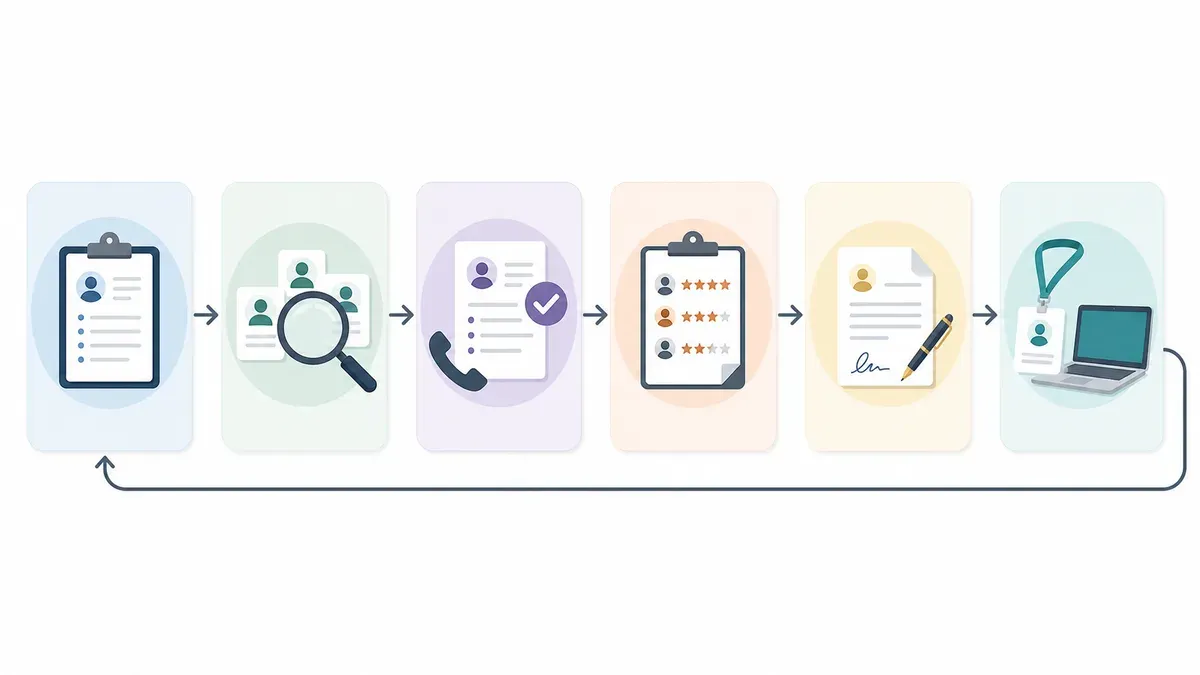
Preparing
Preparing is the first step in the full cycle recruiting process. Define who you need and which skills matter, then turn that into a job description.
Step 1: Define your candidate persona
Knowing your ideal candidate’s goals, experience and qualifications helps you spot strong fits throughout the process.
Step 2: Decide your job’s requirements and compensation range
Job Requirements
Align internally on the requirements first, separating hard-skill must-haves from nice-to-haves. You’ll want to identify both the hard skills that are requirements (must haves) and the preferences (nice-to-haves) for the new role.
Compensation Range
Early compensation decisions set precedents that are hard to unwind, so a simple written framework helps. Three steps cover most of it:
- Benchmark each role. Compare the role against named salary data, such as BLS Occupational Employment and Wage Statistics or startup compensation surveys, for its level and location.
- Define pay bands by level. Set a minimum, midpoint and maximum for each level, and decide the cash and equity mix for each band.
- Document and review ranges. Write the bands down, share them with everyone who makes offers, and revisit them at least once a year as the team grows.
Step 3: Write a great job description
A great job description should be action-focused and easy to skim. An Indeed job posting survey found that 52% of job seekers say the quality of a job description is “very” or “extremely” influential on their decision to apply, and most spend only three to five minutes reading one before deciding whether to apply.
- Show how past experience transfers to the role and call out what makes your organization distinct.
- Define expected outcomes instead of listing general duties. Describe what success looks like over the first 30 to 90 days.
- Separate true must-haves from nice-to-haves. A long, undifferentiated requirements list can discourage qualified candidates from applying.
Sourcing
Sourcing is the second step in the full cycle recruiting process, where you find qualified candidates for your role by posting on job boards, tapping your team’s networks and sending cold outreach to people with the right skills.
Dover’s sourcing tools include:
- A CRM and email outreach campaigns for adding candidates, writing personalized messages and sending follow-ups across roles.
- A Chrome extension that sends outreach campaigns directly from LinkedIn profiles.
Screening
Screening is the third step in the full cycle recruiting process. You review applications and run initial calls so your team only meets candidates who fit the position.
Step 1: Resume Screening
Resume screening is often the most time-consuming part of the process, but it’s a necessary step for determining which candidates move forward. Parse each resume carefully to choose only strong fits for the job.
Step 2: Phone Screening
Phone screens allow you to:
- Check for dealbreakers (availability, relocation, tech stack fit)
- Clarify details from resumes or LinkedIn profiles
- Assess verbal communication skills
- Get to know candidates
- For passive candidates, gauge their goals and interest in switching
For initial screens, create a standardized list of questions asked in the same order for every candidate. Research on structured interviews finds they tend to predict job performance better than unstructured ones and can reduce individual interviewer bias.
Selecting
Selecting candidates is the fourth step, where your team conducts interviews and decides who moves forward. It’s a team effort: everyone on the hiring team plays a part in assessing candidates, and alignment here can make or break the process.
Step 1: Define the selection criteria you’re looking for
The core team (hiring manager, recruiter and leadership) should align on candidate qualities before interviews begin.
Step 2: Design an interview plan
Decide how many interview stages you need to find the best candidate while keeping the experience positive. You can build the plan in your applicant tracking system.
Step 3: Create interview questions and scorecards
Based on the qualities you want, create an interview rubric and keep it somewhere easy to access.
If you’ve never hired before, ask people at other companies what they look for when assessing similar roles. Dover’s interview process best practices also cover stage design, skills assessments, scorecards and structured debriefs.
Step 4: Make scorecards accessible to all interviewers
Share the rubric with everyone involved in hiring. A centralized ATS lets interviewers submit structured feedback so every candidate is graded against the same criteria, but a table in Notion, Google Sheets or Airtable works too.
Step 5: Interview candidates and conduct a debrief
After the final interview, hold a debrief with all interviewers to align on whether to make an offer.
Hiring
Hiring is the fifth step: you’ve narrowed the field and are ready to extend an offer. Know your terms before negotiations start.
Always present a verbal offer before a written one. This lets the candidate ask questions and lets you read their reaction before anything is signed.
Take a transparent approach to closing. Evasiveness about challenges or revenue costs you credibility with strong candidates.
After presenting the offer, ask: “We’re all SUPER excited to work with you. Is there anything else we can do to get you onboard?” Sometimes they’ll close on the spot.
- Confirm salary, equity and start date internally first.
- Check the offer against your compensation bands for consistency.
- Use a consistent offer letter template every time.
Onboarding
Onboarding is the final stage, and in end-to-end recruiting it is often owned by the same person who ran the search. It includes welcoming the new hire, introducing them to the team, and scheduling training and orientation.
With remote-first policies common, Dover created a guide to remote onboarding at startups with simple steps for remote hires.
Full Cycle Recruiting in Late 2026
Recent data from iHire’s State of Online Recruiting 2026 report found that 23.6% of employers received at least one fake or fraudulent applicant in the past year, so verifying identity on phone screens is a basic part of screening.
The report also found that 24.2% of employers now use AI in recruiting, so a person still needs to own every hiring decision AI helps draft.
The report also found that 53.3% of job seekers applied without meeting all listed requirements, which supports separating must-haves from nice-to-haves early in the preparing stage.
5 Benefits of Full Cycle Recruiting
There are five key benefits to a managed, end-to-end recruiting process that has been thoughtfully structured and tracked over time:
| Area | Without Full Cycle Recruiting | With Full Cycle Recruiting |
|---|---|---|
| Cost | A bad hire can mean paying for a second search and onboarding cycle | A structured process can reduce the risk of a bad hire and a repeat search; SHRM’s 2025 benchmark puts nonexecutive cost per hire at about $5,475 |
| Visibility | No consistent tracking means blind spots across your candidate pipeline | Clear metrics on engagement, response rates, and hiring times make gaps easy to spot |
| Speed | Candidates stall or drop off without timely communication | Automation and timely follow-ups keep candidates moving through the process |
| Team Alignment | Siloed feedback and misaligned interviewers slow down decisions | Shared scorecards and clear roles improve how teams communicate and decide |
| Bias Reduction | Inconsistent evaluation opens the door to unconscious bias | Structured interviews and standardized questions can reduce individual interviewer bias |
How Dover Supports Full Cycle Recruiting
Dover’s free ATS supports most of the full cycle recruiting process, from preparing through selecting. AI can help draft a job description and suggest interview questions for your team to review, and the free plan covers job posting to 50+ job boards, candidate tracking, customizable interview plans and scheduling links. Offer templates are also free, while offer management, e-signing and AI resume scoring sit on the $199/month Premium plan, and hiring decisions stay with your team.
An ATS keeps the process organized, but it doesn’t add hiring capacity. When a role is senior or hard to source, applicant volume outpaces what the team can review, or no one has time to run screens and close offers, a fractional recruiter can plug in on top of the existing pipeline. Through Dover, these recruiters can own the full process or cover specific stages like candidate sourcing and closing from within the same ATS, so the hiring team keeps real-time visibility and outreach isn’t duplicated. Dover’s marketplace data puts average cost per hire at about $4,800 across all roles, which can vary by role complexity and recruiter. There are no long-term contracts, the marketplace deposit is refundable, and recruiters build a track record through verified founder reviews over time.
Dover also serves as the infrastructure layer fractional recruiting agencies build on. Agencies can run client pipelines inside Dover’s ATS, with candidate data, notes and outreach history staying in the client’s ATS after the engagement ends.
FAQs
How do I write a job description that improves applicant quality?
Lead with expected outcomes over the first 30 to 90 days instead of a generic responsibilities list, and separate hard requirements from nice-to-haves. A long, undifferentiated requirements list can discourage qualified candidates from applying, which narrows the applicant pool.
What is the difference between an RPO provider and a traditional recruiting agency?
An RPO (recruitment process outsourcing) provider takes over part or all of the recruiting function on an ongoing basis, managing process, tools and reporting across many roles. A traditional agency fills individual searches for a contingency fee, typically a percentage of first-year salary, often cited in the range of 15% to 25%, though it varies by agency and role. An RPO can own every stage, while an agency usually covers sourcing and screening for one role and hands candidates back to the hiring team.
Do I need a recruiter if I’m already using an ATS?
Not always. An ATS handles job posting, candidate tracking, interview scheduling and scorecards, which is often enough for a founder running one or two roles with steady applicants, but it doesn’t add hiring capacity. A recruiter makes sense when volume grows, a role is senior or specialized, or no one has time to own sourcing, screening and closing. A fractional recruiter can work inside the same ATS, so data stays with the company after the engagement ends.
Final Thoughts on Full Cycle Recruiting
Full Cycle Recruiting treats hiring as a connected process instead of a series of handoffs. An ATS gives every stage a shared home, and a fractional recruiter can add capacity when hiring volume or role complexity outgrows the team. How much structure a team needs depends on its stage and hiring volume: a founder filling one role a quarter faces different tradeoffs than a team opening several roles at once. Dover’s model, a free ATS paired with on-demand fractional recruiters in the same pipeline, is one way to put that framework in place.