
When you’re scaling a startup, you face a classic hiring dilemma: do you need a job board to find candidates, or do you need someone who can actually run your entire recruiting process? Wellfound gives you access to startup-focused talent pools, while Dover connects you with experienced fractional recruiters who handle everything from sourcing to closing. Both approaches have merit, and the right choice depends on whether you have internal recruiting expertise or need it built from scratch. Below, we compare which service fits different startup hiring scenarios and growth stages.
TLDR:
-
Fractional recruiting gives startups access to experienced part-time recruiters, while a job board like Wellfound gives access to a pool of startup-focused candidates.
-
Wellfound offers free job posts, AI sourcing through Reach, and a managed recruiting service called Autopilot.
-
Even with managed help from a job board, teams often still run interviews, evaluation, and closing internally.
-
A fractional recruiter can often handle the full hiring process from sourcing to closing, billed hourly for the work done.
-
Fractional recruiting can provide senior recruiting expertise at an average cost per hire of roughly $4,800 across all roles, often well below traditional agency fees.
What Wellfound Does
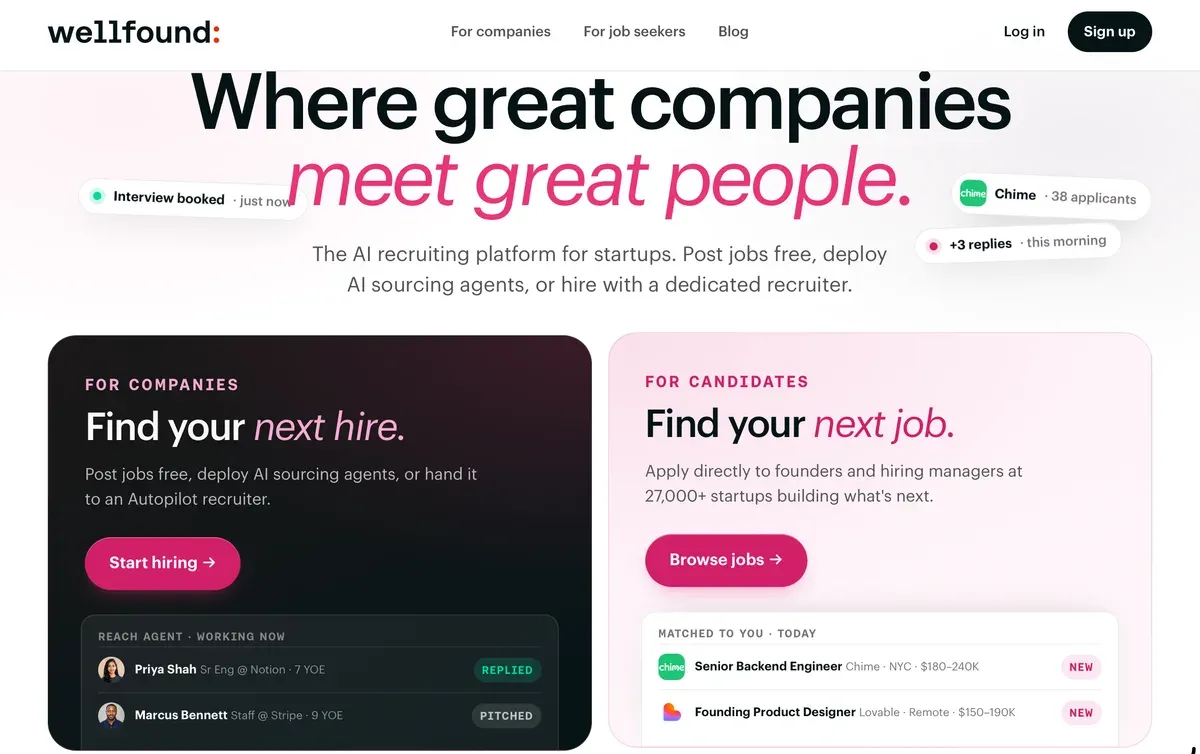
Wellfound is a hiring marketplace that connects candidates with startup positions. According to Wellfound’s employer page, its network includes a large pool of opted-in candidates who built profiles because they want startup roles. Think of it as a two-sided marketplace where startups can post jobs and candidates can create profiles to showcase their skills and preferences.
Wellfound now organizes its employer offering into three tiers: free job posts with unlimited jobs, unlimited applicants and a built-in ATS; Wellfound Reach, an AI sourcing tool; and Wellfound Autopilot, a done-for-you recruiting service. Candidates can also search the job board by skills, career category, location, and salary requirements.
Wellfound targets the startup ecosystem, positioning itself as a source for startup-ready talent. Their focus is on connecting job seekers who are actively looking for their next career move with companies that need to fill open positions.
Wellfound’s strength lies in its large pool of startup-focused candidates. Even with Autopilot, which hands back warm candidates, companies still typically run interviews, evaluation, and closing internally.
What Dover Does
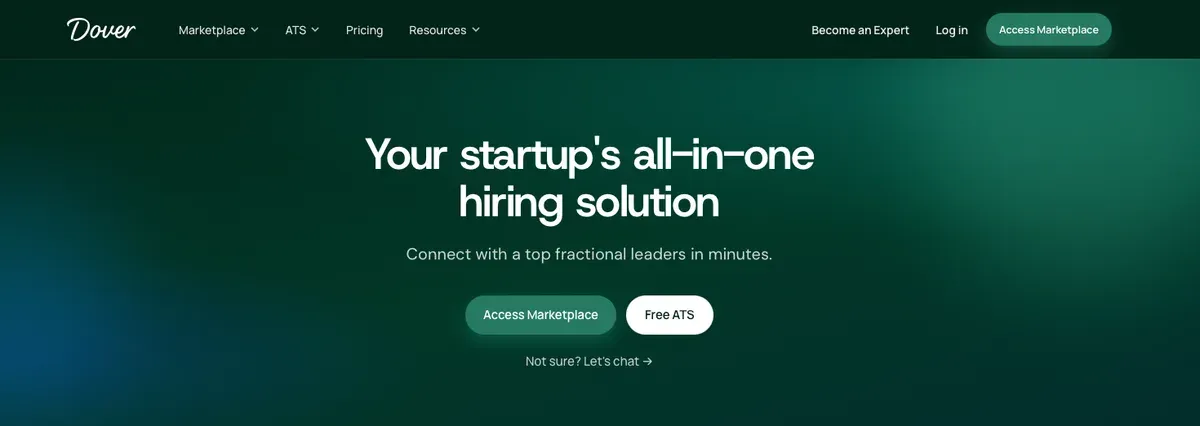
Dover is the layer that fractional recruiting agencies are built on: a free applicant tracking system paired with a network of experienced fractional recruiters. We connect startups with fractional recruiters who specialize in filling engineering, sales, and other critical roles. The service provides both recruiting software and on-demand recruiting expertise through experienced professionals who typically work on an hourly basis.
Dover’s fractional recruiters work part-time or project-based, giving startups senior recruiting expertise without full-time costs. These recruiters integrate directly with teams and adjust strategies based on evolving needs.
The model solves a key challenge for startups: getting professional recruiting support without the overhead of hiring a full-time recruiter or paying massive agency fees upfront. For rough context, the U.S. Bureau of Labor Statistics Occupational Outlook Handbook lists median pay for human resources specialists, a broader category that includes recruiters, in the mid-$70,000s per year before benefits and overhead. That figure works as a proxy, not a recruiter-specific salary, and what a full-time recruiter costs can vary with seniority and market.
Cost Comparison
The cost structures between these two services differ greatly. Wellfound publishes its pricing: job posts are free, Reach has a free entry-level tier with paid seats from $135 per seat per month, and Autopilot costs $500 per month per open role plus a 10% placement fee on a successful hire, per Wellfound’s pricing page.
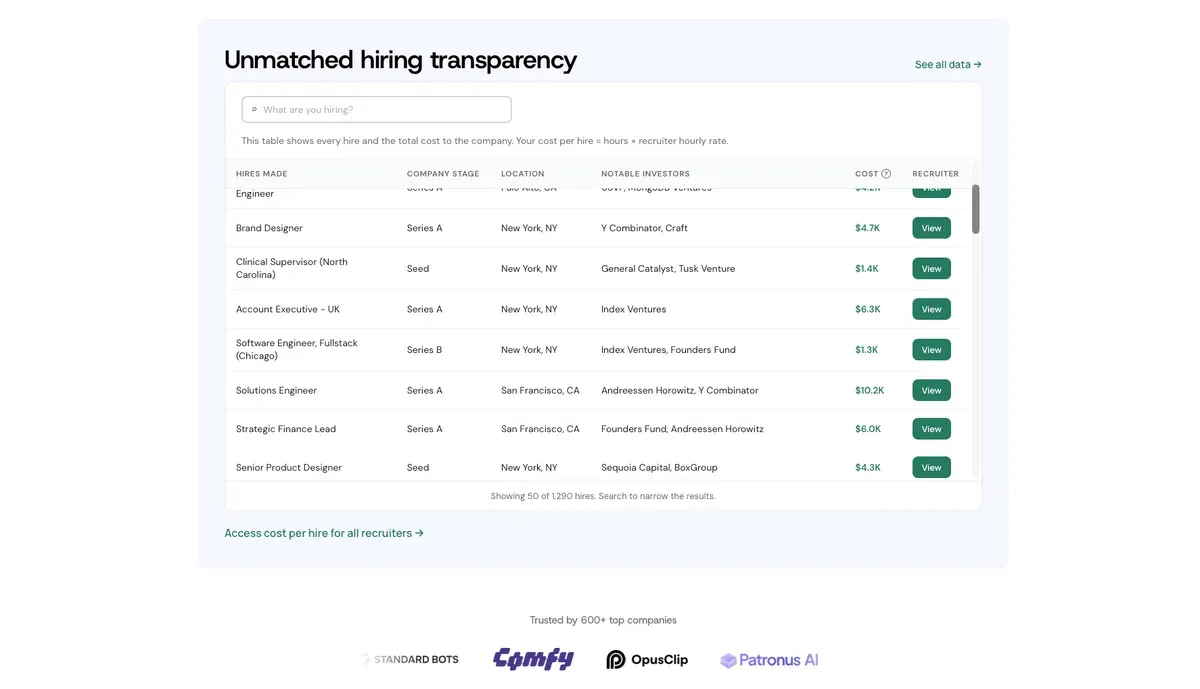
Dover’s average cost per hire across all roles is $4,800, though that figure can vary by role complexity and recruiter. That transparent pricing allows startups to control their recruiting spend. Contingency models like those used by traditional recruiting services often cost $15k-$50k+ since fees are a percentage (15-30%) of the candidate’s salary. For broader context, SHRM’s 2025 benchmarking data puts the average non-executive cost per hire at $5,475, though actual spend varies widely by role and hiring method.
| Service | Typical Cost | Transparency |
|---|---|---|
| Dover | $4,800 average across all roles | Full transparency |
| Wellfound | Autopilot: $500/month per open role + 10% placement fee | Published pricing |
| Traditional Agencies | $15k-$50k+ | Percentage-based |
The hourly model can give you better control over spending. You can scale up during intensive searches or scale down between hires. That transparency typically means fewer surprises and smaller upfront commitments.
Understanding startup recruiter commission structures helps explain why Dover’s approach often delivers better value than traditional contingency models.
Service Delivery Models
Wellfound provides recruiting support through its Autopilot service, which pairs each open role with a dedicated recruiter who sources, pitches, and schedules candidates, delivering roughly 5 to 10 ready-to-talk candidates per week. Self-serve AI sourcing is available separately through Wellfound Reach, which draws on Wellfound’s network of opted-in candidates along with enriched external profiles, per Wellfound’s employer page.
Dover offers fractional recruiting through a network of vetted professionals. We connect startups with experienced recruiters who typically have 5 to 20 years of experience working with top startups and tech companies. Each recruiter profile carries verified reviews from founders who have worked with them, so teams can check a recruiter’s track record on similar roles before a free intro call. These recruiters work alongside client teams, not as external vendors.
Companies can scale their recruiting efforts up or down based on current needs. Dover’s network includes recruiters who have worked directly with founders at Seed and Series A companies, many of them former Heads of Talent, with experience hiring across engineering, product, sales, and operations roles. That range allows us to match the right expert to each specific role and company culture.
The key difference is integration level. Dover’s fractional recruiters often work as part of your team, getting to know your culture and long-term goals. They fill positions while helping build your company.
Technology and AI Features
Wellfound focuses on AI-powered candidate sourcing through Wellfound Reach, where AI agents handle sourcing while the hiring team stays in the loop. Wellfound says Reach draws on its pool of opted-in candidates who built profiles because they want startup roles, plus a wider set of enriched external profiles, and on over a decade of startup hiring data.
Dover takes a different approach by combining human expertise with technology tools. Dover’s recruiters use our system to simplify administrative tasks, which can reduce costs and leave more time for strategic aspects of hiring. The free ATS includes integrated sourcing tools, and the Premium plan ($199/month) adds AI resume review that can score applicants against your own prompt, with humans making the final decisions throughout the process.
An ATS typically handles posting, applicant tracking, and scheduling, while a fractional recruiter adds sourcing, outreach, and closing capacity when the team lacks bandwidth or the role is senior or specialized. When both work in one shared free ATS, the recruiter and hiring team can see the same pipeline in real time, which often cuts coordination overhead and duplicate outreach. That combination can let recruiters spend more time on relationship building and strategic decisions instead of administrative tasks.
The technology should enhance human expertise, not replace it. That’s especially important for startups where cultural fit and growth potential matter as much as technical skills.
Why Dover May Fit Startup Hiring Better
A job board can supply a pool of candidates, but someone on your team typically still has to run screening, interviews, and offers. Teams without that internal capacity may find a model that pairs recruiting software with hands-on recruiter support a closer fit, which is the model Dover uses.
Dover’s fractional recruiters integrate with startup teams, working closely with founders to run sourcing, outreach, interviews, and offer negotiations. They often handle multiple roles at once, understanding how different hires need to work together as your team grows.
Our recruiters are invested in finding the right fit for specific startup needs, focusing on quality matches instead of placing candidates anywhere. As the cost comparison above shows, this approach provides startups with senior-level recruiting expertise while maintaining the flexibility and cost control that early-stage companies require.
The difference comes down to partnership vs. transaction. Dover’s fractional recruiters can become invested in your success as they work with you over time, understanding your evolving needs as you scale.
Choosing the right recruiter for your startup means finding someone who understands both your current constraints and future ambitions.
What Has Changed for Startup Hiring in Late 2026
Both options have moved since this comparison was first written. Wellfound’s sourcing offering now runs through Reach, with a free entry-level tier and seat-based paid plans from $135 per seat per month, while Autopilot, its managed recruiting service, is listed at $500 per month per open role plus a 10% placement fee with no contract, per Wellfound’s pricing page. Teams comparing costs this fall may want to check those published numbers against how many roles they expect to fill, since a per-role monthly fee can add up during a multi-hire sprint.
The wider market has also shifted. AI scoring and sourcing support now ship with most hiring tools, and the open question for many founders is how much judgment to hand to software. Dover’s Premium ATS plan ($199/month) takes an assistive approach, scoring applicants against your own prompt while people make the final calls. Fractional support has also become a more common first step. As Dover’s startup hiring trends overview notes, many seed-stage founders now expect their first recruiting resource to be fractional instead of full-time, though the right fit still varies with hiring volume and role complexity. That is the same dividing line this comparison draws: a job board gives you access to candidates, while a fractional recruiter gives you someone to run the process.
FAQs
What is a fractional recruiter and how do they work?
A fractional recruiter is an experienced recruiting professional who works part-time or project-based with startups, with startups paying only for the hours worked. They integrate directly with your team to handle sourcing, outreach, interviews, and offer negotiations without the commitment of a full-time hire or expensive agency contracts.
Do I need an ATS before bringing in a fractional recruiter?
A fractional recruiter can often work without one, but searches may run more smoothly when the recruiter and hiring team share one ATS. Candidate status is typically visible in real time, feedback tends to stay in one place, and handoffs usually carry less coordination overhead. A team using a free ATS from day one, like Dover’s, can generally bring a recruiter into the same system when a search needs more hands-on help, instead of migrating data later.
What hiring tools work best for YC-backed startups?
No single stack fits every YC-backed startup, and the right mix often depends on hiring volume and whether anyone owns recruiting full-time. Most setups combine three pieces: an applicant tracking system, a sourcing channel such as a startup job board, and recruiting help when several roles open at once. Many teams look at ATS options like Ashby, Greenhouse, and Lever, which some users report can take meaningful setup time and often use pricing that scales with company size. Dover’s free ATS is built for a company’s first ~100 hires, and more than 100 Y Combinator startups have used Dover, often adding a fractional recruiter and paying only for the hours used when a search needs more hands-on work. Wellfound can sit alongside any of these as an extra candidate source.
What is the best free recruiting software for a bootstrapped startup?
For bootstrapped teams, the most useful free option is usually one without seat or job limits. Dover’s free ATS includes unlimited jobs and users, a careers page, posting to 50+ job boards, a LinkedIn sourcing extension, and AI-drafted job descriptions, with the $199/month Premium plan available later for features like AI resume review and the interview scheduling tool. Wellfound also offers free job posts with unlimited jobs and applicants plus a built-in ATS, which suits teams that mainly want startup-focused candidates. Free tiers differ in what they leave out, so it helps to check which features you need before committing. If a search outgrows what your team can run alone, hourly fractional help lets you pay only for the hours you use.
Final Thoughts on Choosing Between Dover and Wellfound for Startup Recruiting
The choice often comes down to whether a team needs someone to run the recruiting process or mainly needs access to more candidates. Wellfound can fit teams that already have internal recruiting expertise and mainly want a job board focused on startups. Teams that need someone to handle sourcing through closing may find fractional recruiters a better fit, since they typically provide senior recruiting expertise on an hourly basis. Dover’s model, a free ATS paired with on-demand fractional recruiters working in one shared system, is one example of combining software and recruiting capacity.