

Contingency’s “pay nothing unless you hire” promise sounds appealing, especially on a tight runway. But it’s worth complicating that pitch: when you do hire, the success fee on a single placement can cost more than a full year of fractional recruiting support. Dover’s fractional recruiting marketplace and Paraform both connect early-stage companies to recruiters, but one charges for time worked and the other takes a percentage of every salary. Deciding which one fits your startup comes down to total cost and incentive structure, and those shape what you spend, how recruiters behave, and how candidates experience your company.
TLDR:
-
Fractional recruiting charges by the hour; contingency recruiting charges a percentage of salary on each hire.
-
Contingency fees typically run 15 to 30% of first-year salary, while fractional recruiting ties cost to hours worked rather than salary.
-
With contingency, 10+ recruiters compete for one role, creating uncoordinated outreach that can affect your employer brand.
-
Paraform works for one urgent, one-off role with budget for a success fee, while a fractional recruiter fits startups planning multiple hires.
-
One fractional option pairs a dedicated recruiter with a free ATS covering pipeline management, job board integrations, and scheduling links.
How Do Dover and Paraform Work?
Dover: Fractional Recruiting Marketplace
Dover is a marketplace for fractional recruiting services. The marketplace lists vetted, independent fractional recruiters with years of experience at leading startups and tech companies, and they work with you on a flexible, part-time basis. Instead of a single contingency fee, Dover supports hourly (the most common setup), retainer, and pay-per-hire engagements: you choose the structure that fits the role and your budget, and agree on terms directly with the recruiter.
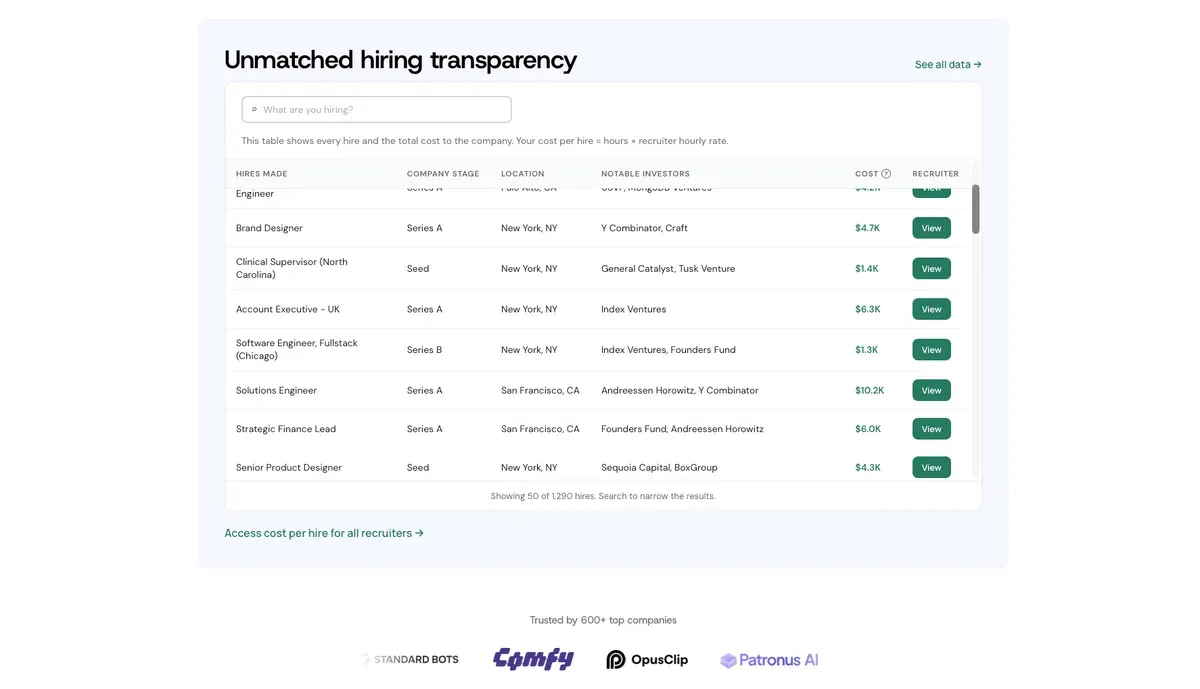
Recruiters work closely with founders to run sourcing, outreach, interviews, and offer negotiations, and they often handle multiple roles at once. It works much like having a full-time recruiter. Because you’re paying for work done instead of a bounty per hire, cost is tied to hours worked rather than a percentage of salary, and the all-in cost of every marketplace hire is published in Dover’s public cost-per-hire table.
Paraform: Contingency Recruiter Marketplace
Paraform operates on a contingency model, meaning companies only pay if they make a hire. This is also known as a “success fee”. Instead of hiring a dedicated recruiter, you post a job and multiple independent recruiters compete to fill it. The typical fee is 15-30% of a hire’s first-year salary, meaning a $150K engineering hire could cost $30K or more in recruiting fees.
The way the engagement works is that Paraform will connect you with a lot (10+) contingency recruiters at once. The nice thing about contingency is that you’re paying the same amount regardless of whether you have one contingency recruiter or many recruiters working on the job (since you only pay when you make a hire).
How Do Dover and Paraform Compare?
| Feature | Dover | Paraform |
|---|---|---|
| Pricing Model | Hourly, retainer, or pay-per-hire | Contingency (% of salary) |
| Typical Cost Per Hire | Tied to hours worked, with every hire’s cost published | A percentage (15-30%) of first-year salary |
| Payment Timing | Pay for hours worked | Pay only on a successful hire |
| Number of Recruiters | 1 dedicated recruiter | 10+ competing recruiters |
| Recruiter Model | Dedicated, integrated with your team | Independent, competing for the role |
| Time Commitment | Flexible, adjustable hours | None until placement |
| Best For | Multiple hires, repeatable process | One-off, urgent hires |
| Software Included | Free ATS with pipeline management, job board integrations, and scheduling links | Basic job posting interface |
| Replacement Guarantee | Ongoing partnership model | Replacement search only (fee is not refunded) |
Dover Is Much Less Expensive
Cost per hire is one of the clearest metrics in startup hiring. SHRM’s 2025 benchmarking data puts the average non-executive cost per hire at $5,475 before agency fees, a figure that grows quickly under a contingency model.
-
Dover’s cost per hire: Tied to hours worked instead of salary, and the all-in cost of every marketplace hire is published in the public cost-per-hire table.
-
Paraform’s cost per hire: A percentage of the candidate’s first-year salary (typically 15-30%), so the fee grows with every increase in pay.
The reason for this difference is simple. Paraform operates on a contingency model, where multiple recruiters compete for the same role but only one gets paid. Some recruiters report doing uncompensated work on roles they don’t win, which can push success fees higher to make up for lost time. The companies that do hire can end up subsidizing the companies that don’t.
With Dover, recruiters are paid for the actual work they do, instead of just the outcome. This results in lower overall costs per hire, more predictable spending, and a better recruiter-client relationship. It also means companies aren’t relying on a model that inherently creates inefficiencies and wasted effort.
Some founders wonder: “But isn’t paying only on success better? Doesn’t this align incentives perfectly?” Not exactly. While contingency recruiting means you don’t pay unless you hire, it also means you’re on the hook for a large fee when you do. That’s why many startups eventually bring recruiting in-house after a couple of agency hires, with typical agency placement fees commonly running 15 to 30% of first-year salary and compounding quickly across multiple roles. Dover, on the other hand, offers a flexible, long-term solution that scales with your company’s needs. With contingency, founders can end up either without a hire or paying a large fee, which is the tension this model tends to create.
Check out Dover’s full history of cost-per-hire data: dover.com/recruiters#cost-per-hire.
Dover Attracts Better Recruiters
We often ask founders: “If you wanted to build a feature, would you ask 10 different engineers to work on contingency?” There’s a reason most companies don’t do this.
The same applies to recruiting. Paraform’s contingency model commoditizes recruiters: they are one of many competing for the same role, and they only get paid if they win. Some recruiters report that this tends to push experienced recruiters elsewhere, and some recruiters on contingency marketplaces juggle many projects at once to hedge their bets, making the recruiter/client relationship transactional instead of a true partnership. Contingency recruiters earn nothing until a candidate signs an offer, so the incentive is to close quickly, not to find the best long-term fit. That can mean presenting candidates who are available and likely to accept over the strongest possible pool. A fractional recruiter paid for hours worked typically faces less pressure to rush a close, so their interests can stay tied to finding the right person, though retainer and pay-per-hire engagements carry their own dynamics.
Dover’s fractional recruiters get consistent work, predictable pay, and the ability to build long-term relationships with clients. Recruiters on our marketplace earn steady, predictable income for the work they complete, instead of a single large commission on a closed deal. This tends to attract senior recruiters who have already built enough of a reputation to value stable client relationships over high-variance bounty income. The recruiters in Dover’s network tend to be experienced recruiters with deep startup hiring backgrounds.
Dover Grows With You
If you’re hiring multiple roles or want to build a repeatable recruiting process, Dover scales better. You can add or reduce recruiter hours as needed instead of committing to paying a large lump sum per hire.
Paraform works best if you just need to fill one or two roles quickly and are less focused on building a repeatable process. But if you’re looking to grow your company long term and plan on making multiple hires, Dover’s flexibility, lower costs, and long-term approach can make it a better fit.
Dover Preserves Your Employer Brand
One major drawback of contingency recruiting is how it affects your candidate experience. Research on candidate experience and employer branding suggests many candidates share their hiring experiences online, meaning uncoordinated outreach can carry real reputational risk. With Paraform, you have multiple recruiters working independently, often reaching out to the same candidates multiple times. This can make your company look disorganized or desperate, which isn’t a great first impression for top-tier talent.
Dover’s model doesn’t have this problem. Because our recruiters act as an extension of your team, all outreach is coordinated and branded under your company name. Candidates go through a structured, high-touch hiring experience, which can lead to better engagement and higher acceptance rates.
So, Should I Use Dover or Paraform?
If you’re deciding between Dover and Paraform, ask yourself what you value most:
-
If speed is your only priority and you want the widest possible candidate flow, you don’t care too much about employer brand, and you are comfortable paying a higher success fee, Paraform may fit.
-
If you want a much lower cost per hire and a dedicated recruiting partner who will represent your company like an in-house recruiter, Dover is the better choice.
Specific Scenarios
-
You need to hire 3 or more people over the next few months. With contingency fees stacking at 15-30% per hire, the cost grows with every senior hire you make through Paraform. The same volume through Dover’s fractional model is billed by hours worked rather than as a percentage of each salary, with every hire’s cost published in the public cost-per-hire table.
-
You need to fill one urgent, one-off role and have the budget for a success fee. If the role needs to close in two to three weeks and you’re comfortable paying a placement fee, Paraform’s large pool of competing recruiters can move quickly.
-
Your employer brand matters and you want a consistent candidate experience. Dover’s recruiter acts as an extension of your team, with all outreach coordinated under your company name. With Paraform, candidates can hear from several recruiters about the same role. Some estimates suggest the cost of a bad hire can reach well above the original placement fee, making the quality of the initial candidate experience worth protecting. Paraform’s 90-day guarantee covers a free replacement search, not a refund of the placement fee, so if the hire doesn’t work out within 90 days, you absorb both the original fee and the cost of re-hiring.
-
You’re a lean team without time to manage a recruiting process. A single dedicated fractional recruiter handles sourcing, outreach, scheduling, and offer management end to end, so your team spends time interviewing, not coordinating.
Both models have their place, but for founders who care about cost, quality, and long-term hiring success, Dover tends to be the better fit.
Why Dover Works for Startup Recruiting
Most early-stage startups don’t need a full-time recruiter on day one, but they do need someone who can move quickly and represent the company well. Dover’s fractional model fills that gap: a dedicated recruiter handles sourcing, outreach, interviews, and offers without the overhead of a full-time hire or the misaligned incentives of a contingency fee.
Recruiters bill hourly for the work they do, instead of a fee tied to the hire’s salary. A free ATS comes included, with pipeline management, job board integrations, and calendar integrations and scheduling links, so founders don’t need to stitch together separate software to run a structured search.
FAQs
How much does startup recruiting typically cost?
Costs vary widely by model. Contingency agencies typically charge 15 to 30% of a hire’s first-year salary, so the fee climbs with the seniority of the role. Fractional recruiting through a service like Dover is billed by hours worked rather than a percentage of salary, with every marketplace hire’s cost published in a public cost-per-hire table.
What is a recruiting success fee?
A success fee is the payment a contingency recruiter receives when a candidate they placed is hired. It is usually calculated as a percentage of the candidate’s annual base salary. The fee only applies when a hire is made; no placement means no payment to the recruiter. For more on how placement fees shape recruiter behavior, see contingency recruiting incentive problems.
How many recruiters should work on a single role?
With a contingency model, it is common to have 10 or more recruiters working a single role at once. With a fractional or retained model, one dedicated recruiter handles the search from start to finish. A single dedicated recruiter typically produces a more consistent candidate experience and better-coordinated outreach.
Final Thoughts on Dover vs. Paraform for Startup Recruiting
The Dover vs. Paraform decision comes down to which one fits your startup, and that depends on what kind of recruiting relationship fits your stage. Contingency works as a short-term lever when you have budget for a large placement fee and need to close one role fast. For startups planning multiple hires, watching cost per hire, or building toward a repeatable process, fractional recruiting through Dover tends to hold up better over time because it offers lower fees, a dedicated recruiter who knows your company, and a candidate experience that reflects well on your brand. Neither model is wrong in every context, but the economics and incentive structures are different enough that it’s worth running the numbers before committing.