
At a glance
- Start with
- 4 to 6 must-have competencies
- Questions per interviewer
- 4 to 6 core, plus probes
- Question types
- Behavioral, situational, role-specific
- Part of
- Series, part 1 of 2
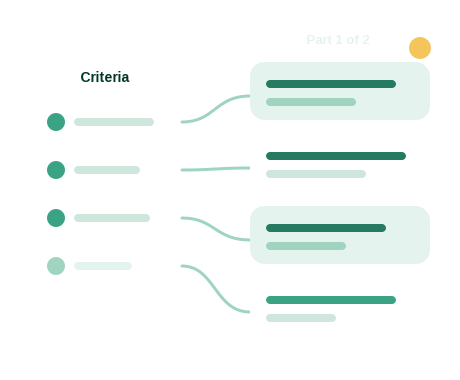
Part 1 of 2 in a series on structured interviewing. Part 2 is the interview scorecard guide, which covers how to score what you hear. Here you decide what to measure and which questions get you the evidence: define the criteria first, then pick questions to match. You will also get a copyable question bank grouped by competency.
Step 1: Define the criteria before you write a question
What to do: List the four to six things a person must be able to do to succeed in the role, and call them your must-have competencies. Draw them from the intake meeting, the job description and your best current performers. Write each as an outcome, such as “owns a project from vague brief to shipped result” rather than a trait like “self-starter”. If you have not run the intake yet, start with how to run an intake meeting.
Split the list into two groups:
- Must-haves: the person cannot succeed without them, and you cannot easily teach them in the first few months.
- Nice-to-haves: useful, but trainable or not decisive.
Only must-haves earn dedicated interview time.
Why: Questions chosen without criteria drift toward whatever the interviewer finds interesting, and candidates get compared on different things. The US Office of Personnel Management describes a structured interview as a method that measures job-related competencies, with all candidates asked the same predetermined questions in the same order (OPM). Published research on selection methods ranks structured interviews among the stronger predictors of job performance (Sackett et al., 2022).
Step 2: Choose the question types
What to do: Use a mix of three types. Pick the type for each competency based on what you need to see.
| Type | What it asks | Best for | Example |
|---|---|---|---|
| Behavioral | What did you do in a real past situation? | Experienced candidates, ownership, collaboration | “Tell me about a time you had to change a plan midway.” |
| Situational | What would you do in this realistic scenario? | Earlier-career candidates, new situations, judgment | “A customer asks for a feature that is not on the roadmap. What do you do?” |
| Role-specific | Show or explain how you do the core skill | Craft skills, tools, domain knowledge | “Walk me through how you would prioritize this backlog.” |
Behavioral questions rest on the idea that past behavior is the best guide to future behavior, so ask for a specific example, not a general opinion. Use situational questions when the candidate may not have faced the situation, and keep the scenario close to your real work. Use role-specific questions for the skills that cannot be judged from a story, and pair them with a short exercise where it fits. For technical and craft roles, see the role playbooks.
Why: Each type gives different evidence. Relying only on stories rewards the best storyteller, and relying only on hypotheticals rewards confidence over experience.
Step 3: Decide how many questions each interviewer asks
What to do: Plan four to six core questions per interviewer for a 45 to 60 minute interview. Leave about 10 minutes for the candidate’s questions and the rest for follow-ups. Give each interviewer different competencies, so your loop adds new information rather than repeating the same questions.
Why: Time is the limit. One good answer takes five to ten minutes with probing, so a long list means shallow answers. A short, focused plan also stops interviewers adding their own improvised questions that other candidates never get.
Step 4: Cover every criterion once across the loop
What to do: Build a simple coverage map before the first interview. List the competencies down the side and the interview stages across the top, and put one interviewer’s name in each cell that needs a score. Check that every must-have is covered at least once and that no one is asked to judge something they cannot see.
| Competency | Recruiter screen | Hiring manager | Skills round | Team panel |
|---|---|---|---|---|
| Role skill | [Interviewer Name] | |||
| Ownership | [Interviewer Name] | |||
| Communication | [Interviewer Name] | [Interviewer Name] | ||
| Collaboration | [Interviewer Name] | |||
| Motivation and fit with the job | [Interviewer Name] | [Interviewer Name] |
Avoid asking every interviewer the same “tell me about yourself” opener. Spend the time on a new competency instead. See interview process best practices for how to shape the stages, and how to run a recruiter screen for the first one.
Why: Gaps are the usual failure. If no stage tests a must-have, you find out after you hire. If three stages test the same thing, you waste the candidate’s time and give that criterion too much weight.
In Dover, create one feedback form per interview stage in Settings → Feedback Forms, or from a stage on the job’s interview plan. Add your questions, include help text so the interviewer knows what a strong answer looks like, and assign the form to the stage. Every interviewer in that stage then answers the same questions, and you can start from one of Dover’s role-based templates and edit it. See Interview feedback forms and Setting up your interview plan. Interviewers can also click View AI suggested questions to see ideas based on the candidate’s background and add the ones they want to their rubric, while your core questions stay the same for everyone. See Interviewing candidates.
Step 5: Write follow-up answers in advance
What to do: For each core question, write two or three probes you can use when the first answer is vague. Good probes ask for specifics, not opinions.
Situation:  What was the context, and what was at stake?
Role:       What exactly did you personally do, versus the team?
Action:     Why did you choose that approach? What else did you consider?
Result:     What happened? How did you know it worked?
Learning:   What would you do differently now?
Depth:      Who disagreed with you, and what did you do about it?
Listen for “I” versus “we”, for numbers and outcomes, and for what the candidate learned. If they answer with a general habit (“I always…”), ask for one real example.
Why: The first answer is often rehearsed. The probe is where you see how the candidate really thought and acted. Writing probes ahead keeps follow-ups consistent for every candidate, and makes it easier to write evidence in your notes, which part 2 of this series covers.
Step 6: Skip questions that are risky or tell you little
What to do: Remove two kinds of question before you finalize the list.
Legally risky questions reach into protected characteristics. The EEOC says pre-employment questions should be limited to what is essential to judging whether someone is qualified, and questions that could reveal race, religion, age or similar traits should generally be avoided. Before a conditional offer, you generally cannot ask disability-related questions (EEOC pre-employment guidance). Do not ask about:
- Age, birth year or when someone graduated, if that points to age
- Marital status, children, pregnancy or family plans
- Religion, national origin, citizenship status or where their family is from
- Health, disability or medical history
- Salary history, in the many places that bar it
Ask “Are you legally authorized to work here?” in the way your counsel recommends, not “Where are you from?” For the full list and what to ask instead, see how to interview diverse candidates. This is general information, not legal advice, and rules vary by state and city, so check with counsel.
Low-signal questions are easy to rehearse or reveal nothing about the job:
- “What is your greatest weakness?” and “Where do you see yourself in five years?” get canned answers.
- Brainteasers and trick questions test puzzle practice, not job skill.
- “Would I want to have a beer with you?” style questions reward similarity, which is bias.
- Leading questions (“You are comfortable with ambiguity, right?”) tell the candidate the answer.
Why: A legally risky question can expose you to claims even when you did not mean to use the answer. A low-signal question uses time you could spend on evidence.
Step 7: Ask the same core questions of every candidate
What to do: Lock the core questions before the first interview and use the same wording, order and time for each candidate. Let interviewers add follow-up probes and one or two open questions about a resume, but record those separately from the core scoring.
Why: Consistency makes candidates comparable and the process defensible. If you change the questions after you have met a few people, you can no longer tell whether a difference between candidates comes from them or from your questions.
Copyable question bank
Pick two or three from each competency you need. They are not tied to any one role, so add role-specific questions from your own work. Replace the brackets before you use them.
GENERAL (motivation and fit with the job)
- What drew you to this role, and what would make it a great next step?
- Tell me about the work you are proudest of in the last two years. What was your part?
- What kind of work environment helps you do your best work? Give an example.
- Describe a time you had to learn something quickly to do your job.

LEADERSHIP
- Tell me about a time you led a project or a team through a difficult stretch. What did you do?
- Describe a time you had to make a decision with incomplete information.
- Tell me about a time you helped someone else grow. What did you do and what changed?
- Describe a time you had to give hard feedback. How did you approach it?

COLLABORATION
- Tell me about a time you disagreed with a teammate. How did you resolve it?
- Describe a time you worked with a team or function that had different priorities from yours.
- Tell me about a time you needed help from someone who did not report to you.
- Walk me through a time you changed your mind because of someone else's input.

OWNERSHIP
- Tell me about a time you took on something that was not in your job description.
- Describe a project that went off track. What did you do?
- Tell me about a mistake you made at work and what you did about it.
- Describe the hardest problem you solved without much direction. How did you start?

COMMUNICATION
- Describe a time you explained something complex to someone without the background.
- Tell me about a time you had to deliver bad news. How did you do it?
- Walk me through a time a message or plan did not land as you expected. What did you change?
- How do you keep stakeholders up to date when a project is moving fast?

SITUATIONAL (adapt to your work)
- A teammate misses a deadline that blocks your work, and they are not responding. What do you do?
- Two senior people give you conflicting priorities for the same week. What do you do?
- You find a serious problem in something you shipped, and nobody has noticed. What do you do?

ROLE-SPECIFIC (replace with your own)
- Walk me through how you would approach [core task for this role] in your first 30 days.
- Here is [short realistic scenario]. How would you handle it, and what would you need to know?
For more ideas, see the blog post on questions to ask during an interview, and how to interview candidates for your startup.
Next step: score what you hear
Questions only help if you capture and compare the answers consistently. Part 2, the interview scorecard guide, covers how to design a rating scale, write evidence and weigh must-haves. Then train your team with interviewer training, and compare notes in a debrief (how to run interview debriefs).
Frequently asked questions
How many interview questions should you ask?
Plan four to six core questions for a 45 to 60 minute interview, so each gets time for follow-ups. Fewer questions with deeper probing tell you more than a long list answered on the surface.
What is the difference between behavioral and situational questions?
Behavioral questions ask what the candidate did in a past situation. Situational questions ask what they would do in a realistic scenario you describe. Use behavioral for experienced candidates and situational when they have less directly relevant history.
Should every candidate get the same questions?
Yes for the core questions. The US Office of Personnel Management says asking every candidate the same job-related questions supports consistent, fair assessment. You can add follow-up probes based on each answer.
Which interview questions are illegal to ask?
Questions about race, religion, age, disability, pregnancy, family plans, national origin and similar protected characteristics are generally off limits, and many places also bar salary history questions. Rules vary by location, so check yours with counsel.
How do you choose interview questions for a role you have never hired for?
Run an intake with the hiring manager to list what success looks like in the first year, then turn each outcome into a competency. Ask a person who has done the job to review your questions before you use them.
Can you reuse the same questions for every role?
Reuse the competency questions, such as ownership and communication, across roles, but add role-specific questions for the skills that differ. A general question bank is a starting point, not a full interview plan.
Put your questions in a Dover feedback form
Build one feedback form per interview stage with the questions you chose, assign it on the interview plan and every interviewer asks and records against the same list. Feedback forms are free.