
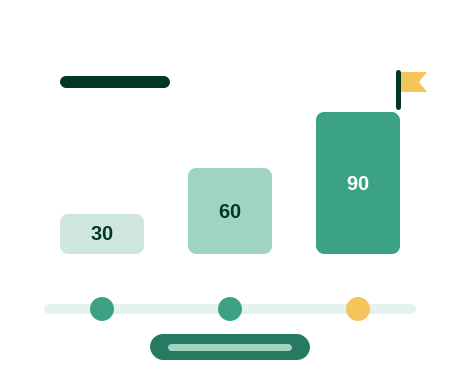
At a glance
- Structure
- Learn, contribute, own
- Goals
- Outcomes, not tasks
- Cadence
- Weekly 1:1s, reviews at 30/60/90
- Written by
- Manager, agreed with the hire
A 30-60-90-day plan turns “ramp up” into specific outcomes for a new hire’s first three months. This page is for hiring managers and founders: it explains the purpose and structure, how to set goals, how often to check in, how to adapt by role, and how to review and act if a hire is off track. Copy the template and example to write your own.
Purpose of the plan
What to do: Use the plan to answer three questions for the new hire: what am I learning, what should I deliver, and how will I know I am doing well? Agree it with them in the first week, after the basics in the employee onboarding checklist.
Why: Most early problems are mismatched expectations, not effort. A written plan makes them visible while they are small, and it gives the new hire a way to show progress.
Structure: learn, contribute, own
What to do: Use one theme for each phase.
| Phase | Theme | What it looks like |
|---|---|---|
| Days 1 to 30 | Learn | Understand the company, customers, product, team and how work gets done. Make a few small contributions |
| Days 31 to 60 | Contribute | Deliver real work with support, and give and receive feedback |
| Days 61 to 90 | Own | Run a piece of the work independently, and propose what to do next |
Why: The three themes match how people ramp up: first context, then output, then judgment. Use them as a shape, and tweak the lengths for senior roles, which often need longer.
Set goals as outcomes, not tasks
What to do: Write each goal as a result and how you will recognize it.
- Task: “Attend sales calls.” Outcome: “Run discovery calls on your own and book [number] qualified second meetings by day 60.”
- Task: “Learn the codebase.” Outcome: “Ship [number] production changes, including one customer-facing fix, by day 45.”
- Keep to two or three goals per phase.
- Tie goals to the reasons you opened the role. The intake meeting and the scorecard from the hiring process are good sources.
- Ask the hire what they think a good first 90 days looks like, and compare it with yours.
Why: Tasks can be done without making progress. Outcomes let the hire choose how to get there and let you judge the result.
Set the check-in cadence
What to do: Use a rhythm that fits the stage.
- Weekly one-on-ones, 30 minutes, for the first three months. Cover progress, blockers and feedback in both directions.
- Short daily or twice-weekly contact in week one, especially for remote hires.
- Formal reviews at days 30, 60 and 90, written down, with ratings of each goal.
- Skip-level or peer check-ins in the first month to hear how the hire is doing.
Why: Frequent, short conversations catch problems early. A hire who only hears feedback at day 90 has had 90 days of guessing.
Adapt the plan by role
What to do: Keep the same structure and change the outcomes. These are examples, not targets.
| Role | Learn (30) | Contribute (60) | Own (90) |
|---|---|---|---|
| Engineering | Set up the environment, read the code, ship a small change | Ship features with code review | Own a service or project end to end |
| Sales | Learn the product, customers and pitch, shadow calls | Run calls and build a pipeline | Own a quota or territory and forecast it |
| Customer success | Learn the product and accounts, shadow customer calls | Manage a set of accounts with support | Own account health and renewals |
| Marketing | Learn positioning, audience and channels, audit what exists | Launch a campaign or content series | Own a channel and report results |
| Product | Learn customers, data and roadmap, meet users | Write specs and ship a scoped feature | Own a roadmap area and its metrics |
| Design | Learn the product, users and design system | Deliver designs with feedback | Own a design area from research to ship |
For what to look for in each role from the start, see the hiring guides for engineers, salespeople, customer success managers, marketers, product managers and product designers.
Why: A plan that fits the role feels useful. A generic one feels like paperwork.
Copyable plan for the manager
30-60-90-DAY PLAN
New hire: [Name]   Role: [Title]   Manager: [Name]   Start: [Date]
Why we hired for this role: [one or two sentences]

DAYS 1-30: LEARN
Goals (outcomes):
1. [Result and how we will know]
2. [Result and how we will know]
Learning: [people to meet, systems, customers, docs]
Support: [buddy, access, training]

DAYS 31-60: CONTRIBUTE
Goals:
1. [Result and how we will know]
2. [Result and how we will know]
Support: [what the manager will do]

DAYS 61-90: OWN
Goals:
1. [Result and how we will know]
2. [Result and how we will know]
What "owning" means here: [decisions, metrics, projects]

CHECK-INS
Weekly one-on-one: [day, time]
Reviews: day 30 [date], day 60 [date], day 90 [date]
How we will measure success: [metrics or signals]
Generic example
DAYS 1-30: LEARN
1. Meet [8] people across [teams], and write down what you learn
   about customers and how decisions get made.
2. Deliver [one small project] with help, reviewed by [name].

DAYS 31-60: CONTRIBUTE
1. Deliver [project] on your own with weekly feedback.
2. Share one improvement idea for [process or product] with data.

DAYS 61-90: OWN
1. Run [area] independently, with [metric] as the signal.
2. Present a plan for the next quarter to the team.
Review at 30, 60 and 90 days
What to do: For each review, hold a 45-minute conversation and write a short summary.
- Ask the hire to go first: what went well, what was hard, what they need.
- Go through each goal: met, partly met or missed, with evidence.
- Share your feedback with specific examples, good and hard.
- Agree on changes: update the next phase’s goals, adjust support.
- At day 90, set goals for the next quarter and move to the normal review cycle.
Why: A written review keeps the conversation fair and consistent, and it gives you something to look back on. Ask for feedback on the plan itself and your management too.
Signs a hire is off track and what to do
What to do: Watch for patterns, not one bad week.
- Missed goals with no learning or change from feedback
- Avoiding questions, hiding blockers or going quiet
- Poor fit with how the team works, found in feedback from peers
- A gap between what was shown in interviews and the work
When you see them, act early.
- Name it in a one-on-one, with specific examples, and ask what they see.
- Find the cause: unclear goals, missing access, the wrong support, a skills gap or a mismatch with the role.
- Agree on what changes in writing, with a date to check again, usually two to four weeks.
- Fix what is yours, such as clarity and resources.
- Escalate carefully. If progress does not improve, involve your founder or HR, document the conversations and speak to counsel before any termination decision.
Why: The longer a problem goes unsaid, the harder it is to fix, and it is unfair to the hire. Use what you learned to improve the interview process, and ask whether the signs were in the interviews. See how to make an offer for setting expectations before the start date.
Keep the plan connected to the hire
In Dover, the notes, interview feedback and scorecard from the hiring process stay on the candidate’s profile in your free ATS, along with their signed offer if you used Dover for it. Before you write the plan, open the profile and look at what the interviewers said the hire was strong at and where they needed support. When the candidate accepts, change their Status to Hired. See Candidate actions and Interview feedback forms.
Frequently asked questions
What is a 30-60-90-day plan?
It is a document that sets what a new hire should learn in the first 30 days, contribute in the next 30 and own by day 90. It aligns the manager and hire on what success looks like.
Who writes the 30-60-90-day plan?
The manager drafts it, and the new hire edits and agrees it in the first week. Writing it together gives the hire a sense of ownership and surfaces mismatched expectations early.
How many goals should a 30-60-90-day plan have?
Two or three per phase. More than that and nothing is a priority, and the hire will not know what to focus on.
What is the difference between onboarding and a 30-60-90-day plan?
Onboarding is the logistics and orientation, such as accounts, paperwork and introductions. The plan sets the goals and expectations for the work itself.
What should you do if a new hire is behind at 30 days?
Have a direct conversation about what is getting in the way, whether it is clarity, skills, access or fit, and agree specific changes and a date to check again. Do not wait for the 90-day review.
Should the plan be shared with the team?
Share the goals with the people who work closely with the new hire, so they can help. Keep feedback and any concerns private between the manager and the hire.
Keep the hiring record with the new hire
The scorecard feedback, notes and offer from the hiring process stay on the candidate record in your free ATS, so the manager can build the plan from what the team learned.