

Full life cycle recruiting means one person owns the entire hiring process from job description through onboarding, with no handoffs splitting accountability across roles. Companies increasingly specify full life cycle experience as a baseline requirement because it signals the ability to own outcomes, not merely execute tasks within a stage.
TLDR:
-
Full cycle recruiting means one person owns the entire hire from job description through onboarding.
-
Most roles take 44 days to close, though better upfront planning cuts delays more than rushing later stages.
-
Full cycle recruiters typically cost $85,000-$170,000 annually in loaded costs for companies hiring 15-20+ roles per year.
-
Hiring structure impacts candidate experience more than most teams expect, especially as handoffs increase.
-
Some fractional recruiting services provide full cycle support at recruiter-set hourly rates, often working out to a few thousand dollars per hire, without adding full-time headcount.
What Is Full Life Cycle Recruiting?
Full life cycle recruiting is an end-to-end approach to hiring where one recruiter owns the entire process, from writing the job requisition through onboarding. A single person holds accountability at every stage, which keeps context intact and reduces friction across the hire.
You’ll see this model called by a few names: full life cycle recruiting, full cycle recruiting, or end-to-end recruiting. They all describe the same thing.
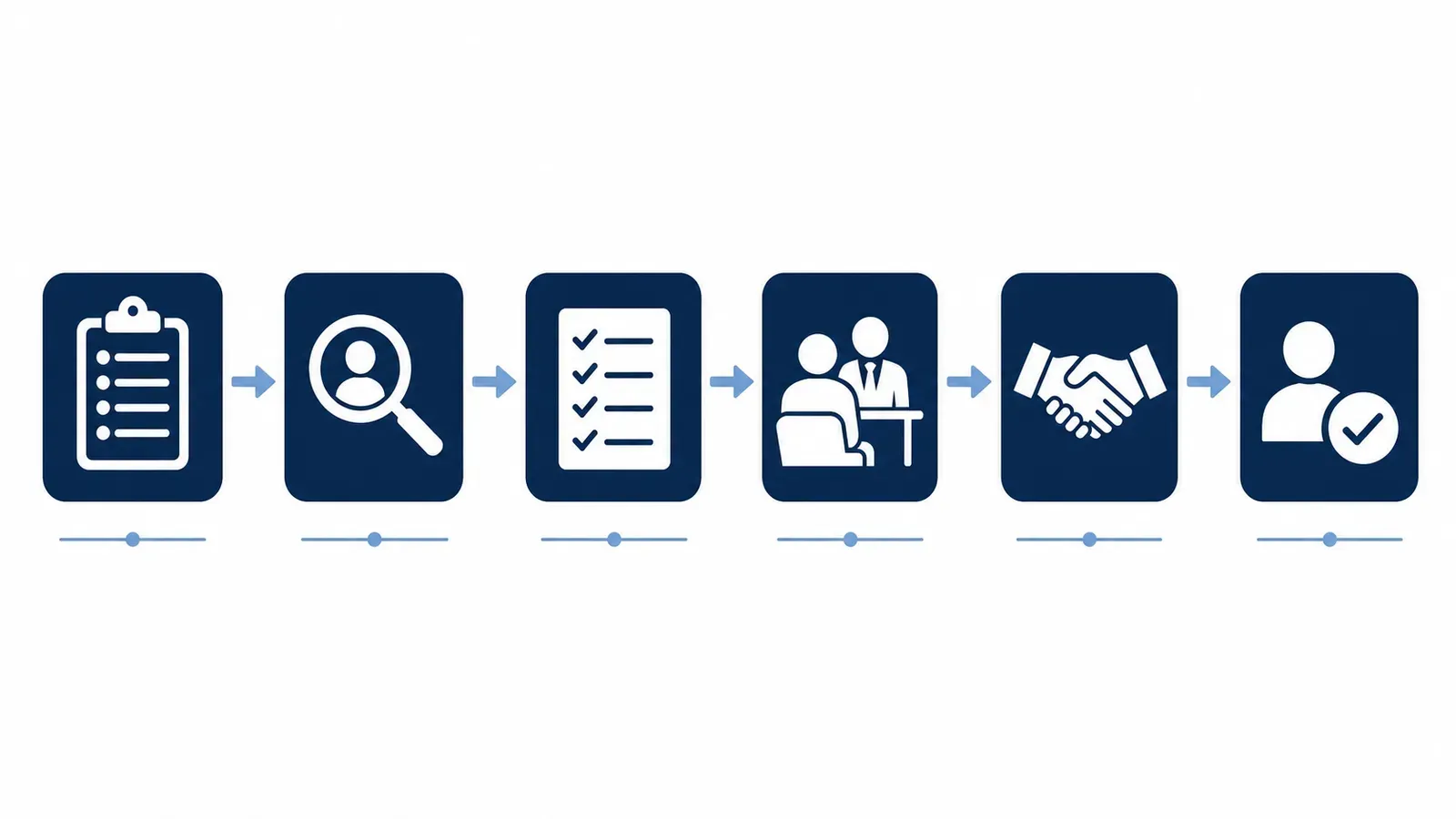
The 6 Stages of Full Life Cycle Recruiting
Each stage builds on the last, and rushing through any one of them tends to create problems downstream. These recruiting process steps provide a framework that full cycle recruiters adapt based on role requirements and company needs.
1. Preparing
Before any outreach happens, the recruiter works with the hiring manager to define the role, write the job description, set compensation bands, and align on what a strong candidate looks like. Skipping these conversations is the most common mistake, since misalignment only surfaces after strong candidates are already in the pipeline.
2. Sourcing
Sourcing means active outreach through job boards, referrals, and LinkedIn, and direct sourcing. The goal is building a qualified pipeline, not collecting resumes; optimizing for volume instead of quality is the most common sourcing mistake.
3. Screening
Resume review and phone screens filter for minimum qualifications and basic fit before the broader team gets involved. A structured phone screen uses a consistent scorecard and the same core questions for every candidate, which makes comparisons fair and defensible.
4. Selecting
Structured interviews, assessments, and reference checks form the core of this stage. The recruiter coordinates feedback and guides the hiring team toward a decision, keeping the process moving without letting strong opinions crowd out careful evaluation.
5. Hiring
Extending the offer, negotiating compensation, and securing a signed offer letter. Verbal offers should be followed within 24 hours with a written offer, as delays signal disorganization and give candidates time to disengage.
6. Onboarding
Onboarding closes the loop by getting the new hire set up for success. A 30-day check-in catches early misalignment before it becomes a retention problem and gives direct input for refining the job description before the next search begins.
Full Life Cycle Recruiting vs. Traditional Recruiting
The core difference is ownership: one person carries the whole hire in full cycle recruiting, versus multiple specialists each handling a slice. Neither model is inherently better; the right choice depends on hiring volume and coordination capacity.
| Factor | Full Life Cycle Recruiting | Specialized/Traditional Recruiting |
|---|---|---|
| Accountability | Single recruiter owns outcome | Shared across multiple roles |
| Candidate experience | Consistent point of contact | More handoffs, higher drop-off risk |
| Best fit | Startups, small teams, targeted hiring | High-volume enterprise hiring |
| Coordination cost | Low | High |
| Ramp-up time | Faster per role | Slower across the chain |
Specialized recruiting makes sense at scale. When a company is filling hundreds of roles simultaneously, dividing the work by function can increase throughput. Sourcers get very good at sourcing. Coordinators keep pipelines moving. The tradeoff is a fragmented candidate experience and accountability gaps at every handoff.
Full cycle recruiting trades volume capacity for depth. One recruiter with full ownership has far more context than three specialists passing notes between stages. That context leads to better screening, stronger candidate relationships, and fewer late-stage surprises.
“The candidate doesn’t care how your org chart is structured. They care whether someone knows the role, communicates consistently, and treats the process like it matters.”
For most startups and growing companies hiring selectively, full cycle recruiting is the more practical choice.
Full Life Cycle Recruiter Job Description and Responsibilities
Full life cycle recruiters own every part of hiring. Core responsibilities typically include:
-
Partnering with hiring managers to define roles and set expectations before sourcing begins
-
Writing and posting job descriptions across relevant channels
-
Sourcing candidates through outreach, referrals, and job boards
-
Running phone screens and coordinating interview panels
-
Collecting and synthesizing feedback from interviewers
-
Managing offers, negotiations, and closing
-
Tracking pipeline metrics and reporting on hiring progress
The best full cycle recruiters combine sharp judgment with process discipline.
Full Life Cycle Recruiter Qualifications and Experience Requirements
Most postings require three years of full cycle recruiting experience, and depth matters more than tenure. Candidates should show owned sourcing (not inherited pipelines), conducted screens, and influenced offer decisions. Hard requirements typically include ATS proficiency and offer negotiation experience.
In interviews, ask candidates to walk through a hire they owned from intake to close; those with genuine full cycle experience give specific, concrete answers about their personal decisions rather than team outcomes.
Full Life Cycle Recruiter Salary and Compensation
Salaries vary considerably depending on geography, experience, and industry. The average full cycle recruiter in the U.S. earns around $128,315 per year, though that number moves quickly based on where you are and who you’re hiring for.
California and Texas tend to sit at opposite ends of the range. Recruiters in San Francisco or Los Angeles often command $140,000 to $160,000 or more, while Texas-based roles typically land closer to $90,000 to $120,000. At companies like Amazon, senior or specialized recruiters can reach considerably higher through base plus equity.
For hiring managers, these numbers matter when setting expectations. A full cycle recruiter costs real money, whether in-house or fractional.
Benefits and Challenges of Full Life Cycle Recruiting
Full life cycle recruiting works well until it doesn’t. The model has real advantages, but it also has a ceiling, and which side you end up on depends largely on hiring volume, role complexity, and whether you have the right recruiter for the job.
Benefits of Full Life Cycle Recruiting
The biggest gains show up in candidate experience and decision quality. When one person owns the process from intake to close, nothing gets retranslated between stages.
-
Consistent candidate experience. One recruiter means one relationship, with fewer dropped messages and less confusion throughout the process.
-
Clear accountability. If a hire goes wrong, you know exactly where the breakdown happened.
-
Preserved context. Information stays intact across every stage instead of getting filtered through handoffs.
-
Better screening accuracy. A recruiter who built the role brief can screen for fit at a depth that a late-joining specialist cannot match.
-
Faster decisions. Context does not need to be re-explained between handoffs, which compresses timelines and reduces back-and-forth.
-
Stronger employer brand signal. Candidates associate a consistent, informed point of contact with a well-run company.
Challenges of Full Life Cycle Recruiting
The model’s weaknesses are structural, not personal. They show up predictably at certain volume thresholds and role types, which makes them worth planning around before you run into them mid-search.
-
Uneven skill sets. Few recruiters are equally strong at sourcing, screening, and closing, and the full cycle model exposes every weak spot.
-
Single point of failure. If the recruiter leaves or goes offline mid-search, the entire pipeline stalls.
-
Burnout risk. Owning every stage is cognitively demanding, and full cycle recruiters tend to report higher burnout than those who specialize.
-
Volume ceiling. At 30 or more annual hires, the model typically requires a second recruiter or a hybrid approach to maintain throughput.
-
Tool dependency. Without the right ATS and scheduling stack, one person managing all stages can get buried in coordination work.
Below roughly 20 to 25 annual hires, full cycle recruiting offers more context per role at lower coordination cost. Above that threshold, a hybrid or specialized approach typically makes more sense, and most growing companies will cross that line at some point.
Core Skills and Tools for Full Life Cycle Recruiters
Full cycle recruiters rely on a short tool stack: an ATS to track candidates and keep hiring managers aligned, sourcing tools for finding passive candidates, scheduling software to reduce coordination overhead, job board distribution for broad reach, and AI-assisted screening to surface qualified applicants faster. When a fractional recruiter works inside the same ATS as the hiring team, sourcing notes, candidate history, and pipeline stages stay in one place. The internal team gets real-time visibility, and when the engagement ends, all data stays with the company instead of leaving with the recruiter.
Dover functions as the shared ATS infrastructure layer that fractional recruiting engagements are built on. Because recruiters work inside the client’s own Dover ATS from day one, each completed search leaves behind a documented pipeline, candidate notes, and stage history. That record compounds over time, so the second and third searches start with more context than the first.
AI tools like Lantern AI, Juicebox, and Contrario now automate sourcing and screening stages that previously required manual effort. Full cycle recruiters using these tools move faster on pipeline-building, but intake conversations, offer negotiations, and close-stage decisions still depend on relationship context a tool cannot replicate.
The role rewards people who switch modes quickly. Sourcing requires patience and pattern recognition. Screening demands judgment under uncertainty. Closing is relationship work. Few recruiters are equally strong at all three, which is worth knowing before you hire one.
Best Practices for Full Cycle Recruiters
-
Set a clear intake SLA before sourcing begins. A 30-minute intake call with the hiring manager that produces a written role brief prevents the most common source of mid-search pivots. Without it, scope creep surfaces after qualified candidates are already in the pipeline.
-
Build a candidate-facing FAQ for every role. Answering the five most common candidate questions in advance (comp range, growth path, team size, interview format, timeline) reduces ghost rates at the screen stage. Candidates who know what to expect show up prepared and are less likely to disengage.
-
Send a structured rejection within 48 hours of a decision. Candidates who receive a timely, respectful rejection are more likely to reapply or refer someone. The turnaround signals that the company values their time.
-
Create a debrief scorecard before interviews begin, not after. Post-hoc scorecards get contaminated by halo effects; locking criteria upfront forces the team to assess against the role, not against each other. The debrief then surfaces genuine disagreement instead of confirming the group’s first impression.
-
Track your own stage conversion rates per role type. Knowing your screen-to-interview and interview-to-offer ratios lets you diagnose problems early. Low screen-to-interview usually points to a sourcing problem; low interview-to-offer usually points to intake misalignment.
How Dover Supports Full Life Cycle Recruiting for Startups
Most early-stage startups don’t need a full-time recruiter. They need full life cycle recruiting coverage without the overhead of a $100,000+ salary before hiring volume makes sense for it.
Dover’s fractional recruiters act as embedded full cycle partners, owning the entire process from intake through close. They source candidates, run screens, coordinate interviews, manage offers, and report back through a shared ATS so your team has full visibility at every stage. That ATS is free for unlimited users and jobs, with a $199/month Premium tier for AI applicant scoring and AI note taking. One recruiter, one pipeline, one point of accountability.
Recruiters set their own rates and you agree terms with them directly; companies have most often spent between $2,000 and $7,000 per hire through Dover, well below the $18,000 to $30,000 a traditional agency typically charges (see our fractional vs. agency cost breakdown). That range is what past searches have cost rather than a quoted price. Every recruiter in Dover’s marketplace carries real reviews from founders, so companies can assess fit before committing. There is no long-term contract and no percentage-of-salary placement fee on hourly or retainer work, so you can scale recruiting support up or down as your hiring needs change. Because the recruiter and internal team work from the same shared ATS, all candidate data and sourcing history stay with the company when the engagement ends instead of leaving with the recruiter.
FAQs
What does full life cycle recruiting mean?
Full life cycle recruiting means one recruiter owns the entire hiring process from writing the job description through onboarding, instead of splitting responsibilities across specialists. This single point of ownership keeps context intact and reduces friction at every stage.
When should a startup hire a full-time recruiter instead of using fractional support?
Most companies reach the threshold around 15 to 20 annual hires, when a full-time recruiter’s loaded cost of $85,000 to $170,000 becomes justifiable. Below that volume, fractional recruiting often delivers comparable results at lower cost without the overhead of a full-time salary.
Do I need an ATS before bringing in a fractional recruiter?
A shared ATS is not required, but it makes the fractional model considerably more effective. When the recruiter and hiring team work from the same pipeline view, candidate context stays intact and the internal team has real-time visibility without chasing status updates. Some fractional recruiting services include ATS access as part of the engagement so both sides work from the same data from day one.
Final Thoughts on the Full Recruiting Life Cycle
Full life cycle recruiting works best when ownership is clear and context stays with one person from start to finish. It gives hiring teams a cleaner process and gives candidates a more consistent experience, both of which tend to lead to better outcomes. For companies not ready to commit to a full-time recruiter but still needing that level of ownership, Dover offers a way to bring full life cycle recruiting into the team without adding permanent headcount, while keeping visibility and control over every stage of the hire.